On this page
- What LinkedIn changed in March 2026
- What the ranking system reads
- Relevance can now outrank recency
- Every confirmed change, dated
- What LinkedIn says it pushes down
- How each format is treated
- What third parties have measured
- Confirmed, measured, or guessed
- Why your reach dropped
- What to do about it
- FAQ
Almost everything written about the LinkedIn algorithm is someone’s inference from their own reach chart. Confident, unsourced, and contradicted by the next article you read.
That changed in March 2026. LinkedIn shipped a rebuilt feed ranking system and, unusually for a platform, published both a plain-language announcement and an engineering write-up describing how it works. Most of what you can now say about LinkedIn ranking is on the record.
This post separates three things that usually get mixed together: what LinkedIn has confirmed, what third parties have measured, and what is still guesswork.
What LinkedIn changed in March 2026
The old feed was, in LinkedIn’s own description, a patchwork of separate systems. It has been replaced by two stages.
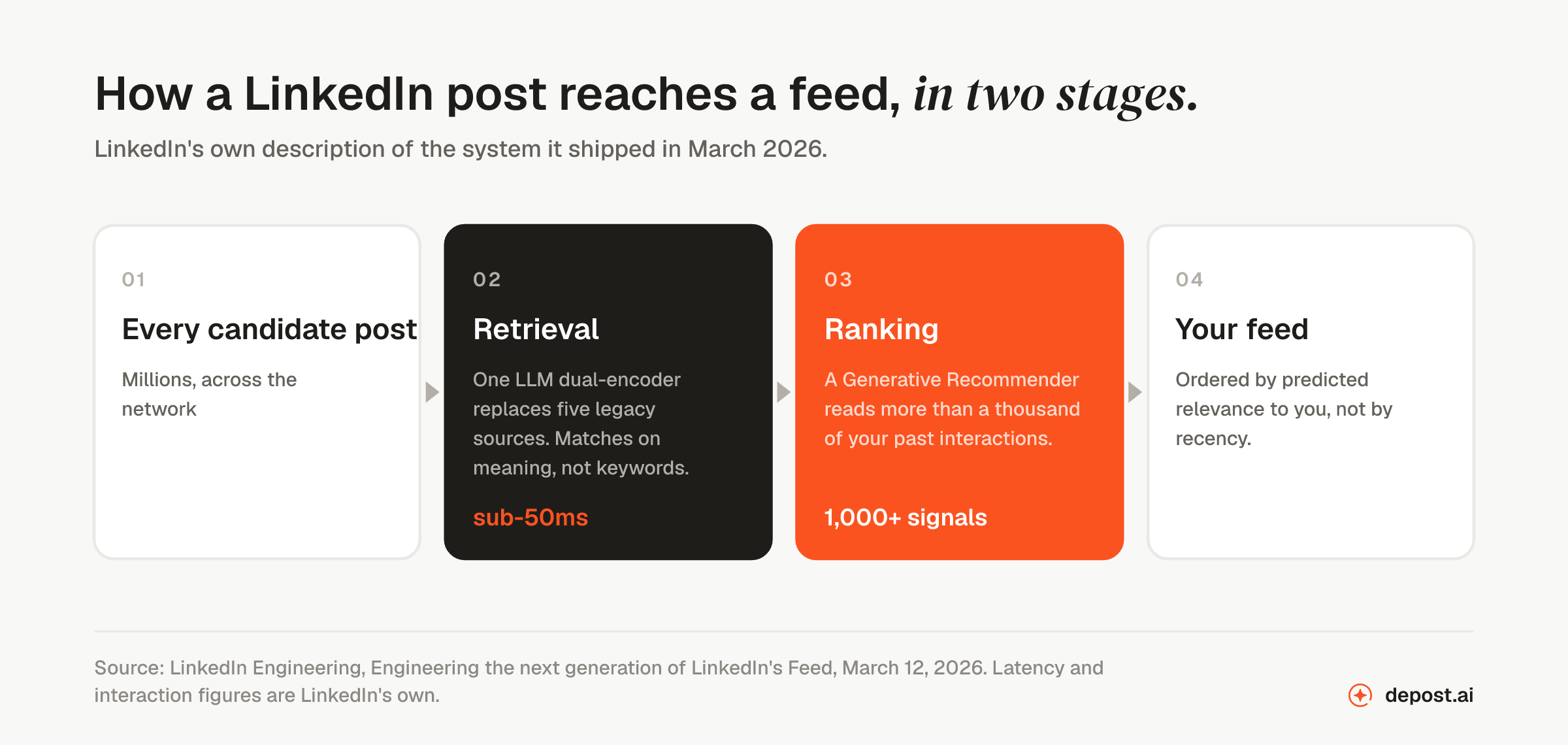
Retrieval finds the candidates. A single system built on large language models replaced five legacy retrieval sources. It encodes both you and each post as text and compares them, which means it matches on what a post is about rather than on the words it happens to contain. LinkedIn reports this runs in under 50 milliseconds across millions of posts, with new posts becoming available within minutes.
Ranking orders what survives. A model LinkedIn calls a Generative Recommender reads more than a thousand of your historical interactions and predicts what you will do with each candidate. It is a transformer, and it is trained on sequences of your behavior rather than on hand-built numeric features.
The practical consequence of the retrieval change is the one to remember. Keyword stuffing and hashtag games were always weak tactics; against a system that reads for meaning they are close to pointless. LinkedIn’s announcement says the feed “better understands what a post is actually about and how your professional interests evolve.”
Both documents were published on 12 March 2026: the plain-language announcement from LinkedIn and the engineering write-up by Hristo Danchev.
What the ranking system reads
The engineering post lists the signals it uses. Grouped, they look like this.
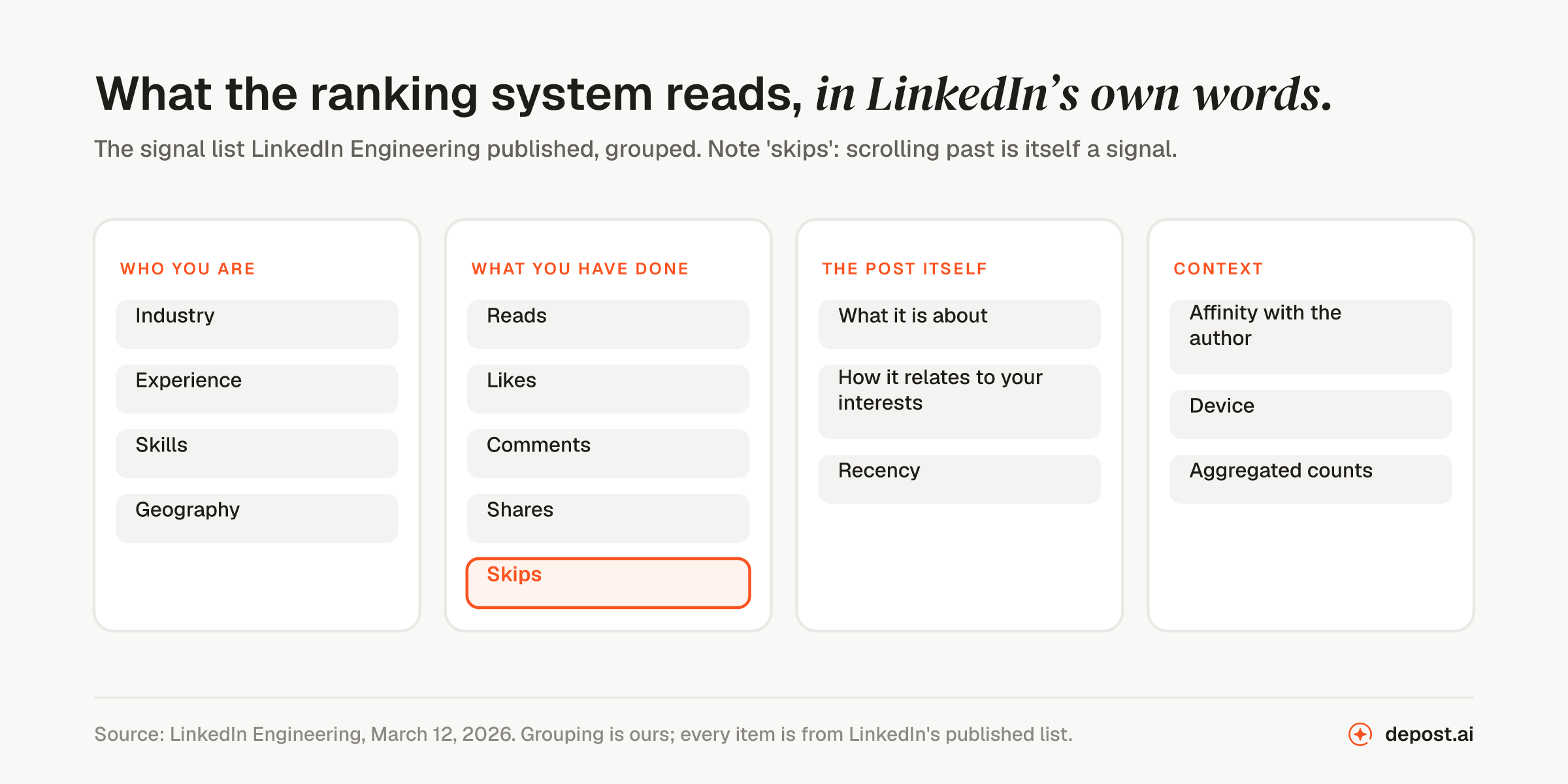
Three things stand out.
Skips are a signal. Scrolling past a post is recorded alongside reads, likes, comments and shares. This is the mechanism behind advice that otherwise sounds like superstition. A weak first line does not merely fail to earn a click on “see more”; it produces an active negative signal from everyone who scrolls by. Reach that stops early is often a skip problem, not a penalty.
Your profile is an input. Industry, experience, skills and geography are used in ranking, not just in search. An account whose profile does not say what it is about gives the retrieval stage less to match against.
Recency is one signal among many, listed beside affinity and interest. It is no longer the axis the feed is organized on.
Relevance can now outrank recency
Through 2025 and into 2026, people started seeing posts in their feed that were days or weeks old. That was not a bug.
This is LinkedIn’s own design. The engineering post lists recency as one signal beside affinity and interest rather than the axis the feed is sorted on, and the announcement says the feed now weighs how your professional interests evolve. LinkedIn has since described this as balancing the two rather than dropping recency, so the feed still leans recent; it is no longer bound to it.
For anyone publishing, two things follow. A good post has a longer tail than it used to, so the first hour matters less as a hard ceiling than it once did. And a post aimed at everybody is now competing against posts precisely matched to each reader, which makes a narrow, consistent subject more valuable than it used to be, not less.
That does not make timing irrelevant. It decides who is awake for the first test. That is a smaller effect than most guides claim, but it is real. The three current posting-time studies disagree with each other by up to twelve hours, which is itself the most useful fact about them.
Every confirmed change, dated
Most articles on this subject describe a single moment. The useful version is a list with dates on it, because a claim from 2024 is not evidence about the feed you are looking at now.
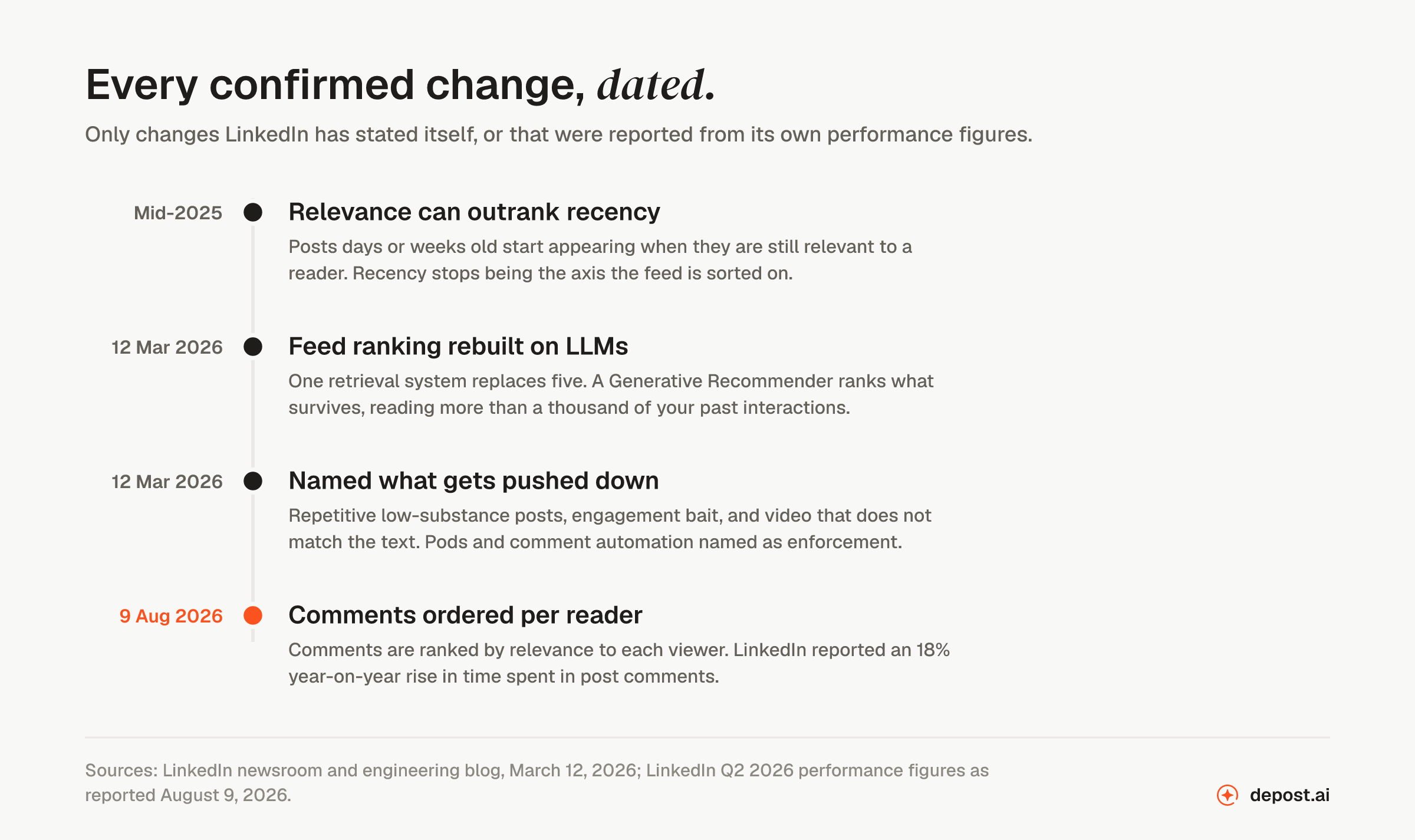
The most recent one is easy to miss because it changes the page rather than the feed. Since August 2026, comments under a post are no longer shown to everyone in the same order. LinkedIn ranks them by relevance to each reader, using professional interests, connections, and engagement activity, and it made the change after reporting an 18% year-on-year rise in time spent in post comments.
That has a practical edge. The old advice to get an early comment from a well-known account assumed everyone would see it at the top. Now your comment appears high for the people it is relevant to and may not appear high at all for anyone else. Comment where you have standing on the subject, not where the follower count is largest.
What LinkedIn says it pushes down
The announcement is specific about this, and the distinction it draws matters.
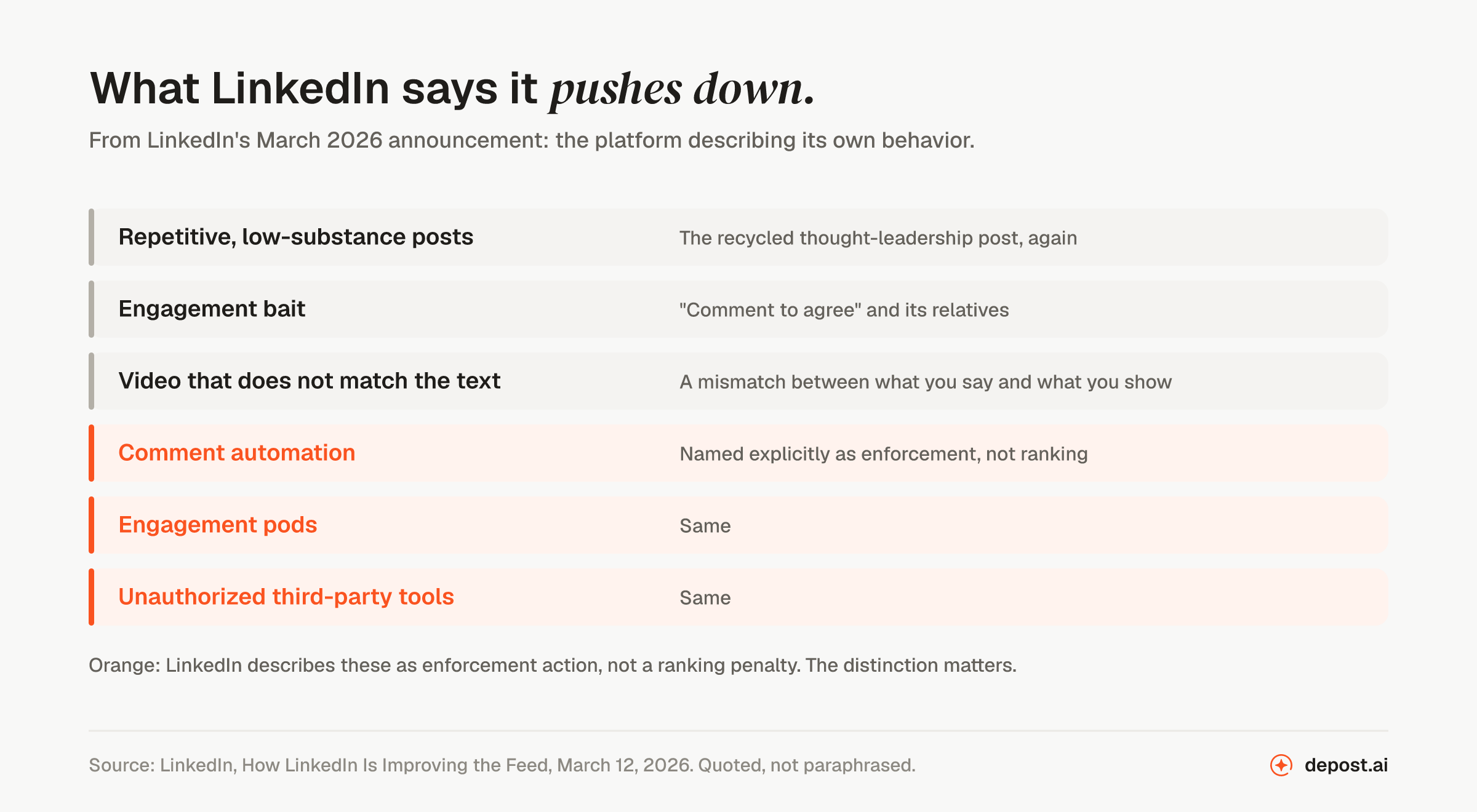
Three are ranking decisions: repetitive low-substance posts, engagement bait such as “comment to agree” prompts, and video that does not match the text around it.
Three are enforcement: comment automation, engagement pods, and unauthorized third-party tools. That is a different category. A downranked post is a post that did not do well. An account using an unauthorized tool is an account LinkedIn may act against, which is why anything that publishes for you should be going through LinkedIn’s official API and nothing else.
The engagement bait line matters, because a lot of advice still tells you to do exactly that. Asking a question at the end of a post is fine and always was. “Comment YES if you agree” is the thing being named.
How each format is treated
LinkedIn does not rank formats directly. It ranks predicted response, and formats differ in how much response they tend to earn, which is why the gap between the best and worst format is close to two to one.
The mechanism is attention. Dwell time is one of the things the system reads, so anything that keeps a reader on the post is working in your favor before the writing does anything at all.
- Documents and multi-image posts lead, because each swipe is another moment spent on the post. This is most of why carousels have outperformed everything else for three years running.
- Video sits in the middle. It holds attention when it earns the first three seconds and loses badly when it does not, and LinkedIn now names video that does not match its own text as something it pushes down.
- Single images and polls are middling. A poll buys cheap votes rather than the comments that carry more weight.
- Text-only posts run below average, which surprises people who write well. It is a ceiling on the format, not a verdict on the writing, and it is why a strong text post often does better rebuilt as a carousel.
- Posts with an external link come last, every year. Not a penalty so much as an exit: a post whose purpose is to send people away earns fewer of the actions that count.
The current numbers for each format are in what a good LinkedIn engagement rate looks like in 2026, which is where we keep the benchmark table up to date.
What third parties have measured
LinkedIn does not publish the weight of each signal, so this is where independent data helps.
Hootsuite’s analysis of more than three million posts found saves the strongest engagement signal available, driving roughly five times the reach of a like and about twice that of a comment. That order, save then comment then like, tracks how much each action costs the reader.
Format matters too, and by a wide margin. Socialinsider’s 2026 benchmarks put multi-image posts and documents, the format everyone calls carousels, well clear of text-only posts. The full table is in what a good LinkedIn engagement rate looks like in 2026.
Confirmed, measured, or guessed
Sorting the claims by how much you can rely on them is more useful than another list of tips.
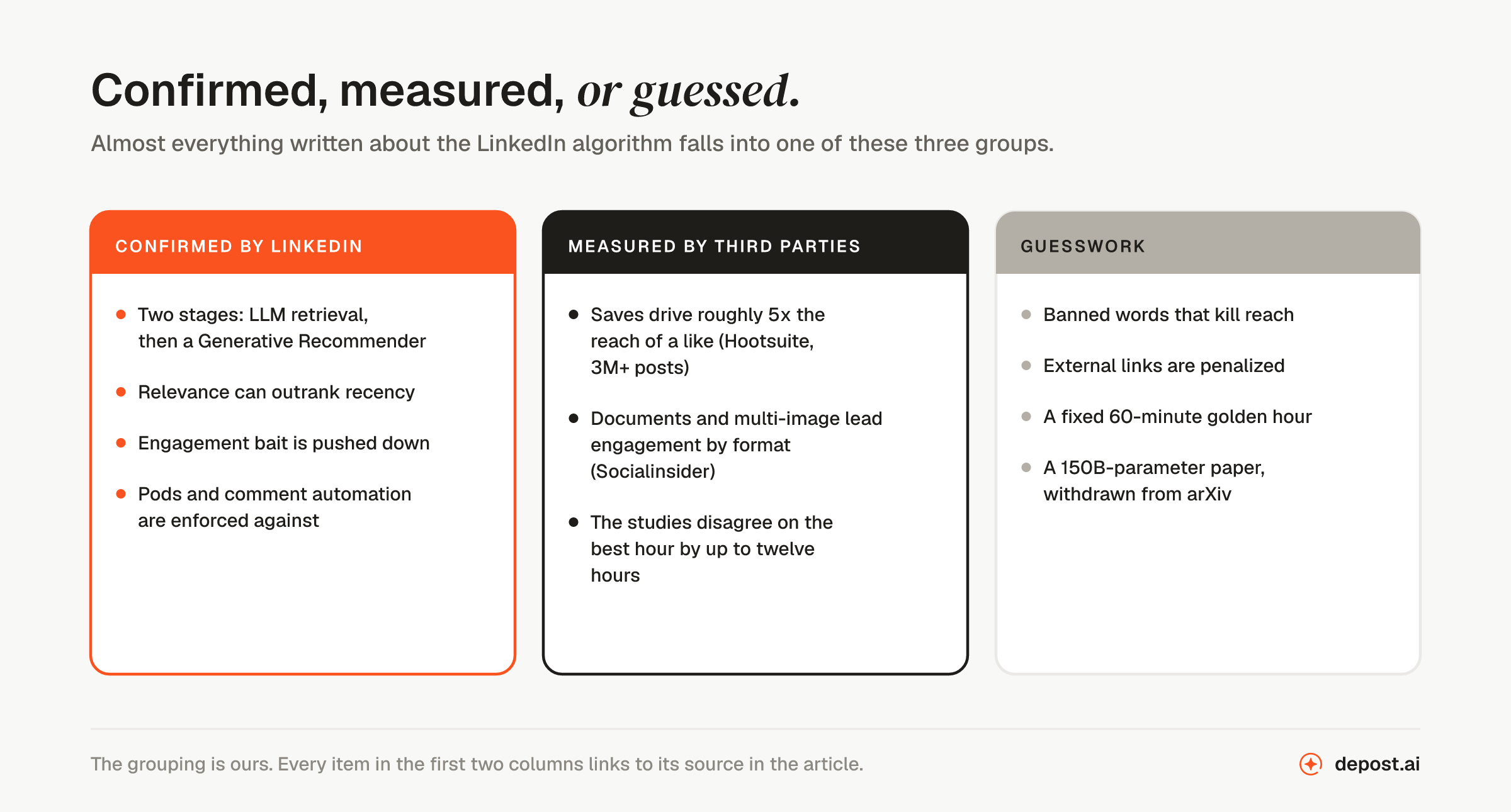
A note on the fourth item in that last column, because it is everywhere. Many 2026 articles cite a LinkedIn research paper describing a 150-billion-parameter model called 360Brew handling more than thirty ranking tasks. That paper has been withdrawn from arXiv. The notice states it was removed by administrators because the submitter did not have the right to agree to the license. The engineering blog post is the source that still stands, and it is the one this article uses.
On the rest of the guesswork. There is no published list of banned words. External links are not penalized as a rule, though a post whose job is to send people elsewhere earns fewer of the actions that count as engagement, which looks identical in your analytics. And the “golden hour” is a useful habit rather than a documented switch: LinkedIn says early engagement influences distribution and has never published a fixed window.
Why your reach dropped
Almost nobody arrives at this subject out of curiosity. They arrive because the numbers fell and they want to know who to blame. Here is the honest order to check.
Your first line stopped working. Skips are a signal, so a weak opening does not just fail to earn the click on “see more”, it feeds the system a negative response from everyone who scrolls by. This is the most common cause and the easiest to fix.
You changed what you write about. The system decides who to test a post on, and it learns that from your recent history. Change subject and you are shown to a different, colder group who have no reason to respond. Reach recovers when you go back to one subject and stay there for a few weeks.
You changed format. Moving from carousels to text-only is worth a real drop on its own, with the writing held constant.
You posted a link. Link posts sit at the bottom of every benchmark, every year.
Nothing changed and this is normal. Reach is noisy. One quiet post is not a signal, and a month of posts is. Compare your median rather than your last post against your best one.
It is not a shadowban. There is no such published mechanism, no list of banned words, and no confirmation from LinkedIn that any such thing exists. What does exist is enforcement, and LinkedIn names it plainly: comment automation, engagement pods, and unauthorized third-party tools. If you are not doing those, you have not been secretly penalized. You have been outranked.
What to do about it
The mechanism changed. The work did not change much.
Write for one audience about one thing. Retrieval matches on meaning, and consistency is what teaches the system who to show you to. An account that changes subject weekly resets that each time.
Earn the first line. Skips are a signal, so the opening sentence is doing more than persuasion. If your rate is flat everywhere, start there; the hook generator will write five alternatives from a draft.
Use formats that hold attention. Dwell time is read as interest, which is most of why carousels lead the benchmarks. The carousel maker builds one from plain text.
Give people a reason to save. The strongest measured signal is the one nobody optimizes for. Reference material, checklists, and frameworks get saved; opinions get liked.
Be there afterwards. Replies are fresh engagement while the post is still being tested, and a thread where the author is answering pulls other readers in.
Do not buy reach. Pods and comment automation are named in LinkedIn’s own enforcement language. The risk is no longer theoretical. Commenting by hand is unaffected, and how many comments per day is safe covers where that line actually sits.
None of that is new advice. The ranking system got substantially more sophisticated and the conclusion stayed the same, because a distribution mechanism amplifies the response your writing earns. It cannot manufacture one. For the full picture of how reach is decided, the glossary entry on the algorithm is the short version, and ten things that actually move a post is the practical one.
FAQ
How does the LinkedIn algorithm work in 2026?
In two stages. An LLM-based retrieval system finds candidate posts by matching what a post is about against your profile and interests, in under 50 milliseconds. Then a model LinkedIn calls a Generative Recommender ranks those candidates using more than a thousand of your past interactions. LinkedIn published both the announcement and the engineering detail in March 2026.
Did the LinkedIn algorithm change in 2026?
Yes, substantially. LinkedIn replaced five legacy retrieval systems with one built on large language models and moved ranking to a Generative Recommender. The visible effects are a feed that understands topics rather than keywords, and older posts appearing when they are still relevant.
Does the LinkedIn algorithm penalize external links?
Not as a stated rule, and LinkedIn has never published one. What is true is that a post whose purpose is to send people away earns fewer reactions, comments and reposts, so it performs worse on the signals that drive distribution. The usual fix is to make the post stand on its own and put the link where it does not compete with the argument.
What does LinkedIn downrank?
By its own account: repetitive low-substance posts, engagement bait such as “comment to agree” prompts, and video that does not match the accompanying text. Separately, it enforces against comment automation, engagement pods, and unauthorized third-party tools, which is account risk rather than a ranking penalty.
Do saves matter more than likes on LinkedIn?
According to Hootsuite’s analysis of more than three million posts, yes, by a wide margin: a save drives roughly five times the reach of a like and about twice that of a comment. The ordering follows how much each action costs the reader.
Does the first hour still matter?
It matters, but less as a hard ceiling than it used to. LinkedIn says early engagement influences how widely a post is distributed, and has never published a fixed window. Now that relevance can outrank recency, a good post can keep surfacing for days, so a slow start is no longer final.
Why did my LinkedIn reach suddenly drop?
Check in this order: a weaker first line, since scrolling past is itself a negative signal; a change of subject, which sends your post to a colder test group; a change of format, since text-only runs well below documents; and a link post, which sits at the bottom of every benchmark. If none of those changed, it is probably normal variance. Compare your median across a month rather than one post against your best.
Does LinkedIn shadowban accounts?
There is no published shadowban mechanism and LinkedIn has never confirmed one. What LinkedIn does confirm is enforcement against comment automation, engagement pods, and unauthorized third-party tools, which is a stated action rather than a secret one. Low reach without any of those is almost always a content or consistency problem.
Are LinkedIn comments shown in the same order to everyone?
No, not since August 2026. Comments are ranked by relevance to each reader, using signals like professional interests, connections, and engagement activity. A comment that appears near the top for one reader may sit far down for another.
Is there a list of banned words on LinkedIn?
No such list has ever been published, and the ranking system reads for meaning rather than scanning for terms. What LinkedIn does name is engagement bait, which is a pattern rather than a vocabulary.