Best Time to Post on LinkedIn: By Day, and How to Find Yours
The three current studies disagree by up to twelve hours, which tells you something. Here is what they say day by day, where they agree, and the four-week method for finding the window that fits your audience.

· 13 min read · Updated
On this page
Search for this and you get a confident heatmap. Search again and you get a different confident heatmap, pointing at an hour the first one rated poorly.
Three serious studies are current. Each analyzed millions of posts, each is dated this year or last, and they disagree with each other by as much as twelve hours. That disagreement is the most useful thing on this page, because it tells you the honest answer is not a chart at all.
So this post has both halves. First, what Sprout Social, Buffer, and Hootsuite actually found, day by day, with their sample sizes and dates. Then the four-week method for finding the window that fits your audience rather than theirs.
Where the studies agree
Start from the consensus, because it is free and it holds.
All three rate Wednesday in their top tier. Midweek beats the edges of the week in every dataset, and weekends are the weakest ground in all three, which fits a professional network read mostly on work rhythms. That converts to one line: post Tuesday to Thursday unless your own data says otherwise.
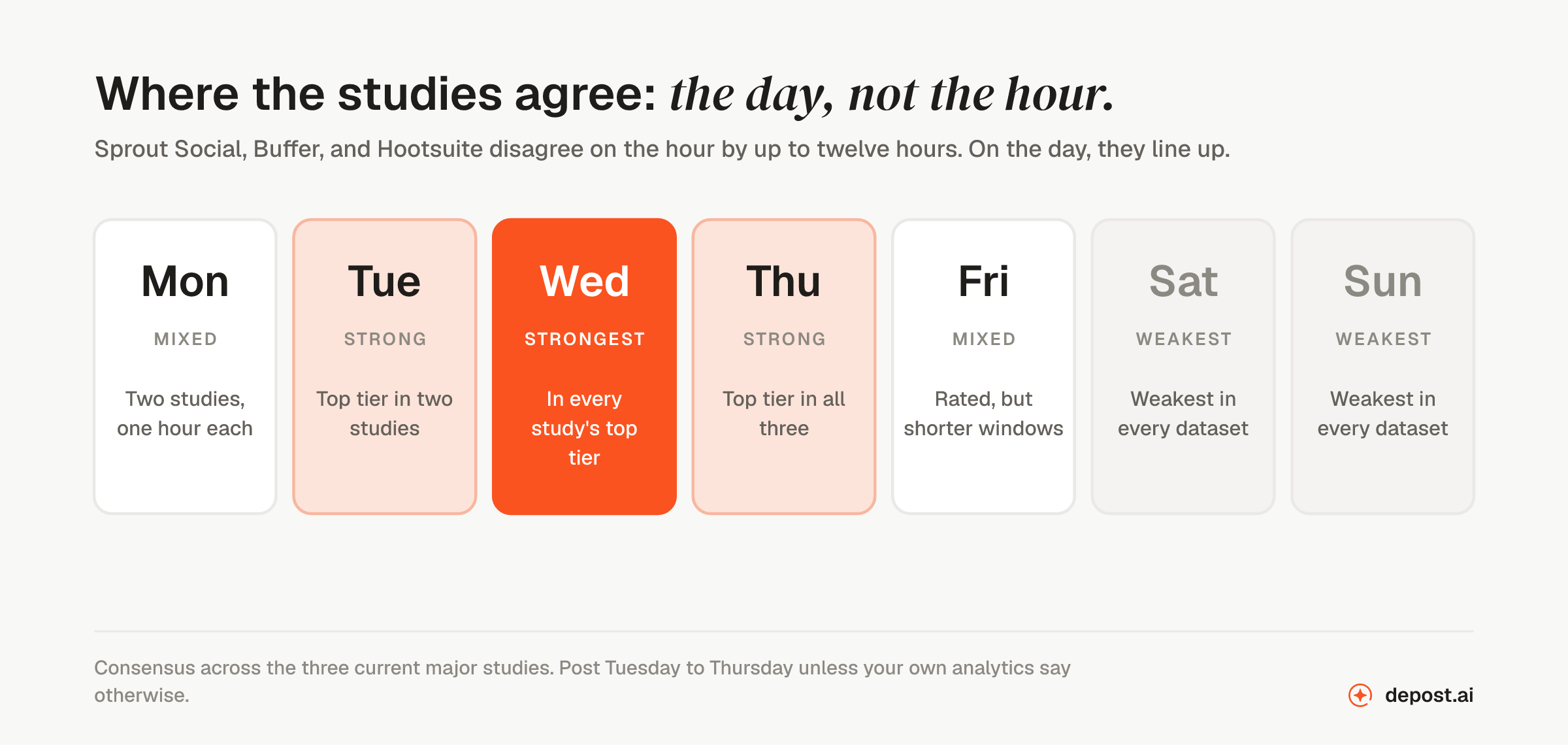
What the consensus does not give you is an hour. Here is why.
The three studies, side by side
Each study is serious, current, and measuring a different crowd.
| Study | Sample | Published | Headline window |
|---|---|---|---|
| Sprout Social | Nearly 2 billion engagements across 307,000 profiles, Nov 2025 to Feb 2026 | Updated March 2026 | Tuesday to Thursday, 11am to 5pm |
| Buffer | 4.8 million posts sent through Buffer | July 2026 | Weekdays, 3pm to 8pm |
| Hootsuite | Over 1 million posts across 118 countries | Updated November 2025 | Tuesday and Wednesday, early morning |
Drawn on one track, the disagreement is obvious.
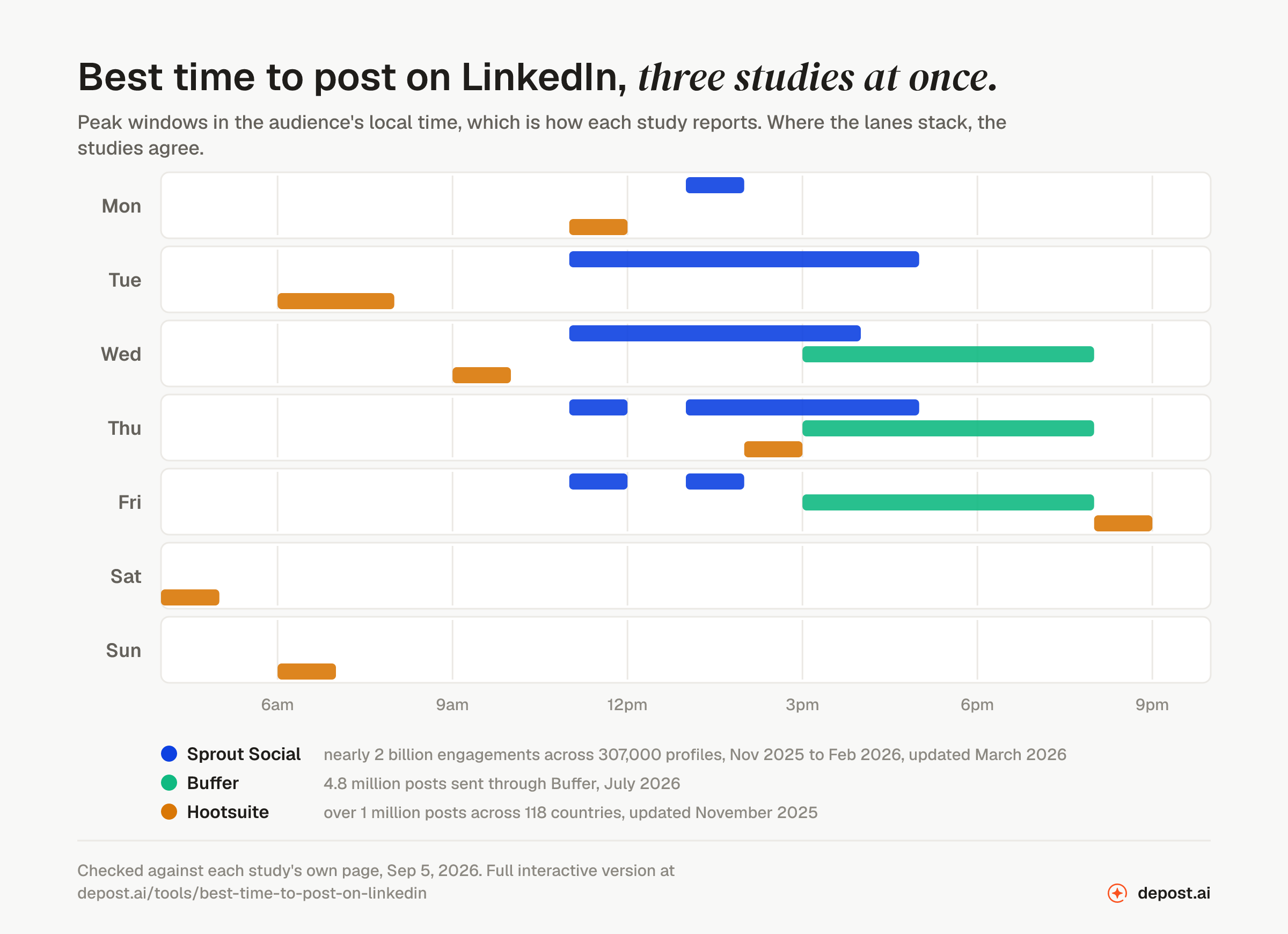
They are not wrong. Each is measuring its own customers, and those customers live in different industries, regions, and time zones. Sprout’s sample leans toward the brands and agencies that buy Sprout. Buffer’s is the posts its users schedule. Hootsuite’s spans 118 countries, which pulls the clock in every direction at once. An average of millions of unlike audiences describes none of them exactly.
Buffer’s own note is the clearest evidence that these numbers move: peak engagement in its 2025 analysis sat inside working hours and fell off after 5pm, and in the 2026 data those peaks shifted later into the evening. A chart with no date on it is not a finding.
The best time to post tool on this site draws all three on one track, named and dated, and converts every window to your own clock.
Best time to post on LinkedIn, by day
Here is every day with what each study found. Sprout reports peak windows, Buffer reports its top three slots, and Hootsuite reports a single best hour, so the columns are not the same shape. All of them are in the audience’s local time.
| Day | Sprout Social | Buffer (top 3) | Hootsuite |
|---|---|---|---|
| Monday | 1pm to 2pm | 10pm, 5pm, 9pm | 11am |
| Tuesday | 11am to 5pm | 4pm, 5pm, 10pm | 6am to 8am |
| Wednesday | 11am to 4pm | 4pm, 3pm, 5pm | 9am |
| Thursday | 11am, 1pm to 5pm | 5pm, 7pm, 9pm | 2pm |
| Friday | 11am, 1pm to 2pm | 3pm, 4pm, 5pm | 8pm |
| Saturday | None | 9am, 6pm, 10pm | 4am to 5am |
| Sunday | None | 10pm, 9pm, 6am | 6am |
Monday
The weakest weekday in two of the three datasets. Sprout gives it a single hour at lunchtime, and Buffer explicitly puts Monday among the lowest-engagement days of the week. People are clearing an inbox, not reading a feed. If you post once a week, this is not the day.
Tuesday
The first strong day. Sprout gives Tuesday the widest window of any day, 11am straight through to 5pm, and Buffer’s top slots cluster in the late afternoon. Hootsuite is the outlier at 6am to 8am, which is what an audience spread across 118 countries looks like when you average it. Tuesday is the safest day to start a test on.
Wednesday
The one day every study rates highly. Sprout has 11am to 4pm, Buffer’s top three are 4pm, 3pm, and 5pm, and Hootsuite has 9am. If you take exactly one thing from the research, take Wednesday.
Thursday
Almost as strong as Wednesday, and the day where Buffer’s later shift shows most clearly: its top three run 5pm, 7pm, and 9pm, well into the evening. Sprout still has the afternoon. Thursday is the natural second slot in a two-posts-a-week rhythm.
Friday
Attention thins after lunch, and both Sprout and Buffer put their windows before the day ends. Hootsuite’s 8pm is an outlier worth ignoring unless your audience is genuinely nocturnal. Friday works for lighter posts, the ones that trade on personality rather than a claim you want scrutinized.
Saturday and Sunday
Weakest in every dataset, and the one point where all three agree without qualification. The hours the studies do report at weekends are thin slices of a small number, not an opportunity. The exception is an audience of founders and freelancers who work through the weekend, which your own numbers will show if it is true for you.
The worst times to post on LinkedIn
The studies converge much faster on what does not work.
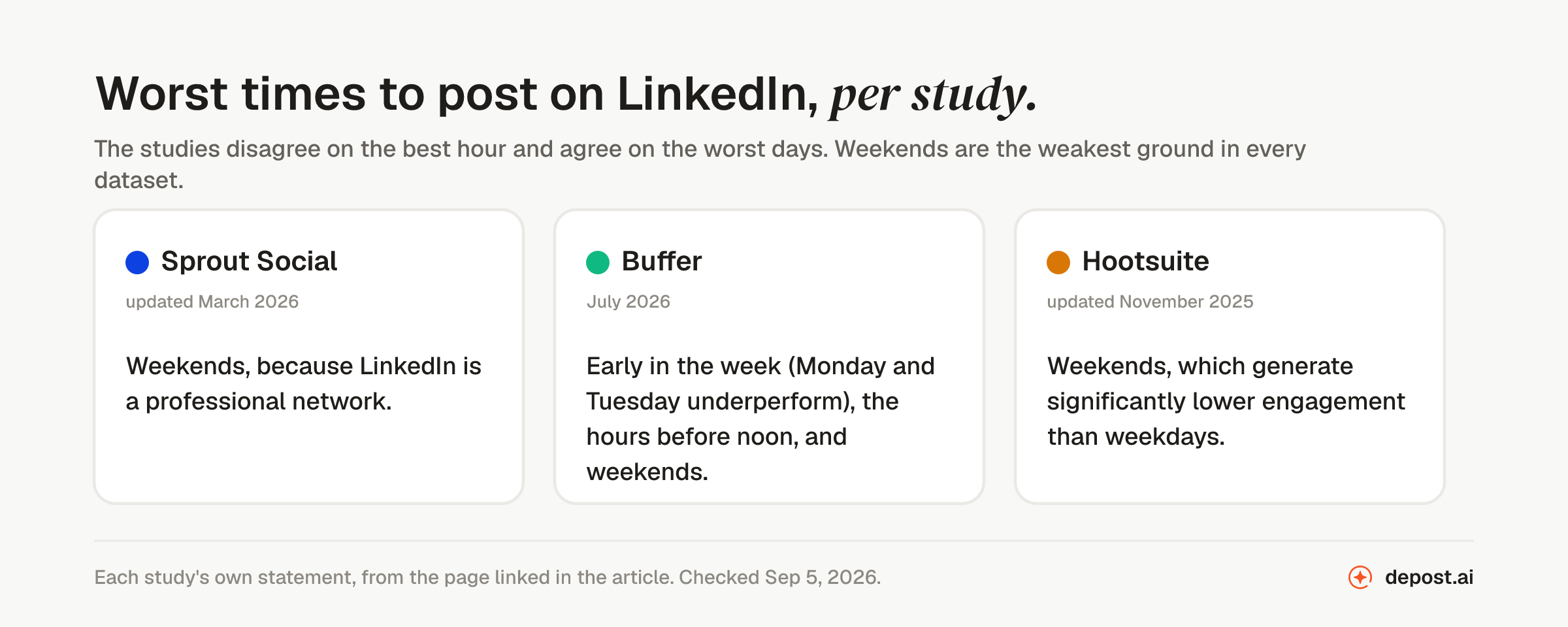
Three rules come out of that:
- Skip weekends unless your audience has told you otherwise through your own analytics.
- Be careful with early mornings if your readers are in one region. Hootsuite’s early hours come from a global sample, where somebody is always at their desk.
- Do not post twice in one day. Two posts split your own audience’s attention across both, and the second usually gets the worse half.
Convert to your audience’s clock, not yours
This is the step most people skip, and it is why so many tests come back inconclusive.
Every study reports in the audience’s local time. If you are in Karachi or Lisbon and your buyers are in New York, “11am” means 11am where they are, which is the evening or the afternoon for you. Test in your own morning because it is convenient and you have tested a window your readers were asleep for.
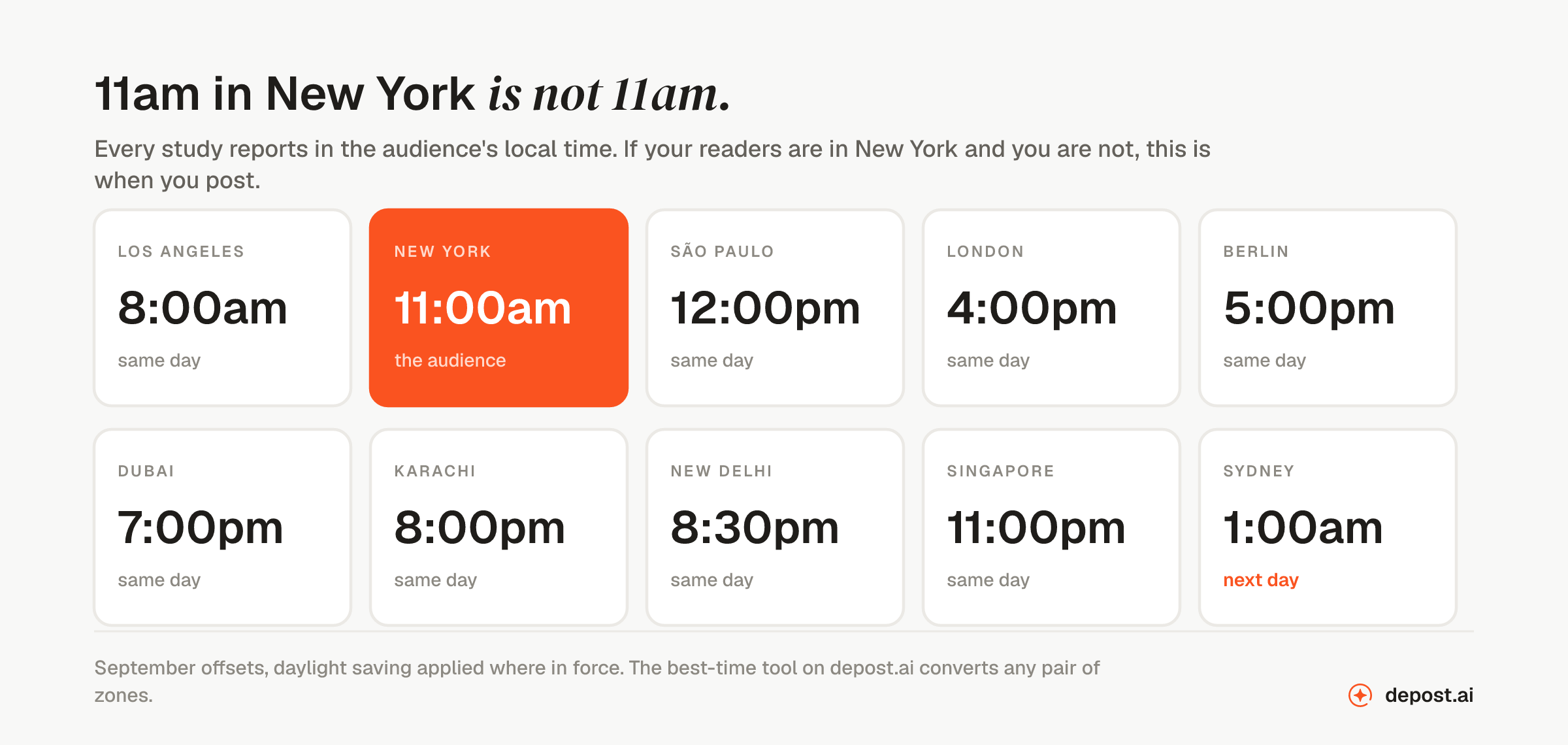
Decide where your audience mostly is and run the test on that clock. If they are spread across the US and Europe there is no single clock to optimize, and a window like late morning Eastern is best read as “working hours where most of your readers are”. The best time tool does the conversion for any pair of zones, with daylight saving worked out for today.
Scheduling solves the inconvenience. A post can publish at 11am Eastern while you are at dinner, as long as you are back for the replies within the hour, because being present after publishing is distribution work, not politeness.
How to find your own best time
Everything above is a starting point. Your own posting history is a study of exactly the audience you care about, with a sample nobody else has. Here is how to read it in four weeks.
It is tempting to copy an account you admire instead. The post date extractor reads the exact time a post went up from its link, so you can see their habit, but it is their audience’s clock, not yours.
Step 1: Start from what the studies agree on
Take midweek as given and stop researching it. Post Tuesday to Thursday, in a window that is plausible for where your readers actually are. You are not testing the day. The three studies have already settled that, and the day is the part they agree on.
Step 2: Pick two windows and alternate them for four weeks
Choose two candidate windows. If you sell to US companies, that might be late morning Eastern and mid-afternoon Eastern. If your readers are founders in Europe, early morning and lunchtime.
Then alternate. Post in window A on Tuesday, window B on Wednesday, A on Thursday, and swap the order the following week.
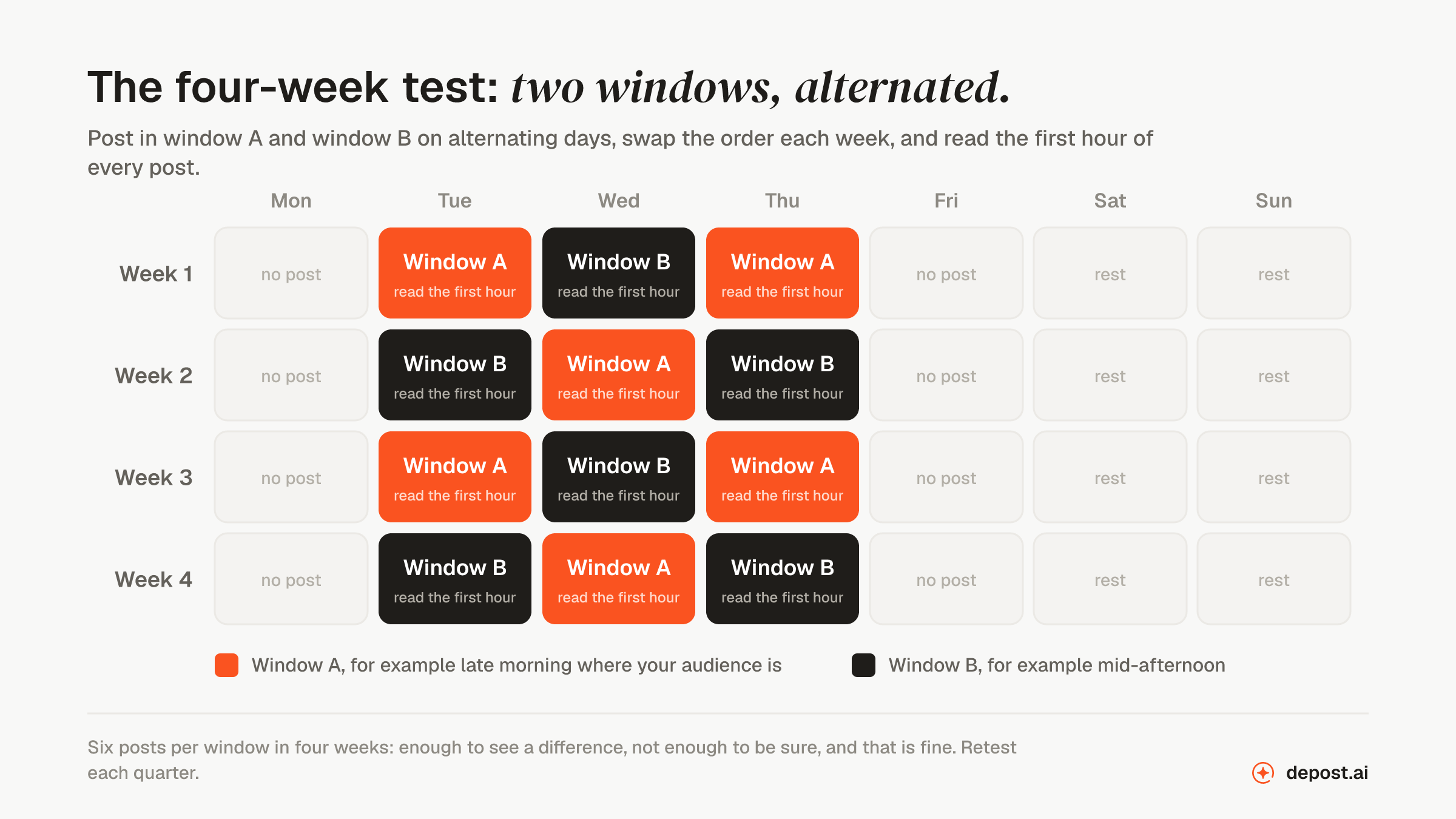
Six posts per window is enough to see a pattern and not enough to be sure, and that is fine. You are looking for a difference big enough to notice, not a p-value.
Two rules keep the test honest:
- Hold everything else steady. Same kind of post, same length, same amount of replying afterwards. If window A gets your best post of the month, the test is measuring the post.
- Do not post in both windows on the same day. Two posts a day split your audience and muddy both readings.
Step 3: Read the first hour, not the total
LinkedIn tests a new post with a small slice of your network first and widens distribution based on how that group responds. How the algorithm works in 2026 covers the rebuilt ranking system behind that. This is why the first hour matters more than anything you do afterwards, and it is also why total engagement is the wrong number to compare.
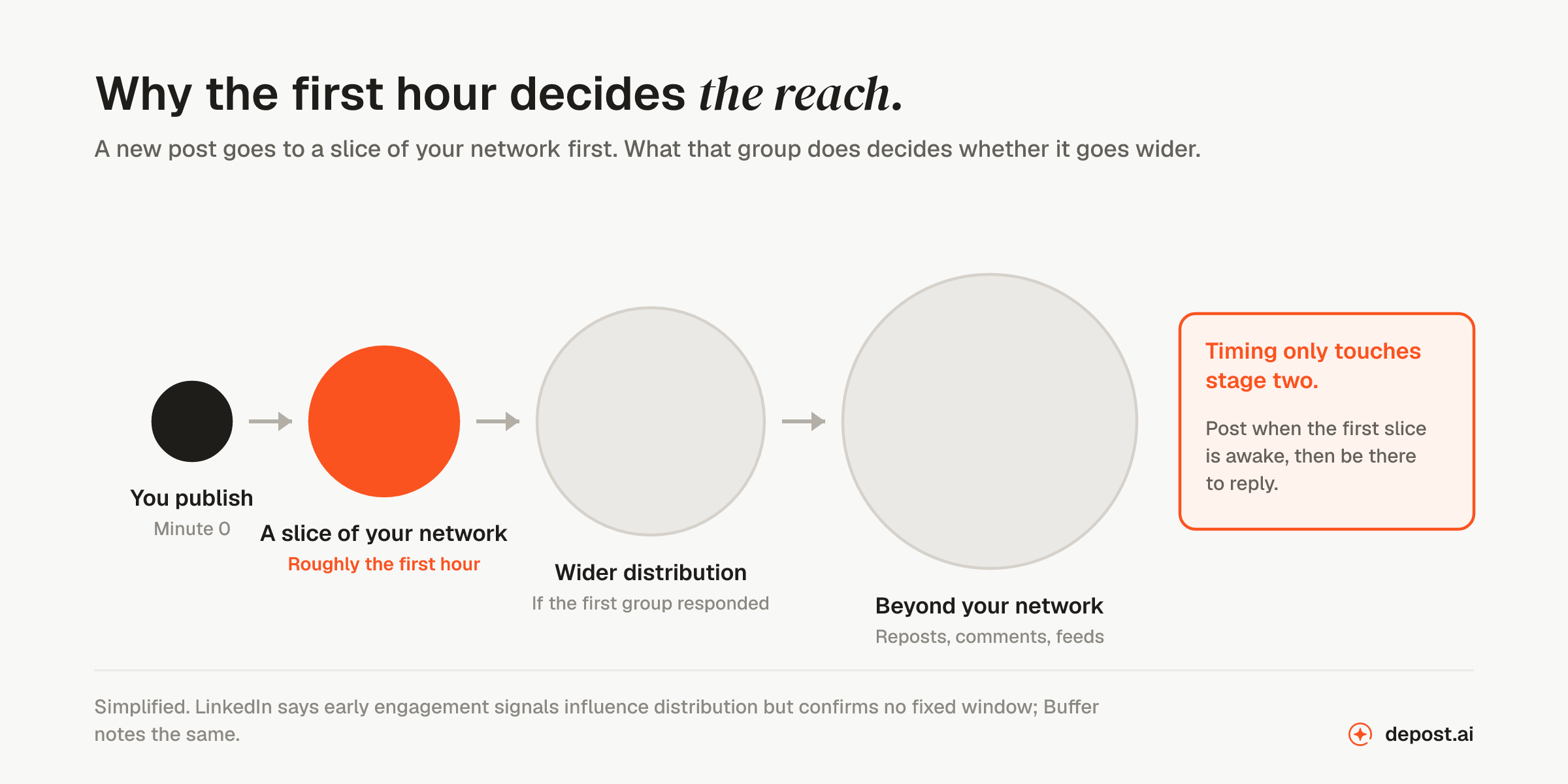
A post that gets a slow start and then a late lift from one large repost will show a good total while telling you nothing about timing. What timing controls is how quickly the first readers arrive.
So for each post, note the engagement in the first sixty to ninety minutes: reactions, comments, and whether anyone you do not know turned up. Compare those early numbers across the two windows. If one window consistently gets your first ten reactions faster, that is your answer, and you will usually see it by week three.
Worth being precise about what is known here. LinkedIn has said early engagement influences how widely a post is distributed. It has never published a fixed sixty or ninety minute window, and Buffer says the same in its analysis. The first hour is a useful habit, not a documented switch.
For a cleaner read on each post, the engagement rate calculator benchmarks it against the platform average, so a good Tuesday and a bad Thursday are compared on the same scale. What counts as a good rate in 2026 has the current benchmarks by format.
Step 4: Convert the winner to a schedule
Once one window is ahead, write it down as an hour in your audience’s zone, not yours, and put it in a queue. This is the step where good tests die. People find the window, then keep publishing whenever they happen to open the app, and three months later the finding is gone.
Scheduling is also what makes the first hour survivable. Pick the window you can actually be present for, or accept that you will publish at the best hour and reply an hour late, which trades some of what you just measured.
Step 5: Lock it in, then retest each quarter
Stop testing and stick with it. Post in the winning window consistently for the next two or three months. Consistency of time helps the same way consistency of subject does: the readers who respond to you learn when to expect you, and the system learns who to run the first test on.
Then retest, because the numbers move. Buffer’s peaks shifted later between its 2025 and 2026 analyses, and your own audience changes as it grows, shifts industries, or spreads across more time zones. One quarter is a sensible interval: long enough to have compounded, short enough to catch a drift.
Keep the retest small. Your locked window against one new candidate, three weeks, first-hour numbers. If the incumbent wins, nothing changes. If the challenger wins clearly, switch.
How much timing actually matters
Less than the post. Timing decides how quickly your first readers arrive; the content decides what they do, and what they do decides the reach. A strong post at a mediocre hour outperforms a weak post at the perfect one, every time.
Treat timing as a small, free gain. Worth taking, because it costs nothing once you know it, and not worth agonizing over, because the rest is what you wrote. If your numbers are flat across every window you try, the problem is not the clock, and the tips that actually move a post are a better use of the next month.
FAQ
What is the best time to post on LinkedIn?
Midweek, and beyond that it depends on your audience. Sprout Social, Buffer, and Hootsuite all rate Wednesday highly and weekends poorly, and they disagree on the hour by as much as twelve hours because each measures a different customer base. Sprout points at 11am to 5pm, Buffer at 3pm to 8pm, and Hootsuite at early morning. Your own analytics beat all three.
What is the best day to post on LinkedIn?
Wednesday. It is the only day that appears in the top tier of all three current studies, with Tuesday and Thursday close behind. Monday and Friday are mixed, and weekends are the weakest ground in every dataset.
What is the worst time to post on LinkedIn?
Weekends, in all three studies. Buffer also finds Monday and Tuesday the weakest days of its week and the hours before noon weaker than the afternoon. The one thing every dataset agrees on is that Saturday and Sunday are not worth a good post.
How long does it take to find my own best time?
About four weeks of alternating two windows, reading the first-hour engagement rather than the total. Most people see a clear winner by week three. Retest once a quarter, because the platform’s own peaks move.
Should I post in my time zone or my audience’s?
Your audience’s. The studies report in the audience’s local time, and a test run in your own morning has tested a window your readers may have been asleep for. Decide where your readers mostly are and schedule on that clock.
Does the day matter more than the hour?
For most accounts, yes. The studies agree on the day and disagree on the hour, which tells you the day is the reliable signal. Get midweek right first, then refine the hour with your own data.
Is it worth posting on weekends?
Rarely, for a professional audience. Every current study finds weekends the weakest ground. The exception is an audience of founders and freelancers who work through them, which your own numbers will show if it is true for you.
Does the first hour after posting really matter?
Early engagement does influence how widely a post gets distributed, and LinkedIn has said so. What has never been published is a fixed window, so treat “the first hour” as a useful habit rather than a rule: be there to reply while the post is new, and do not post at an hour you cannot be present for.
How often should I post on LinkedIn?
Two to four times a week suits most people, and consistency beats volume. Twice a week for six months does more than five times a week for three weeks followed by nothing.