LinkedIn in 2026: Everything Changed Except What Works
We followed 369 people across 2025 and 2026, 89,850 posts between them. What they posted changed a lot. What it was worth hardly moved at all.

· 14 min read

On this page
- What people posted in 2026
- What those choices were worth
- Six kinds got better. Five of them were used less.
- Did it get quieter?
- What still works, whatever the year
- The one thing nobody stopped doing
- Does any of this change if your audience is small?
- What to do in 2027
- What this cannot tell you
- What we got wrong last time
- What Depost AI actually does
- FAQ
Most year-in-review posts compare this year’s creators with last year’s creators. That is not a year in review. That is a change of cast.
So we did it the other way. We found the people who posted at least fifteen times in both 2025 and 2026, and followed only those people. 369 of them. 47,773 posts in 2025, 42,077 in 2026. Same people, two years.
What they posted changed a lot. What it was worth hardly moved at all.
How to read every number here. We compare each post with that same person’s usual post. So “14% better” means that post did 14% better than what that person normally gets. Nobody is compared with anybody else.
What people posted in 2026
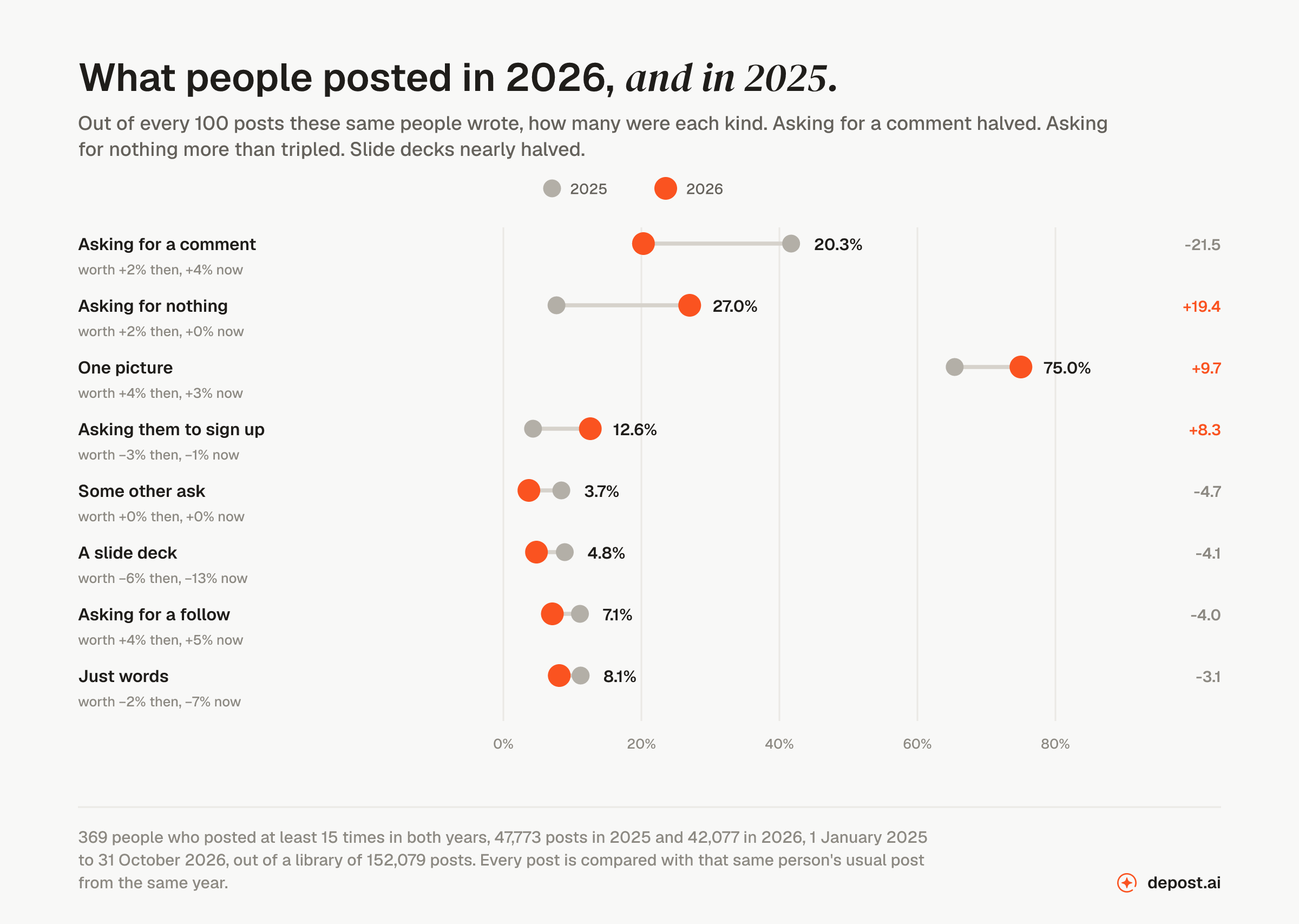
Asking for a comment collapsed. In 2025, 42 posts in every 100 ended by asking for a comment. In 2026, 20. The most common ending on LinkedIn halved in a year.
What replaced it was nothing. Posts that ask for nothing at all went from 8 in every 100 to 27. More than tripled.
Asking people to sign up tripled too, 4 in every 100 to 13. So the people who kept an ask moved it from “comment below” to “join this”.
Slide decks nearly halved, 9 in every 100 to 5, while the single picture took over, 65 to 75. Plain text posts fell. Posts built around a link all but disappeared.
And the mood changed. Posts about something you learned fell from 19 in every 100 to 14. Strong opinions fell from 8 to 5. Posts about hitting a number fell from 5 to 3. How-to posts rose from 18 to 21, posts about a tool from 9 to 11. The feed got more useful and less personal.
What those choices were worth
Here is the same list again, this time showing what each one actually did. Every post is compared with that person’s usual post from the same year, so one person having a better or worse year cannot change what a kind of post looks like it is worth.
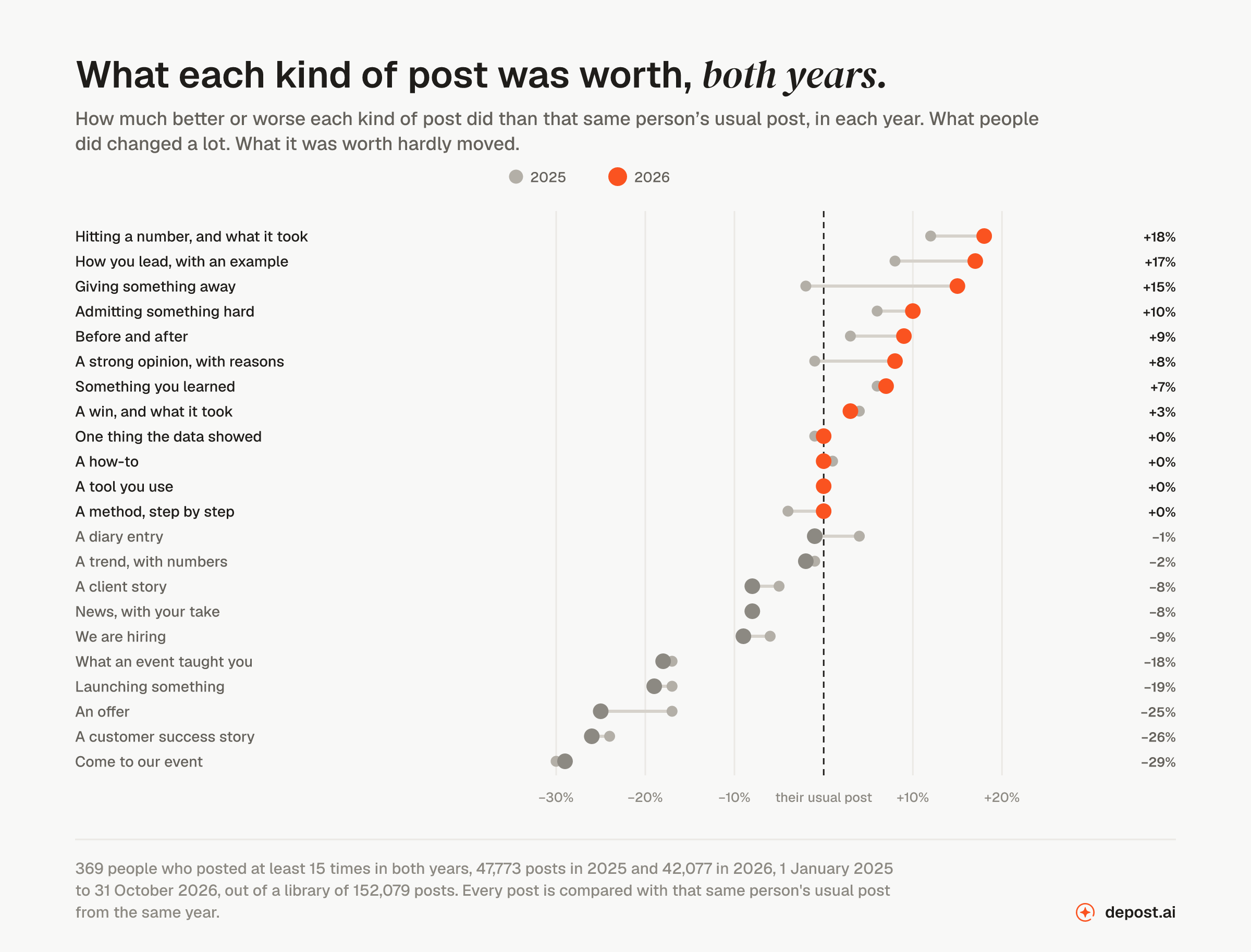
Asking for a comment was worth 2% more than a usual post in 2025, and 4% more in 2026. Asking for nothing: 2% more, then nothing at all. One picture: 4% more, then 3% more. Asking people to sign up: 3% worse, then 1% worse.
Every tactic that changed was worth the same before and after. People abandoned the comment ask in their tens of thousands, and asking for a comment had never been doing anything. They moved to asking for nothing, which does the same nothing. The ones who kept an ask swapped one thing worth nothing for another.
The one place the crowd was right is the slide deck, which went from 6% worse than a usual post to 13% worse while people halved how often they used it. They left it as it got worse.
Six kinds got better. Five of them were used less.
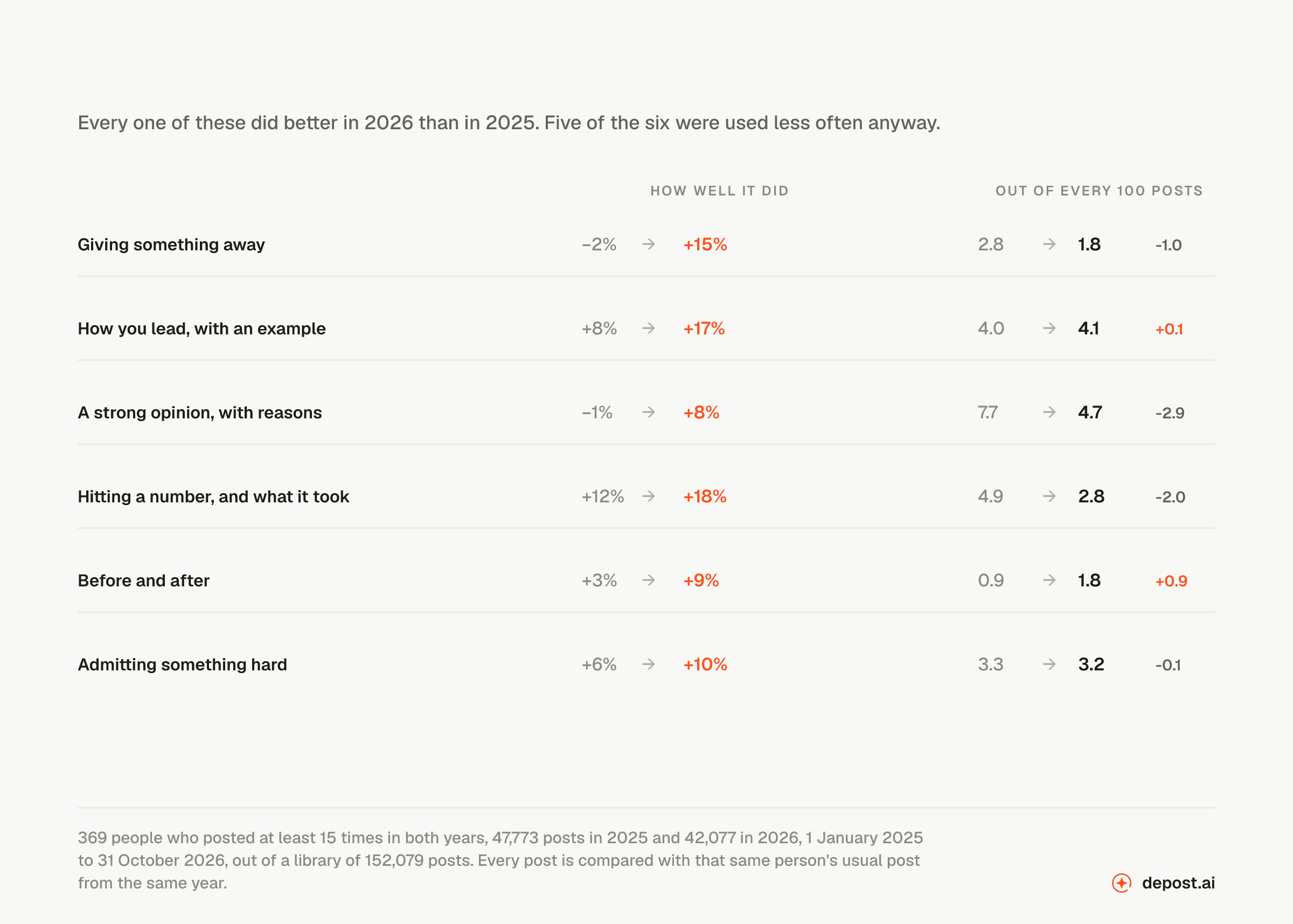
Giving something away went from 2% worse than a usual post to 15% better, the biggest jump of anything, and people used it less. A strong opinion with reasons went from level to 8% better, and fell from 8 posts in every 100 to 5. Hitting a number went from 12% better to 18% better, and fell from 5 in every 100 to 3.
That is the most useful thing in the whole year: the kinds of post that got better are the ones people did less of. Whatever is steering these decisions, it is not evidence.
Did it get quieter?
This is the number everyone wants, and it is the one we nearly got wrong.
Done the quick way it looks grim. Take each of the 369 people and compare 2026 with their own 2025: 16% fewer likes, comments and reposts per post, with only 29 people in every 100 doing better. Likes down 14%. Comments down 17%. “LinkedIn engagement fell 16% in 2026” writes itself.
Then we checked it against stretches of time that have both finished collecting likes.
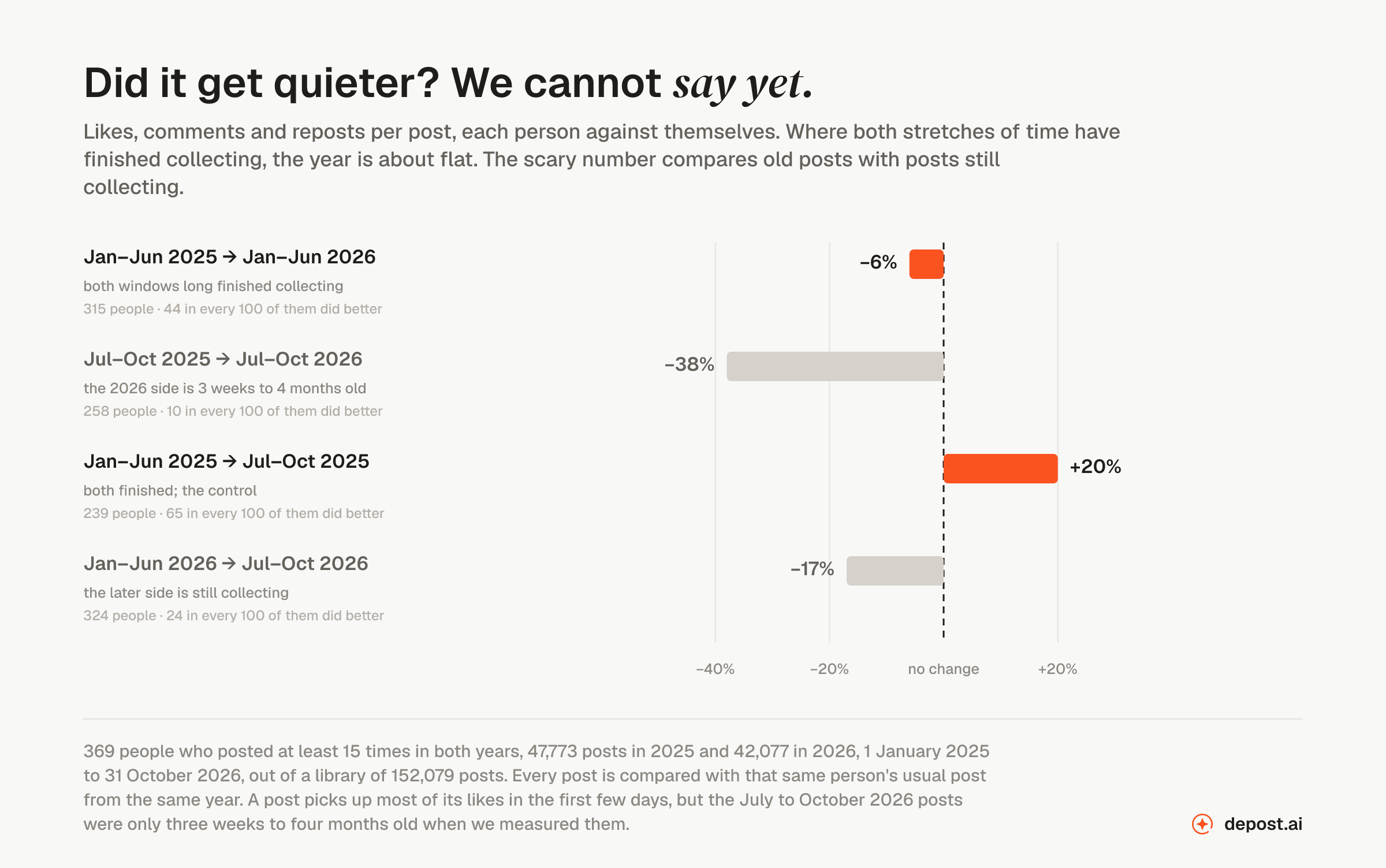
Compare January to June 2025 with January to June 2026, both long finished: 6% lower, with 44 people in every 100 doing better. A dip, not a collapse.
The frightening 38% drop compares posts that are over a year old with posts that were three weeks to four months old when we measured them. A post picks up most of its likes in the first few days, but not all, and those months have not finished.
And one comparison settles it. Inside 2025 alone, where both halves have long finished, the second half did 20% better than the first. Second halves are not naturally quieter. The 2026 second half only looks quiet because it is not done.
So the year is about flat, and we cannot yet say what the second half of 2026 did. Ask us in February.
One thing that is not a measuring problem: these people posted at almost exactly the same rate as the year before, and wrote about 5% more words.
What still works, whatever the year
Since so little moved, last year’s ranking is this year’s ranking. If you read one chart, read this one.
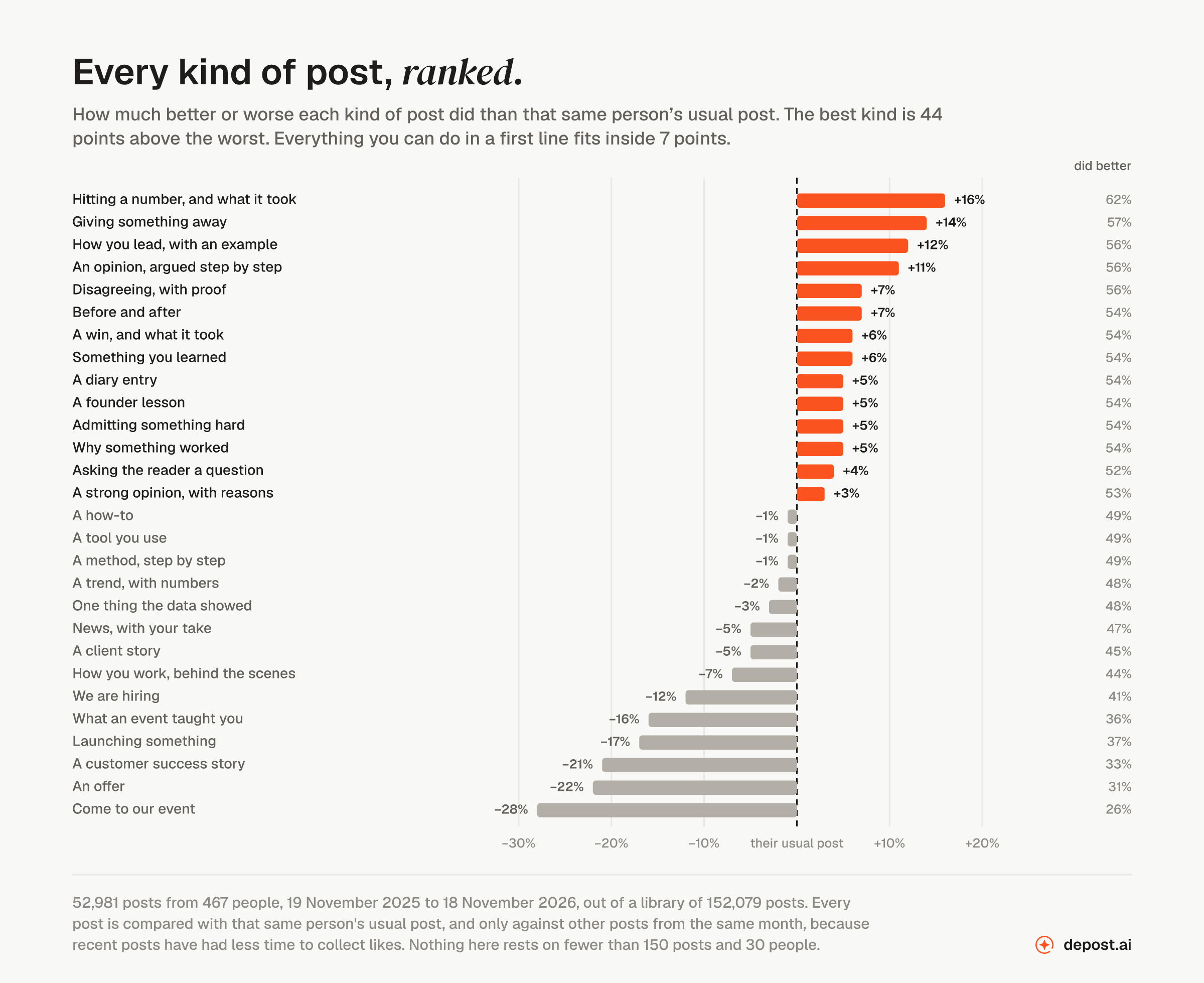
Hitting a number and saying what it took: 16% better than that person’s usual post. Giving something away: 14% better. Writing about how you lead, with an example: 12% better.
At the bottom, it is all selling. Launching something is 17% worse. An offer, 22% worse. A customer success story, 21% worse. Inviting people to your event, 28% worse, and it beat that person’s usual post only 26 times in 100.
And the most common post of all, the how-to, with 10,552 of them in the library, comes out 1% worse than a usual post. Which is to say it does nothing.
The one thing nobody stopped doing
Through all that change, one habit never wavered: rewriting the first line. So we measured that too, across 52,981 posts.
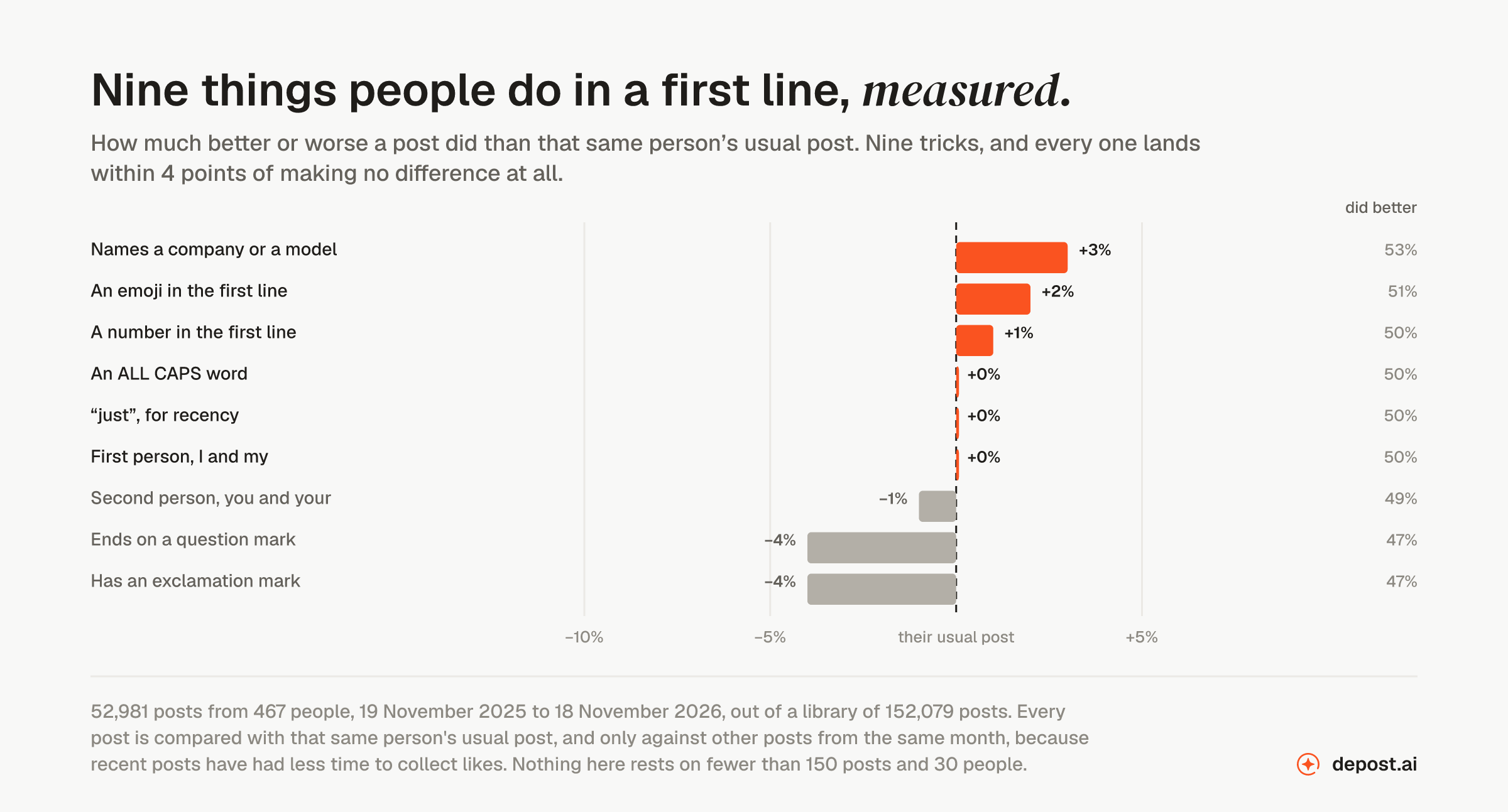
An emoji is worth 2%. A number, 1%. ALL CAPS, nothing. Saying “you”, nothing. The kind of opening is no better: a bold claim 1% better, a curiosity gap 2% worse, pain-then-promise 6% worse. How long the first line is does nothing either.
The best kind of post is 44 points better than the worst. Everything you can do in a first line fits inside 7 points.
The thing nobody sells you is worth about six times the thing everybody sells you.
Does any of this change if your audience is small?
This is the question we get most, and the one we answer worst, because the people in our library are big. The middle one has about 72,000 followers.
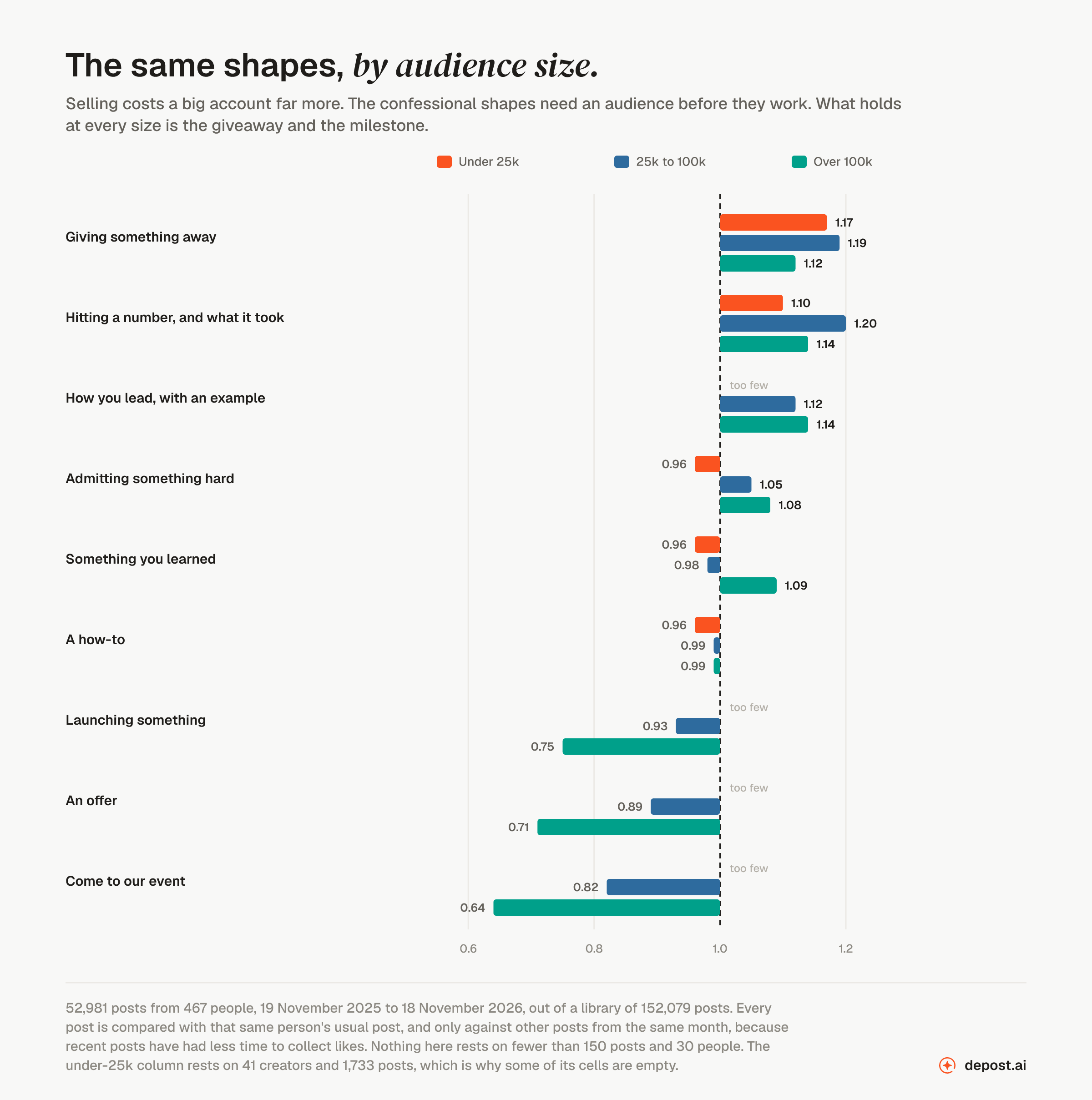
Selling costs big accounts far more. Launching something is 7% worse than a usual post for someone with 25,000 to 100,000 followers, and 25% worse for someone over 100,000. An offer, 11% worse against 29% worse. An event invite, 18% worse against 36% worse.
The personal posts need an audience first. Admitting something hard is 4% worse for someone under 25,000 followers, 5% better in the middle, and 8% better over 100,000. Something you learned: 4% worse against 9% better. The founder story that works beautifully at 200,000 followers is not doing the same job at 8,000. If you are small and your personal posts are not landing, that is why, and it is not your writing.
What holds at every size is giving something away, and hitting a number. If you are small, hand things over and report real numbers. Save the confession for when you have an audience to spend.
The under-25,000 column rests on 41 people and 1,733 posts, which is why some of its cells are empty. Read it as a direction, not a promise.
What to do in 2027
Stop copying the crowd. The two biggest changes of 2026 swapped one thing worth nothing for another thing worth nothing.
Go back to what got better. Giving something away gained more than anything else and people used it less. Same for a strong opinion with reasons, and for hitting a number.
Decide what kind of post it is before you write a word. A number you hit is worth 16% more than your usual post. A decision you made and why, 12% more. Something you are giving away, said plainly, 14% more.
Put in one picture, not a slide deck. The slide deck is the one place the crowd was right.
Take the link out of the post. It costs about 8%, against roughly nothing for every other ending, including asking for nothing at all. Put it in the first comment.
Then stop rewriting the opener.
What this cannot tell you
We cannot yet say what the second half of 2026 did
Covered above, and it is the biggest hole here. Posts from the last few months have not finished collecting likes, so any comparison that includes them reads low. Ask us in February.
We looked at what is in a first line, not whether it is any good
“No trick makes a difference” is not the same as “your first line does not matter”. A genuinely bad opener almost certainly kills a post. What we can say is narrower: none of the tricks people sell separates a post that works from one that does not.
We cannot see how many people saw a post
Only the person who wrote a post can see that. Everything here is built from likes, comments and reposts, which anyone can see. A post that reached a lot of people and moved none of them looks weak in this data.
These people are bigger than you
The middle one has about 72,000 followers. That is the whole reason for the audience-size chart, and also why that chart is the thinnest thing here.
We decide what kind each post is, and we get some wrong
The labelling is good, not perfect. A post about hitting a number, told as a lesson, could go in either row.
We only followed people who kept posting
This follows only people who posted at least fifteen times in both years. Anyone who gave up in 2026 is not in it. If LinkedIn got harder, the people it got hardest for are exactly the ones we cannot see.
What we got wrong last time
Two things, both ours.
Our first edition said our idea library ranks each post against its own writer. It does not. That own-average test is what we run on your posts; the library is ranked against everything else in the library. That post has been corrected.
And it said that ending with no ask beat everything, by 16%. On a full year it comes out level, the same as asking for a comment or a share. The three-month number was too small and we said it too confidently. What survives is narrower: do not end on a link.
What Depost AI actually does
Everything above came out of the same machinery the product runs on. Here is what it does, in the order you would use it.
First it reads your account.
- Reads your profile and everything you have published
- Works out which of your posts beat your own usual post, and which did not
- Finds the gaps: what you write about constantly, and what you never touch
- Learns how you actually write, down to how you open and how you close
Then it looks at what is working elsewhere.
- A library of posts that did well, searchable by subject
- What each kind of post is worth, measured the way this whole piece was measured
- Your account held up against what is performing in your space
It turns that into a plan.
- A written strategy you can read and argue with: who you are for, what you sell, which subjects to push and which to drop
- A week or a month of posts, planned out
- Launch campaigns and lead-magnet sequences
- Ideas that already know what you have posted, so you do not get the same angle twice
Then it writes, in your voice.
- Posts, opening lines, closing lines, pinned comments, series
- And the part most tools skip: it fixes drafts. Make this less salesy. Make it sound like a person. Rewrite it the way my best posts are written. Add proof.
- One idea becomes a post, a slide deck, an infographic, a video script or a lead magnet, without explaining the idea again
- Every brand keeps its own look, used on anything it draws
And it remembers.
- Tell it a preference once and it sticks
- Ideas are saved and searchable, not lost when you close the chat
- Each brand has its own memory, its own voice and its own team
Two things it will not do. It schedules a post once you have approved it, and never posts for you. And it cannot know your voice until your post history has been imported, which happens the first time you connect.
Of the 82 things it can do, 23 are writing a post. The other 59 are reading, deciding, planning, remembering and designing. That split is the whole product.
FAQ
Did LinkedIn engagement fall in 2026?
Compared on stretches of time that have both finished collecting likes, it is about flat. January to June 2025 against the same months of 2026, for the same 369 people, is 6% lower, with 44 in every 100 doing better. The bigger falls you will see quoted compare old posts against posts that are only weeks old and still collecting.
What changed most on LinkedIn in 2026?
The ending. Out of every 100 posts, asking for a comment fell from 42 to 20, asking for nothing rose from 8 to 27, and asking people to sign up rose from 4 to 13. In format, one picture rose from 65 to 75 while slide decks fell from 9 to 5.
Do carousels still work on LinkedIn in 2026?
They got worse. A slide deck went from 6% worse than that person’s usual post to 13% worse, and people roughly halved how often they used them. One picture came out 3% better.
Does asking for a comment still work?
It never did, on this measure. Asking for a comment was worth 2% more than a usual post in 2025 and 4% more in 2026, against 2% more and then nothing for asking for nothing at all. It changes who answers rather than how far the post travels.
What is the best kind of LinkedIn post?
Over the twelve months to November 2026: hitting a number and saying what it took, 16% better than that person’s usual post. Giving something away, 14% better. Writing about how you lead, with an example, 12% better. The weakest were launching something at 17% worse, an offer at 22% worse and an event invite at 28% worse.
Does the hook matter on LinkedIn?
Not in the way it is sold. Everything we could measure about a first line landed within four points of making no difference, across 52,981 posts. Which kind of post you write spans 44 points on the same data.
How was this measured?
We followed 369 people who posted at least fifteen times in both 2025 and 2026. Every post was compared with that same person’s usual post from the same year, so one person having a better or worse year cannot change what a kind of post looks like it is worth. The window runs 1 January 2025 to 31 October 2026. No row rests on fewer than 150 posts and 25 people.