How Often Should You Post on LinkedIn? Is Daily Worth It?
What LinkedIn says, what the 2-million-post study found, where the daily-penalty figure comes from, and what 13,104 posts show when each is scored against its own writer: a busy week costs nothing per post and adds up in total.

· 15 min read
On this page
People ask this question on Reddit about once a week, in five different phrasings. Every day or once a week. Is twice a day too much. Is one a day enough to grow. Founders who post daily, is it worth it. Does consistency still matter.
The first page of Google answers with two datasets that contradict each other and a penalty that nobody sources. Buffer says each step up in frequency pays. Hootsuite says once or twice a day. Somewhere in between, a “daily posting penalty” of 45% or 26% circulates with no study behind it. This post gives LinkedIn’s own words and the one large study that compared accounts with themselves. Then it runs a new test on 13,104 posts, each scored against its own writer. It ends with a cadence for a founder who writes their own posts, and with the thing I got wrong about this a week ago.
What LinkedIn itself says
Consistency, in LinkedIn’s words. In an in-app post reported by Social Media Today in July 2026, LinkedIn wrote: “Consistency is one of the biggest drivers of reach on LinkedIn. Posting regularly signals to the algorithm that you’re an active, valuable contributor.” The same guidance carried a checklist recommending “two to three posts per week.”
Two to three a week, twice over. LinkedIn’s marketing blog, in June 2026, told writers to “publish consistently at least two to three times per week.” Davang Shah, its VP of Marketing, added the timing that matters within a week: “Engagement signals in the first 24 hours influence how widely a post is distributed.”
No frequency penalty, reportedly. LinkedIn has published nothing that says posting often is penalized. A creator who put the question to LinkedIn staff in March 2026 reported their answer: each post is judged on its own, however many you publish. That is a paraphrase of a conversation, not a LinkedIn statement, and it is the closest thing on record.
So LinkedIn’s position is three things: be consistent, two or three a week is enough, and be there in the first day.
The one large study that compared accounts with themselves
Buffer, 2 million posts, within the same accounts. Buffer’s study of more than 2 million LinkedIn posts from 94,000+ accounts, published in August 2025, did the thing most frequency studies skip. It compared “each account’s high- and low-frequency weeks against its own average,” so a big account’s busy weeks were measured against that account’s quiet weeks, not against a small account.
The result. Moving from one post a week to two to five brought “+1,182 more impressions per post” and “+0.23 percentage points in engagement rate.” Six to ten a week: “+5,001 more impressions per post.” Eleven or more: “nearly 17,000 more impressions per post, 3x more engagements, and a 1.4 percentage point jump in engagement rate.” Buffer’s conclusion, in its words: “posting more often helps your performance on LinkedIn. Each step up in frequency delivers better per-post results.”
Two things to hold beside it. Buffer sells scheduling, so it gains when people post more. And a within-account design controls for the account but not for why a week was busy. An account’s heavy weeks may also be its weeks of more effort, more commenting and more to say. The direction is still the best evidence on the first page, and it is the opposite of a penalty.
Where the other advice comes from
“Once or twice a day” is advice for company pages. Hootsuite’s guide, updated April 2025, says “Post 1-2 times per day on LinkedIn.” Read on and the context is a business account: Hootsuite’s own page posts “2-3 times per day,” businesses average 5.5 posts a week, and the supporting figure is a LinkedIn Pages claim about weekly posting. None of that is about a person writing their own posts.
The daily penalty has no source. The figures that circulate are a 45% or a 26% reach cut for daily posting. They are attributed to a paid report at second hand, they disagree with each other, and they contradict Buffer’s within-account result. We could not trace either to a study. Treat them as a rumor until someone publishes a method.
The sharpest version comes from the author of the largest reach study. Richard van der Blom, whose team analyzes over a million posts a year, said in June 2026 that for most creators “structuring two to three posts a week would be enough.” He posts six times a week himself. His warning was about what fills the extra days: people “publishing memes, quotes to get to a frequency of daily. And that is not very good.” The penalty, if there is one, is for filler, not for frequency.
The fair test, three ways
Our library: 13,104 posts published between 9 July and 6 October 2026, thirteen weeks, by 409 creators with four or more posts in the window. Each post’s engagement, meaning reactions plus comments plus reposts, is divided by the same writer’s median post. 1.00 is that writer’s typical post. The same method as our test of what works on LinkedIn.
Per post: busy weeks and quiet weeks
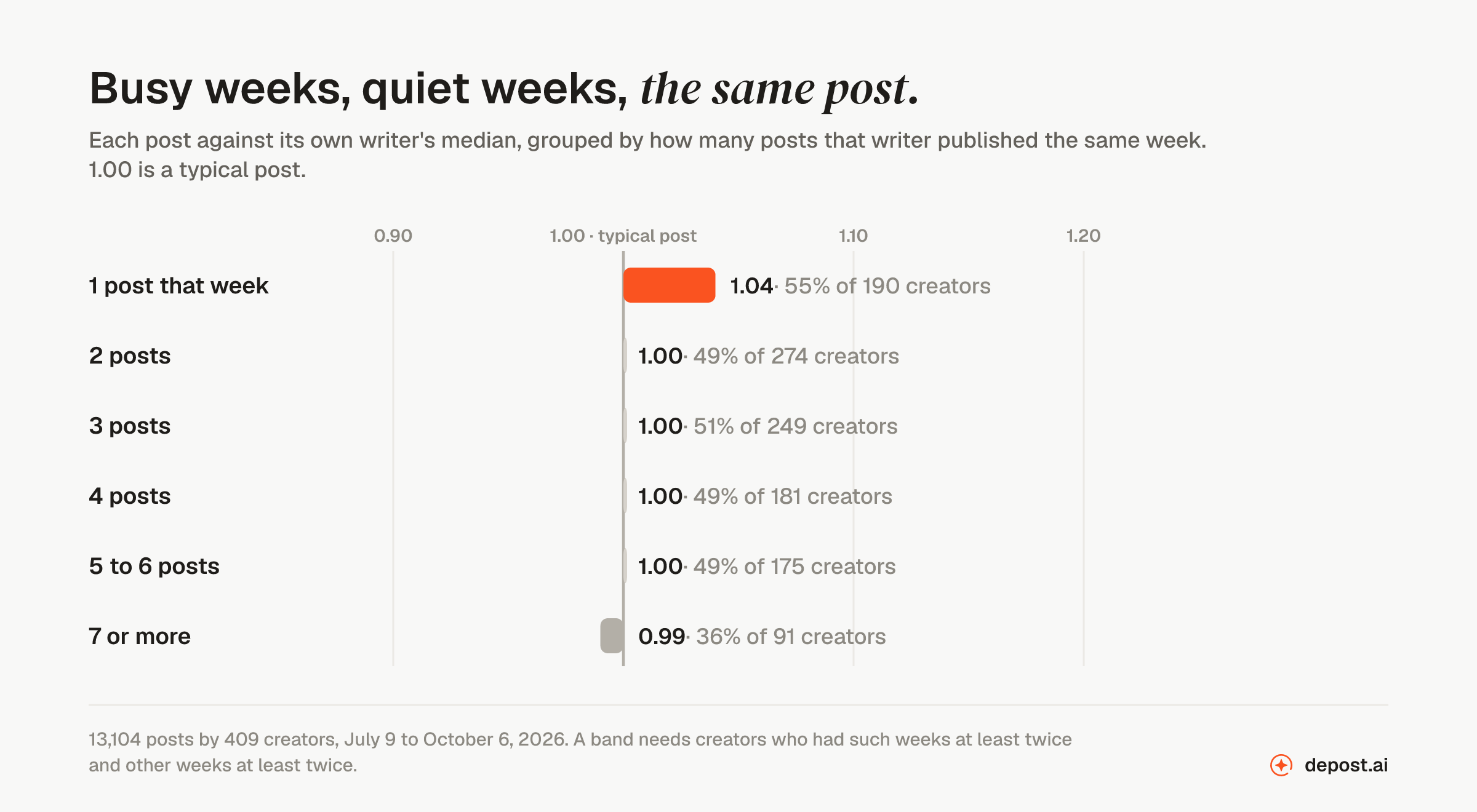
Take each post and ask how many posts its writer published that same week. Then score the post against the writer’s own median.
| Posts that week | Against own median | Writers it worked for |
|---|---|---|
| 1 | 1.04 | 55% of 190 |
| 2 | 1.00 | 49% of 274 |
| 3 | 1.00 | 51% of 249 |
| 4 | 1.00 | 49% of 181 |
| 5 to 6 | 1.00 | 49% of 175 |
| 7 or more | 0.99 | 36% of 91 |
The single post in a quiet week does a little better, at 1.04. That fits: a writer who posts once that week posted the one thing they had. From two to six a week, nothing moves. A post in a four-post week is the same post as one in a two-post week. At daily or more, the median barely dips, but the share of writers it works for drops to 36%. For most people who post seven or more times a week, those weeks are below their own normal per post. Van der Blom’s filler, measured.
The week’s total
Per post is the wrong unit for a writer deciding how often to post. The week is the unit. Take the 166 creators who had both one-post weeks and three-or-more-post weeks. Here is what each kind of week earned in total, in units of that writer’s typical post.
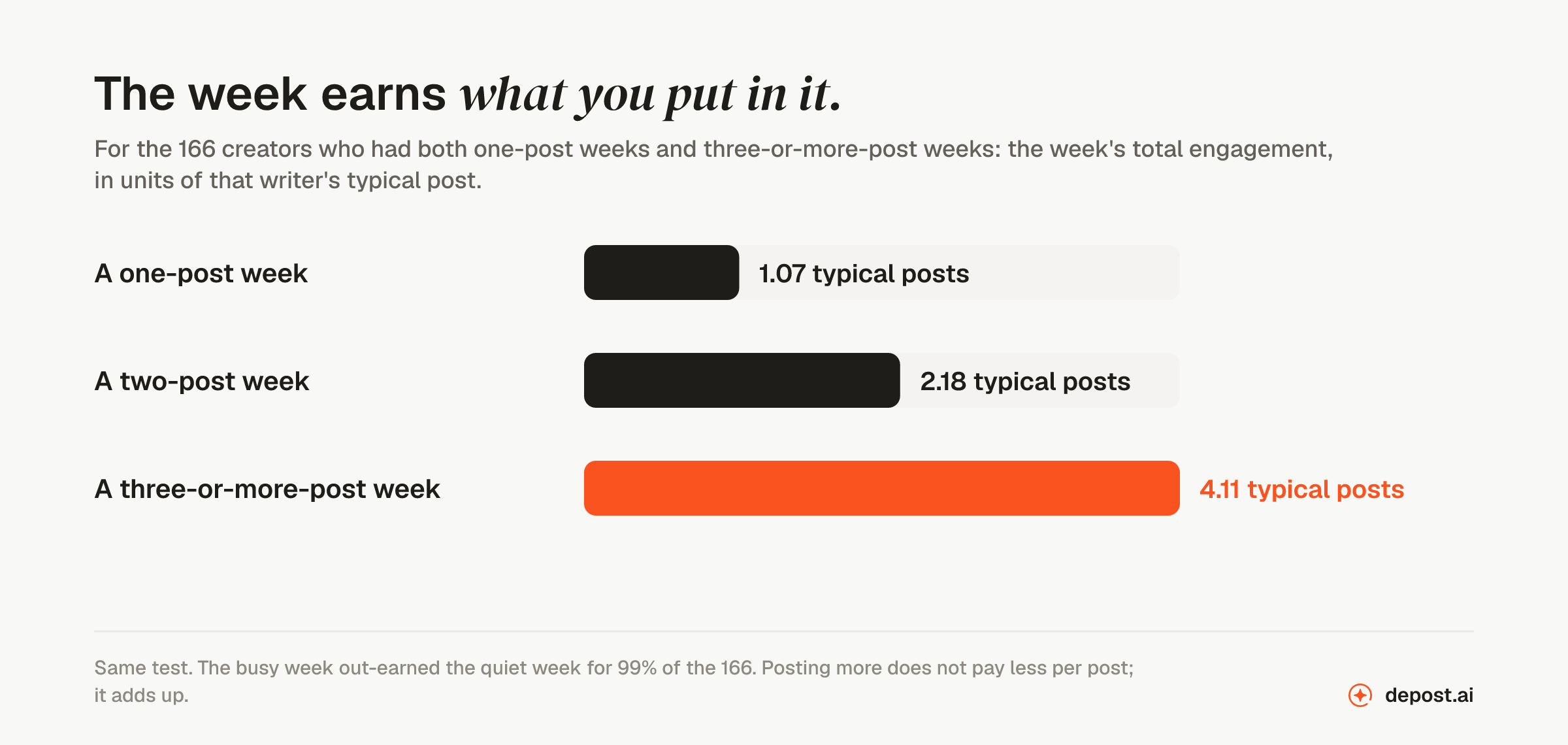
A one-post week earned 1.07 typical posts. A two-post week earned 2.18. A week of three or more earned 4.11. The busy week beat the quiet week for 99% of the 166 creators. There is no point at which the extra post costs the others. Posting more earns more, almost one for one, up to the point where the posts stop having anything in them.
Across creators, and what I got wrong
Now compare creators with each other, the way most studies do.
| Posts a week | Creators | Median engagement per post | Per 1,000 followers | Median followers |
|---|---|---|---|---|
| Under 1 | 146 | 252 | 5.00 | 61,663 |
| 1 to 2 | 82 | 276 | 2.90 | 112,358 |
| 2 to 3 | 50 | 303 | 2.79 | 133,751 |
| 3 to 4 | 44 | 381 | 2.97 | 164,644 |
| 4 to 5 | 32 | 402 | 3.25 | 116,169 |
| 5 to 7 | 35 | 590 | 3.60 | 196,068 |
| Daily or more | 20 | 439 | 1.44 | 287,977 |
Read across and two stories appear. Engagement per post rises with cadence, from 252 to 590. Engagement per thousand followers falls with it, from 5.00 to 1.44. The last column explains both: the creators who post most have the biggest audiences, and big audiences earn more per post and less per follower. Cadence is tangled up with size. That is why the within-writer test above is the one to trust.
A week ago I read this wrong. In our seller analysis on 9 October I wrote that the best-performing sellers post about three times a week. The top quarter of sellers by engagement per follower posted 2.8 times a week, and the bottom quarter 4.1, so that looked like the finding. Re-run today with audience size in view, it is not. The top quarter by that measure has a median of about 36,000 followers and posts 0.8 times a week. The bottom quarter has about 240,000 followers and posts 2.5 times a week. Small accounts earn more per follower and post less. That is a fact about size, not about cadence, and the sentence has come out of our guidance.
Does consistency matter?
LinkedIn says it is “one of the biggest drivers of reach.” Our library cannot test reach, because impressions are visible only to each author. It can test engagement, and the engagement view is inconclusive for the same reason as the table above.
The 197 creators who posted in eleven or more of the thirteen weeks earned a median 391 engagement per post. The 128 who posted in six weeks or fewer earned 271. But the consistent group also has the larger audiences, and per thousand followers the order reverses: 2.87 against 4.81. Our data cannot separate consistency from size. Buffer’s within-account result is the best evidence on the question: more weeks with more posts earned more impressions per post. It points the way LinkedIn says.
Which days
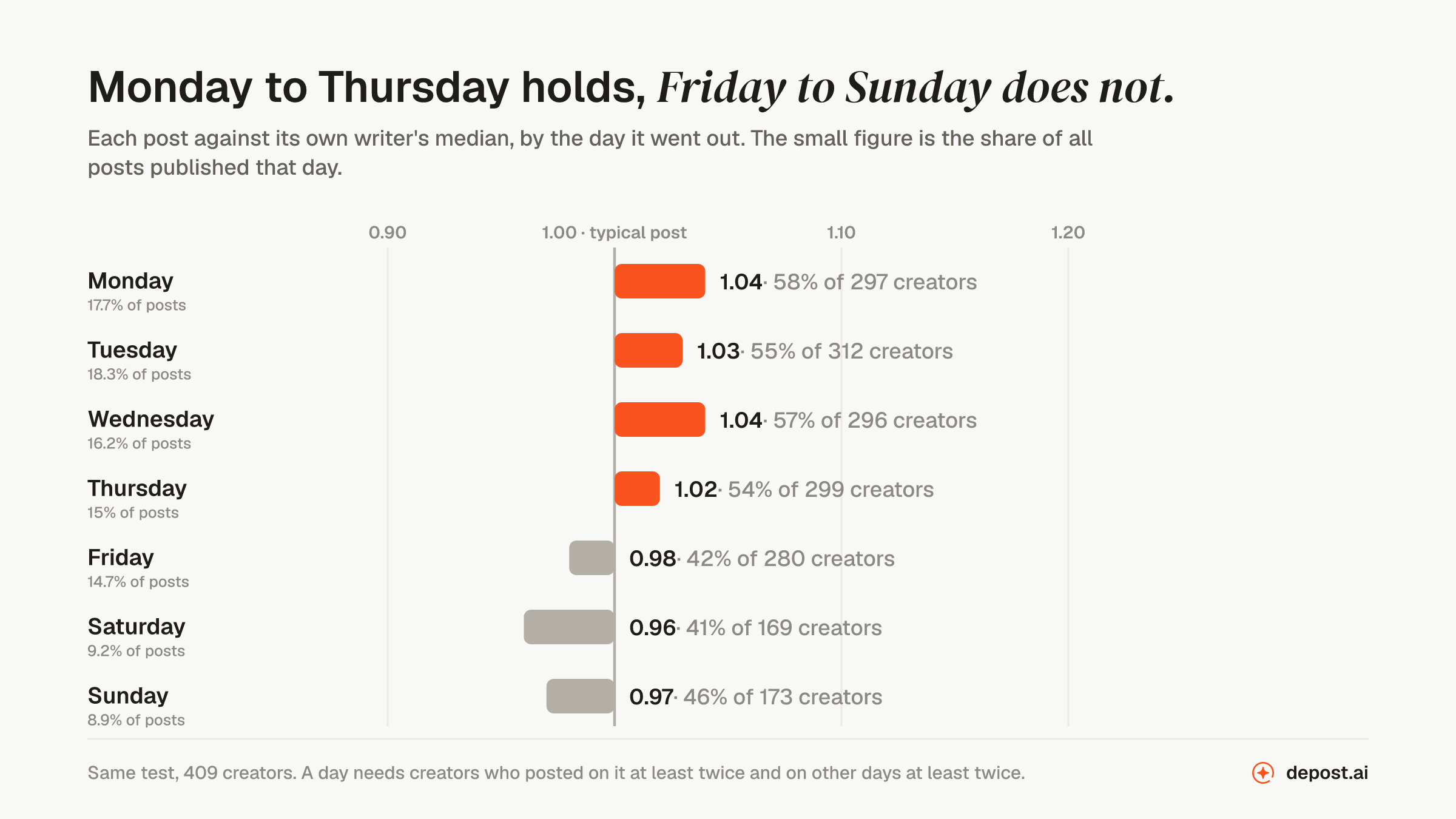
The one scheduling choice the library can settle. Each post against its writer’s median, by the day it went out.
| Day | Against own median | Writers it worked for | Share of posts |
|---|---|---|---|
| Monday | 1.04 | 58% of 297 | 17.7% |
| Tuesday | 1.03 | 55% of 312 | 18.3% |
| Wednesday | 1.04 | 57% of 296 | 16.2% |
| Thursday | 1.02 | 54% of 299 | 15.0% |
| Friday | 0.98 | 42% of 280 | 14.7% |
| Saturday | 0.96 | 41% of 169 | 9.2% |
| Sunday | 0.97 | 46% of 173 | 8.9% |
Monday to Thursday, a post beats its writer’s median for 54 to 58% of writers. Friday to Sunday, for 41 to 46%. The difference is small per post, two to eight points, and it is consistent across 300 creators a day. If you post three or four times a week, the days are Monday to Thursday. The posting-time studies disagree with each other on the hour, so test your own.
On my own account
One account, offered as one account. Fifty posts over the thirteen weeks to 12 October 2026, through Depost AI’s analytics, with one post left out because its metrics never synced. My median post earned 688 impressions, and I posted three times in a typical week.
| Posts that week | Weeks | Median impressions per post | Against my median |
|---|---|---|---|
| 1 | 1 | 471 | 0.68 |
| 3 | 6 | 778 | 1.13 |
| 4 | 2 | 859 | 1.25 |
| 5 or more | 4 | 593 | 0.86 |
Three and four posts a week were my best weeks per post. Five or more were my worst, at 0.86 on four such weeks. Small numbers, and the weeks with five or more are the weeks I was pushing posts out to keep a schedule. By day, my Monday-to-Thursday posts earned a median 777 impressions and my Friday-to-Sunday posts 568, which is the library’s pattern on one account. My three Sunday posts earned a median of 91.
So how often should you post?
For a founder, consultant or marketer who writes their own posts, four rules come out of all of this.
- Count is a total-engagement lever, not a per-post one. A post in a busy week scores the same as a post in a quiet week, and the week earns almost one for one. If you can write three posts with something in them, three posts earn three posts’ worth.
- The ceiling is specifics, not days. The only cadence that scored below the writer’s own median for most people was seven or more a week. Van der Blom’s memes and quotes, Buffer’s unexplained busy weeks and LinkedIn’s “Seems like AI slop” button all describe the same failure: a post published to fill a slot. What LinkedIn has said about AI-written posts is the same rule from the platform’s side.
- Monday to Thursday. Three or four posts a week fit the four days that beat the writer’s median. Leave the weekends unless your own numbers say otherwise.
- Be there for the first day. LinkedIn’s own VP says the first 24 hours of engagement shape distribution. A post you can answer comments on at 3pm beats a post that goes out at midnight to hit a quota.
Three or four a week, then, Monday to Thursday, and each one with a number, a decision or an opinion in it. The frequency is the easy part.
Depost AI is built for that week. It plans from what has beaten your own average and drafts each post in your voice. It schedules each one once you approve, at the times your own audience reads. The Performance Analyzer shows your own busy-week and quiet-week numbers. The cadence you settle on is measured on your account, not borrowed from this page.
What this cannot tell you
Engagement is not reach. The library scores reactions, comments and reposts. Buffer measured impressions. The two agree on direction, and neither can see what the other sees.
Busy weeks may be effort weeks. A within-writer test controls for the writer but not for why a week was busy. Weeks with more posts may be weeks with more replies, more commenting and more to say.
Correlation, not cause, and one season. July to October 2026, creators who already post well. The direction transfers better than the decimals. The number to beat is your own median, over your own weeks.
FAQ
How often should you post on LinkedIn?
Two to three times a week is LinkedIn’s own advice. Three or four, Monday to Thursday, fits the data for someone who writes their own posts. Across 13,104 posts scored against each writer’s median, a post in a busy week scored the same as a post in a quiet week. The week’s total engagement rose almost one for one with the number of posts. The ceiling is how many posts you can fill with something specific.
Is posting every day on LinkedIn bad?
Not per post, by the median: a post in a week of seven or more scored 0.99 of the writer’s typical post. But only 36% of the writers who posted that often beat their own median in those weeks. At two to six a week, about 50% did. Daily works for the few who have a post’s worth of material every day and costs the rest. The “daily penalty” figures quoted online have no published source.
Is there a LinkedIn posting frequency penalty?
LinkedIn has published none, and its staff have reportedly told creators that each post is judged on its own. Buffer’s within-account study of 2 million posts found each step up in frequency improved impressions per post, with no penalty threshold. Our own test found a post in a busy week scores the same as one in a quiet week. What is penalized is filler, which reads the same at any cadence.
What does LinkedIn recommend for posting frequency?
“Two to three posts per week,” in a July 2026 checklist, and “publish consistently at least two to three times per week,” on its marketing blog in June 2026. It also said in July 2026 that “consistency is one of the biggest drivers of reach on LinkedIn.”
Should you post on LinkedIn at the weekend?
Measured against each writer’s own median, Saturday posts scored 0.96 and Sunday posts 0.97, beating the writer’s median for 41% and 46% of writers. Monday to Thursday scored 1.02 to 1.04 and worked for 54 to 58%. Only 18% of posts in the library went out at the weekend. Unless your own numbers say otherwise, use the four weekdays.
Is it better to post once a week with quality or every day?
The single post in a one-post week scored 1.04, the best per-post figure in the test. A one-post week earned 1.07 typical posts in total. A three-or-more-post week earned 4.11. Quality per post is not what falls when you post more; the week’s total is what rises. Post as often as you can write something with a number, a decision or an opinion in it, and stop there.
How often should a founder post on LinkedIn?
Three or four times a week, Monday to Thursday, each post with something only the founder could say. Our earlier reading that the best-performing sellers post about three times a week turned out to be audience size rather than cadence. The honest basis is the within-writer result. The week earns what you put in it, and the limit is material, not days.
Does consistency matter on LinkedIn?
LinkedIn says it is one of the biggest drivers of reach. Our library cannot test reach, and its engagement view cannot separate consistent posters from large accounts. Buffer’s within-account study is the best evidence on the question: more weeks with more posts earned more impressions per post. It points the way LinkedIn says.