The 30 LinkedIn Post Formats That Keep Winning in 2026, Tested the Fair Way
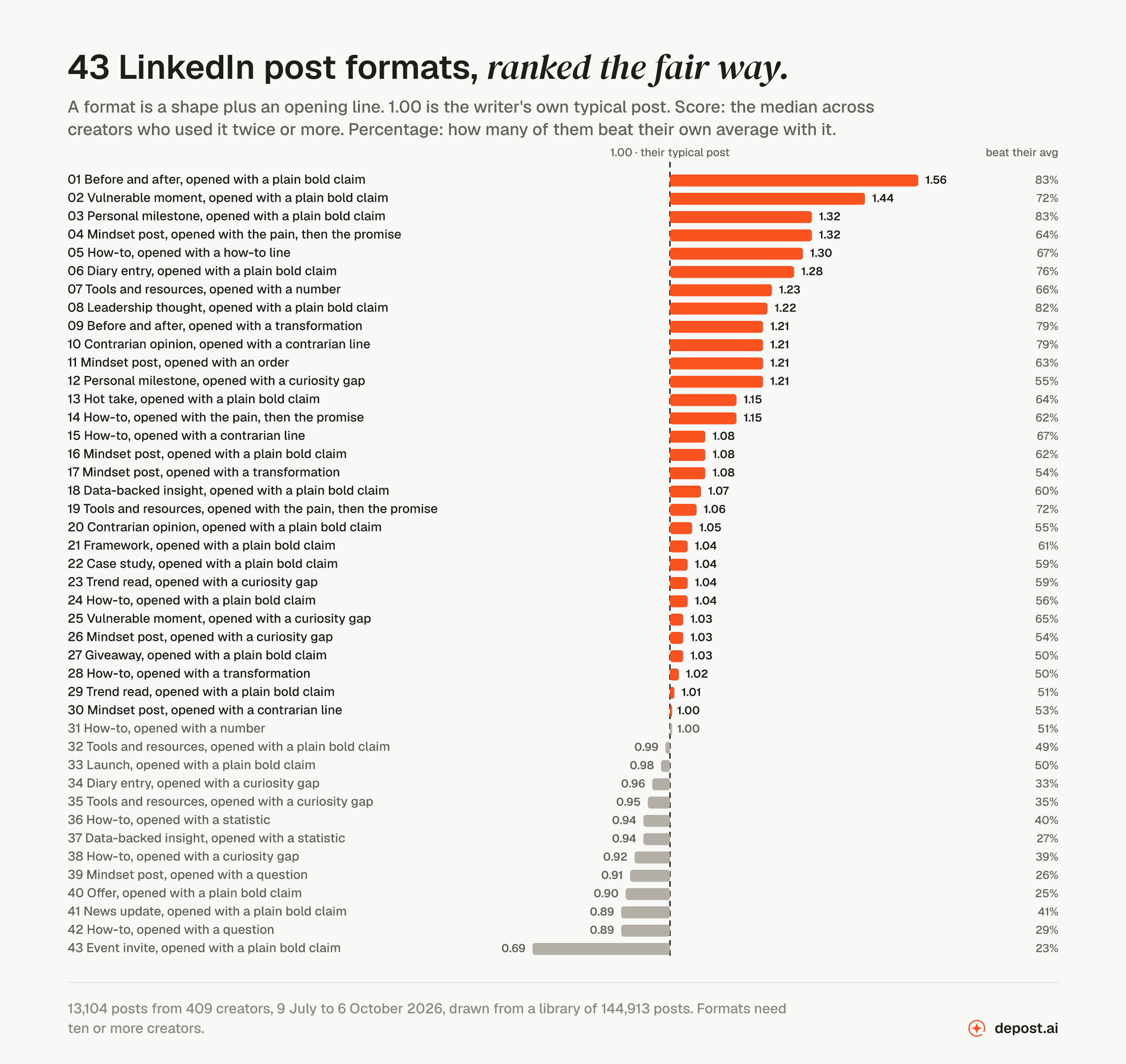
We scored 43 LinkedIn post formats against each writer's own typical post, across 13,104 posts from July to October 2026. Thirty beat it. Here they are, each with a real post that proves it and a fill-in template.

· 42 min read
On this page
- How this was measured
- The three mistakes that kept showing up
- Tier one: 1.20 and above
- Tier two: 1.08 to 1.19
- Tier three: 1.00 to 1.07
- The 13 formats that do not win
- The opening line that wins for each shape
- Image, video, text or carousel, by shape
- How a post ends
- How to write any of these from your own facts
- What this cannot tell you
- Save this page
- FAQ
Most lists of LinkedIn post formats are the same list. A carousel, a poll, a personal story, a how-to, a hot take, a listicle, with a sentence on why each one works and no measurement behind any of it.
So we measured. We took 13,104 LinkedIn posts published between 9 July and 6 October 2026 by 409 creators, drawn from a library of 144,913 posts, and scored every one against its own writer’s typical post. Not against other creators. A post at 1.50 did half again as well as that writer’s normal post; a post at 0.80 did a fifth worse. Then we grouped the posts by format, meaning the shape of the post plus the kind of first line it opens with, and asked one question of each format: do the people who use it beat their own average with it?
Forty-three formats had enough writers to judge. Thirty win. Thirteen do not. The how-to post, the most common shape on the platform, only ever breaks even. A link at the end is the worst ending there is. And the best format in the set, a before-and-after that opens with a plain claim, was used twice in three months by only 12 of the 409 creators.
Below are the 30, in three tiers, each with a real post that proves it, what the first line, the body and the ending are doing, and the fill-in template. Then the 13 to stop writing, the opening line that wins for each shape, which shapes win as an image and which lose as a carousel, and how to end.
How this was measured
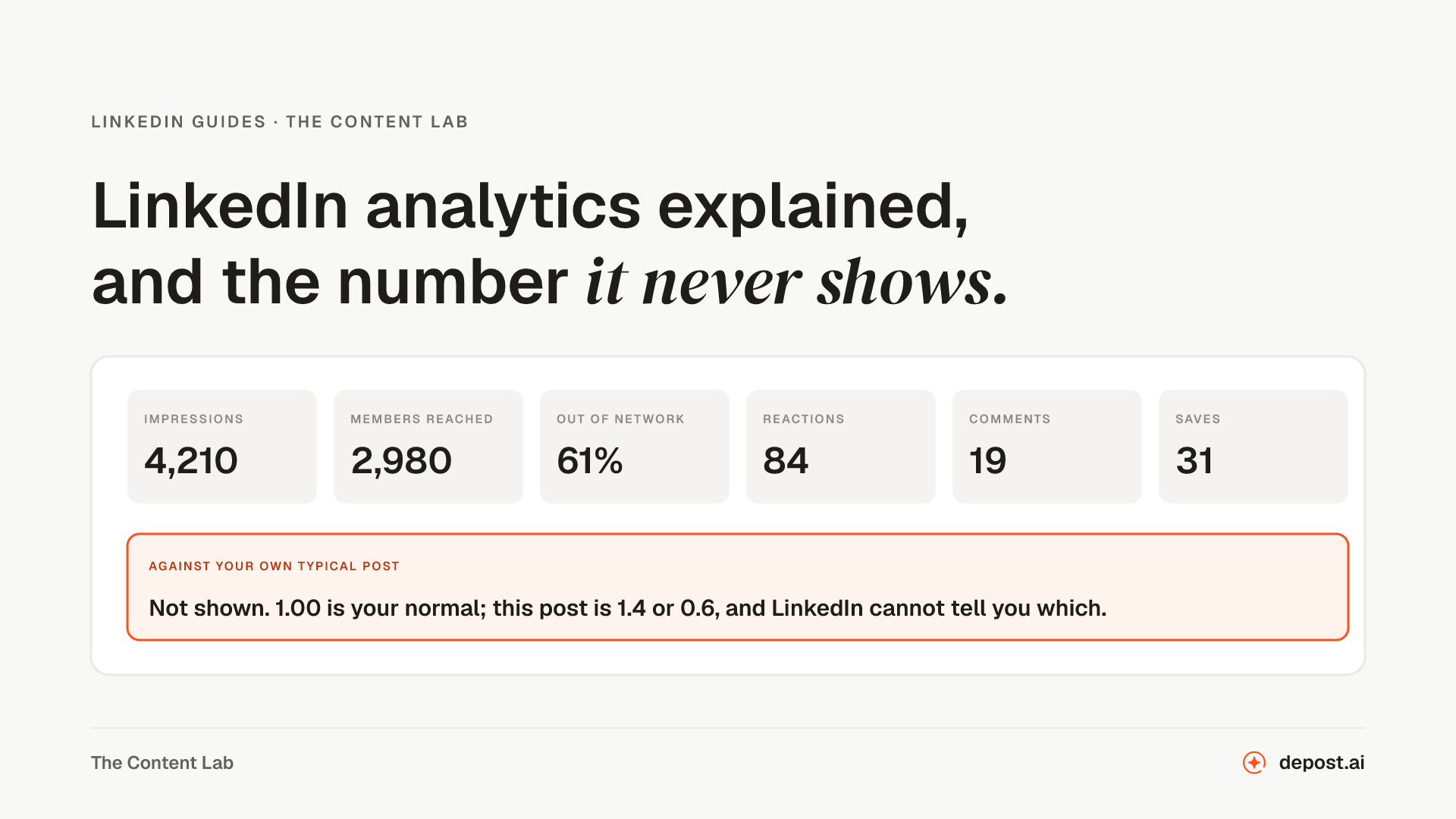
For every post, engagement (reactions, comments and reposts) divided by the same writer’s median post over the three months. On that scale 1.00 is that writer’s typical post. Impressions are not in the test, because nobody but the author can see them.
A format is a shape plus an opening line. The shape is what the post is, a leadership thought, a how-to, a milestone. The opening line is the kind of first sentence, a plain claim, an order, a question. “A leadership thought, opened with a plain claim” is one format; “a how-to, opened with a question” is another. The library’s classifier labels both for every post.
A format’s score is the median across the writers who used it at least twice and did something else at least twice, so one post that went viral cannot carry a format. Beside each score is the share of those writers who did better with the format than their own median, which is the number that says whether a format works for most people or for a loud few. A format needed ten or more writers to appear; 43 did.
The same method, on an earlier cut of the library with a higher bar, produced the 14 rules tested against each creator’s own posts. The figures here come from a larger library and a later window, so they differ slightly from that post. Where the two disagree on a number, this page is the newer one.
The three mistakes that kept showing up
Defaulting to the how-to post. 188 of the 409 creators wrote one, more than any other shape, and the shape scores 1.00. It breaks even: 48% of the people who write how-to posts beat their own typical post with them, and 52% do not. The first line decides which side you land on, which is why four how-to formats are in the 30 and four are in the 13.
Ending with a link. 194 creators do it, and the ending scores 0.91. Only 31% beat their typical post with a link at the end, so seven in ten do worse than their own normal post. It is the worst ending in the library and the second most used. The honest trade-off: a link in the first comment protects the post and earns fewer clicks.
Never writing the format that wins most. A before-and-after opened with a plain claim scores 1.56, and 83% of its writers beat their typical post with it. Twelve creators used it twice in three months. The formats everyone writes are average because everyone writes them; the one at the top is open because almost nobody does.
Tier one: 1.20 and above
Twelve formats. Eight of them open with a plain claim, which is the whole lesson of the tier: the shapes that win most are personal, and the line that opens them best is a flat statement.
1. Before and after, opened with a plain bold claim
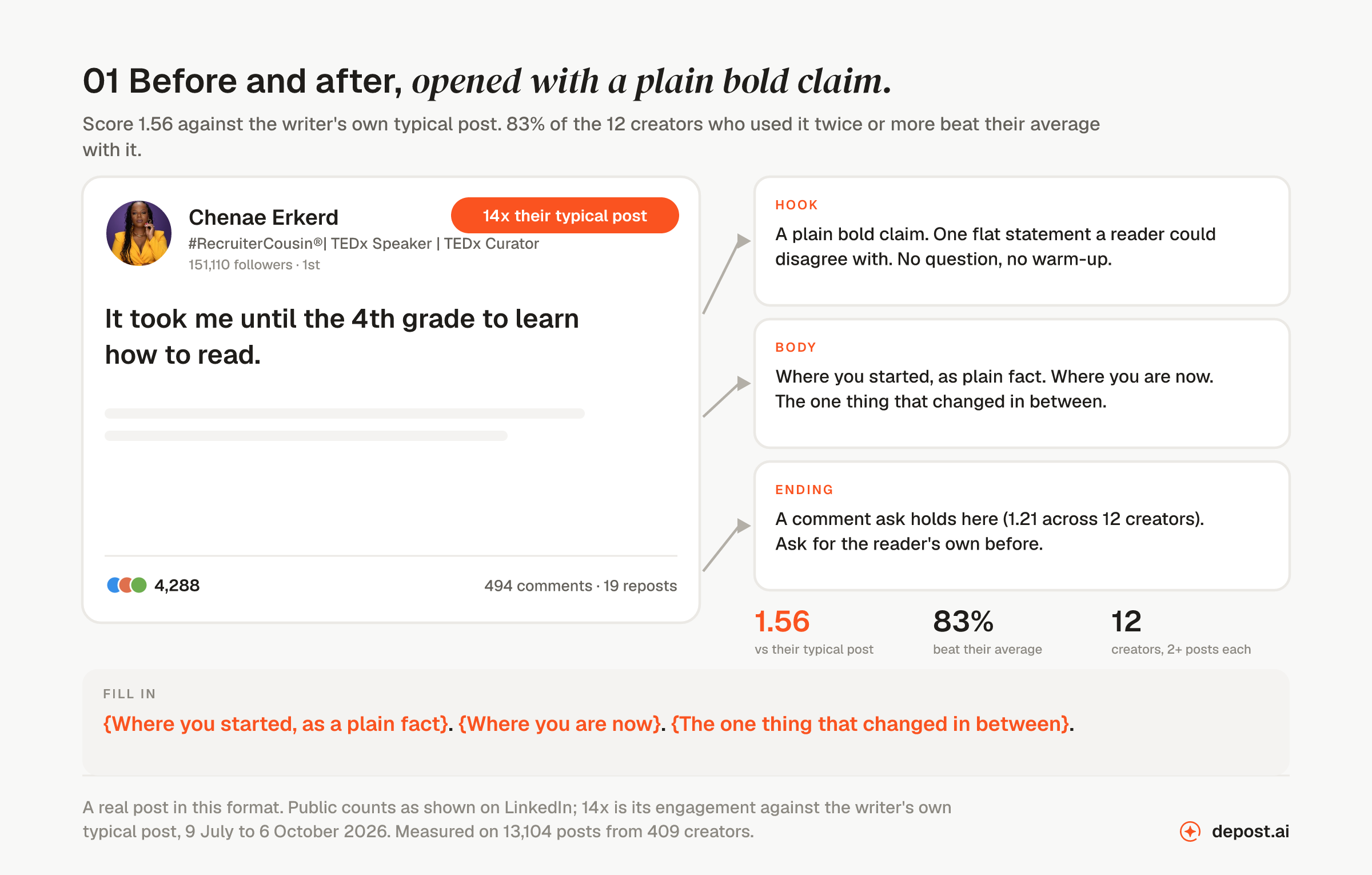
Seen working. Chenae Erkerd: “It took me until the 4th grade to learn how to read.” 4,288 reactions, 494 comments and 19 reposts, 14 times their typical post.
Why it works. The claim is the before, stated without softening, and the reader supplies the gap. Only 12 creators used it twice in three months, which is why it is still open.
What sinks it. Softening the before. “I didn’t start with much” is a claim; “things were tough” is not.
Image or text. As a single image it scores 1.20 (70% of 47 creators). The ending. A comment ask holds here (1.21 across 12 creators). Ask for the reader’s own before.
2. Vulnerable moment, opened with a plain bold claim
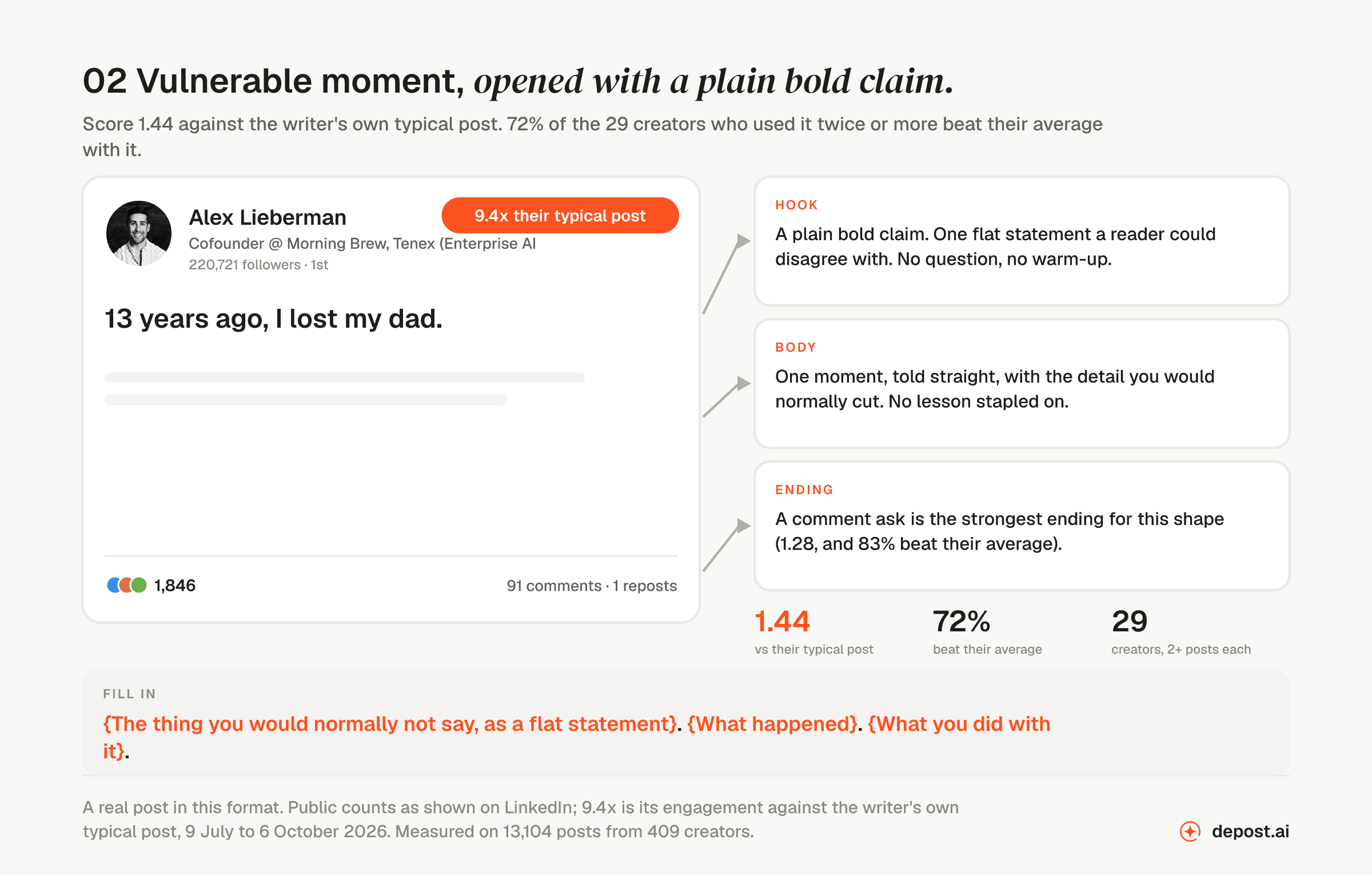
Seen working. Alex Lieberman: “13 years ago, I lost my dad.” 1,846 reactions, 91 comments and 1 reposts, 9.4 times their typical post.
Why it works. A plain statement of something hard, with no warm-up, reads as true because nobody writes it as a hook. 72% of 29 creators beat their own average with it.
What sinks it. Ending with a lesson. The moment is the post.
Image or text. As a single image it scores 1.19 (78% of 50 creators). The ending. A comment ask is the strongest ending for this shape (1.28, and 83% beat their average).
3. Personal milestone, opened with a plain bold claim
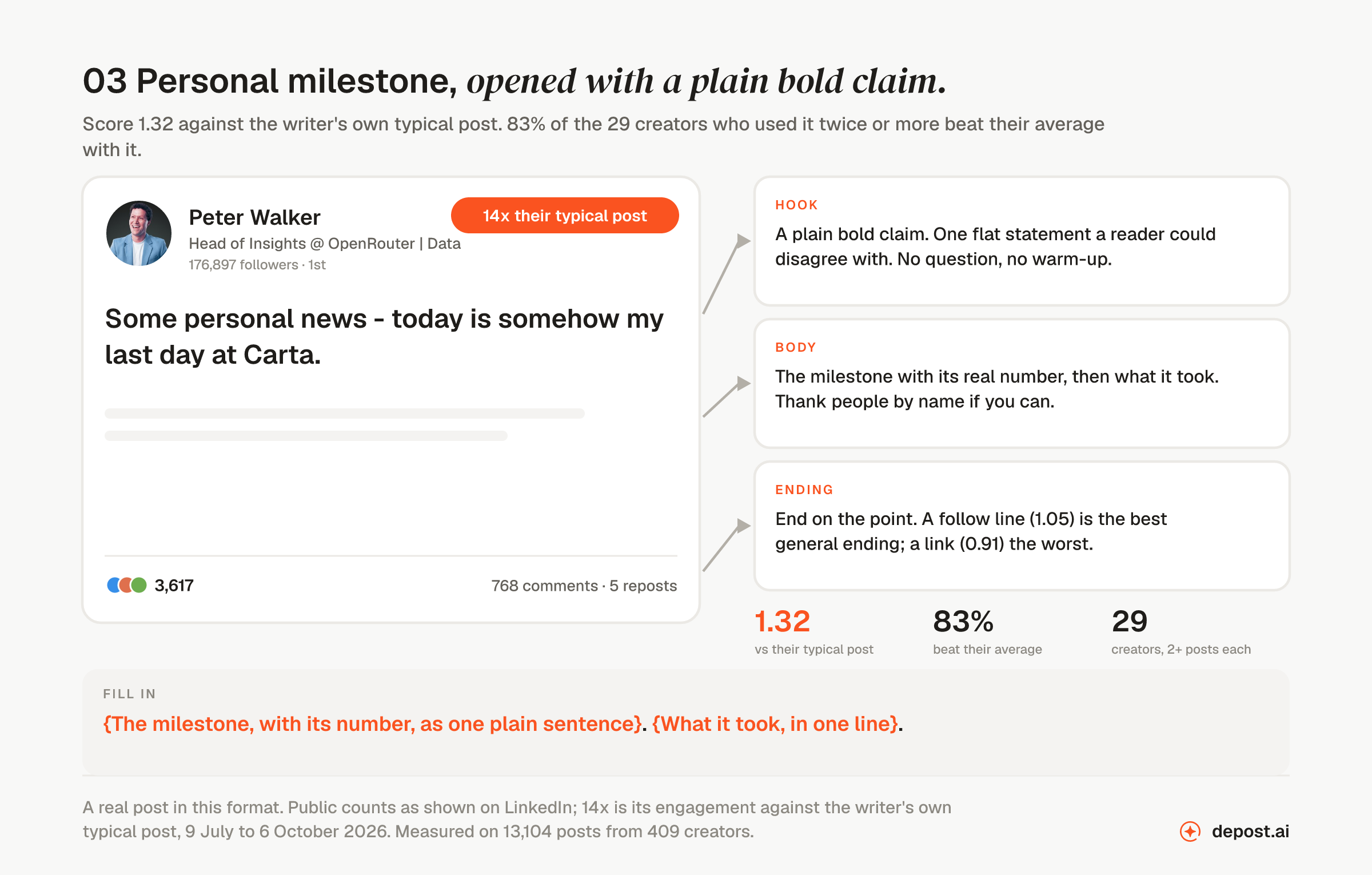
Seen working. Peter Walker: “Some personal news - today is somehow my last day at Carta.” 3,617 reactions, 768 comments and 5 reposts, 14 times their typical post.
Why it works. The milestone is the shape people who sell underrate. 83% of the 29 creators who opened one with a plain claim beat their own typical post.
What sinks it. Leaving out the number, or thanking nobody.
Image or text. As a single image it scores 1.26 (69% of 68 creators). The ending. End on the point. A follow line (1.05) is the best general ending; a link (0.91) the worst.
4. Mindset post, opened with the pain, then the promise
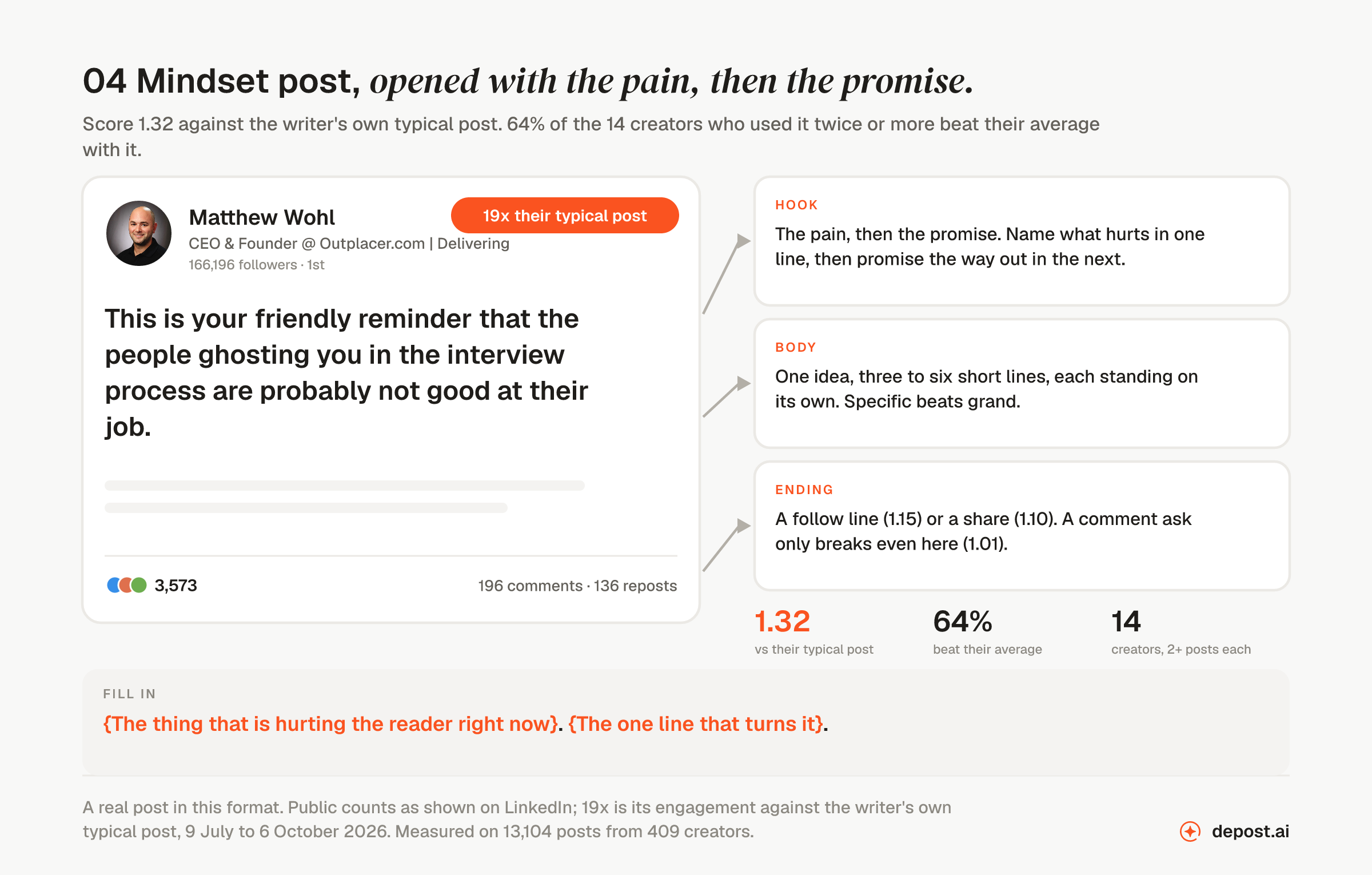
Seen working. Matthew Wohl: “This is your friendly reminder that the people ghosting you in the interview process are probably not good at their job.” 3,573 reactions, 196 comments and 136 reposts, 19 times their typical post.
Why it works. The pain line earns the second line. On its own this opener is average (1.00); inside a mindset post it is one of the four best formats in the set.
What sinks it. Being general. “Keep going” is the average post; “the first month looks ordinary” is the one that wins.
Image or text. As a single image it scores 1.09 (60% of 133 creators). As video it scores 0.99 (42% of 26 creators). As text only it scores 0.90 (41% of 17 creators). The ending. A follow line (1.15) or a share (1.10). A comment ask only breaks even here (1.01).
5. How-to, opened with a how-to line
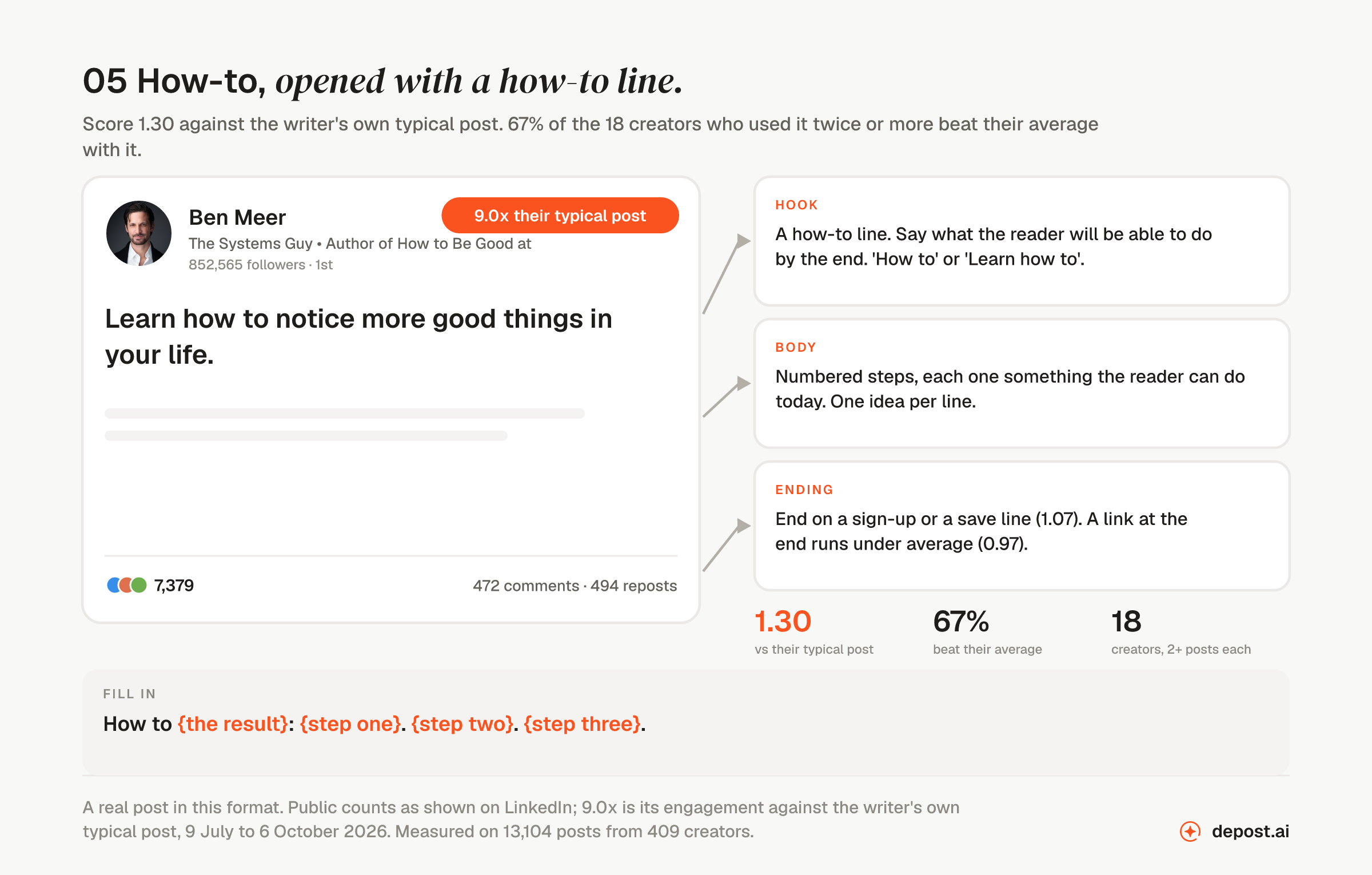
Seen working. Ben Meer: “Learn how to notice more good things in your life.” 7,379 reactions, 472 comments and 494 reposts, 9.0 times their typical post.
Why it works. A how-to post breaks even across the library (1.00). Opened with a how-to line it rises to 1.30, because the first line promises exactly what the body delivers.
What sinks it. Ending with a link (0.97) or opening with a question (0.89).
Image or text. As a single image it scores 1.04 (58% of 158 creators). As video it scores 1.01 (55% of 31 creators). As text only it scores 0.98 (48% of 21 creators). As a carousel it scores 0.79 (36% of 14 creators). The ending. End on a sign-up or a save line (1.07). A link at the end runs under average (0.97).
6. Diary entry, opened with a plain bold claim
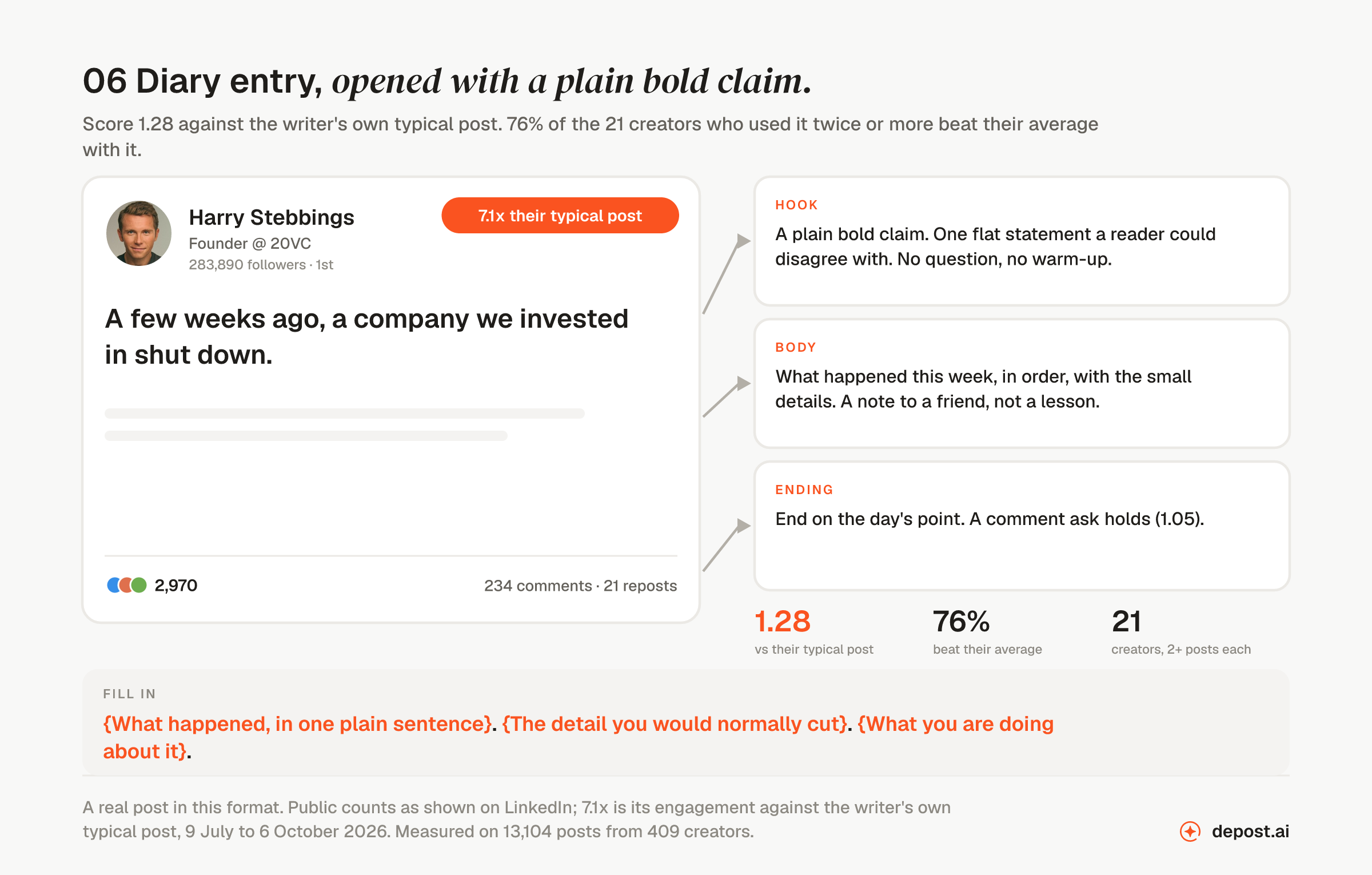
Seen working. Harry Stebbings: “A few weeks ago, a company we invested in shut down.” 2,970 reactions, 234 comments and 21 reposts, 7.1 times their typical post.
Why it works. A diary entry reads as a record, not a lesson, and the plain opener keeps it that way. 76% of 21 creators beat their average.
What sinks it. Turning it into advice halfway through.
Image or text. As a single image it scores 1.09 (68% of 59 creators). The ending. End on the day’s point. A comment ask holds (1.05).
7. Tools and resources, opened with a number
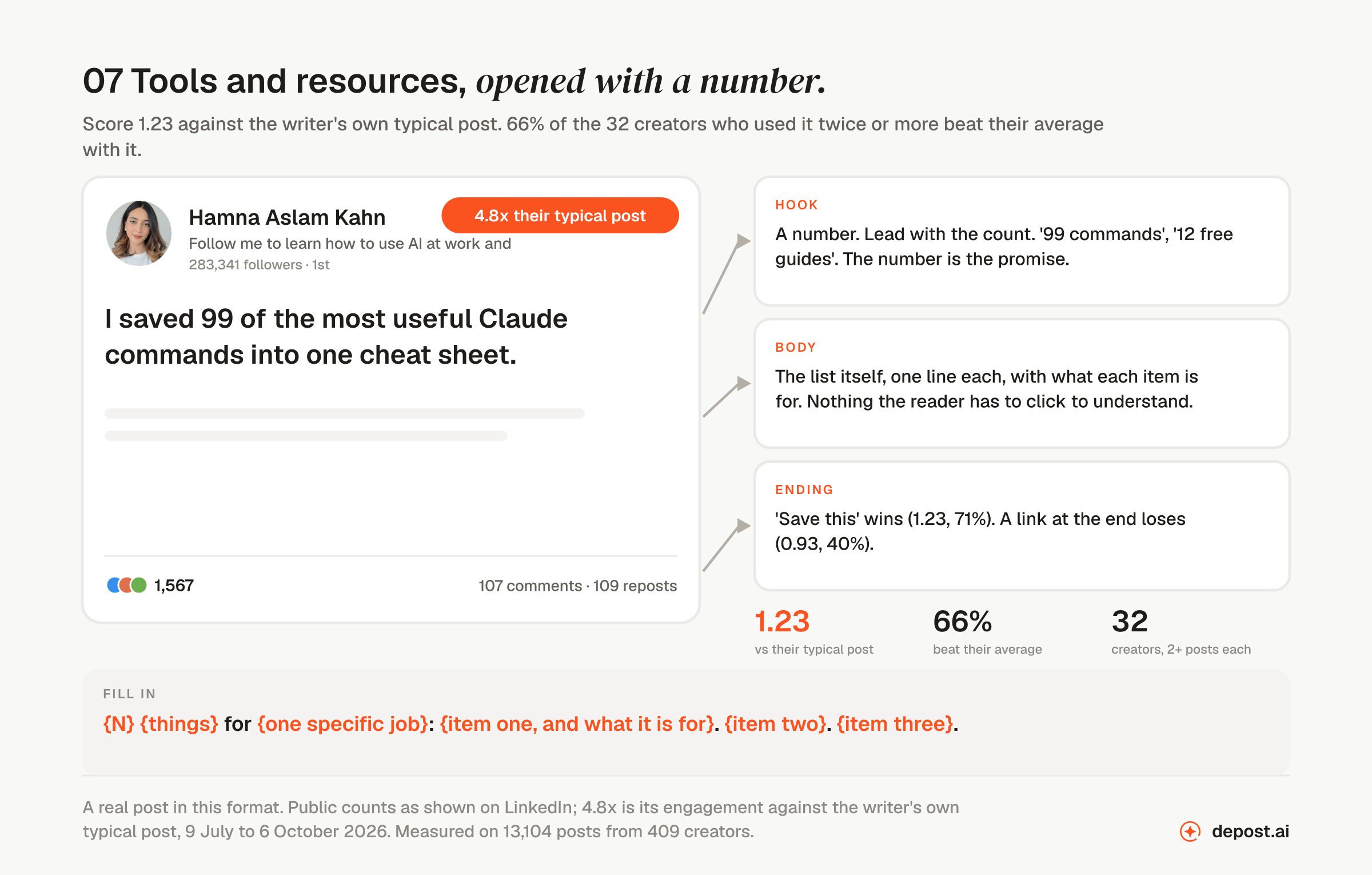
Seen working. Hamna Aslam Kahn: “I saved 99 of the most useful Claude commands into one cheat sheet.” 1,567 reactions, 107 comments and 109 reposts, 4.8 times their typical post.
Why it works. The number is the promise and the list keeps it. Open the same list with a claim instead and it drops under average (0.99).
What sinks it. A list the reader has to click to understand, and a link at the end (0.93).
Image or text. As a single image it scores 1.04 (61% of 87 creators). As video it scores 0.96 (41% of 44 creators). The ending. ‘Save this’ wins (1.23, 71%). A link at the end loses (0.93, 40%).
8. Leadership thought, opened with a plain bold claim
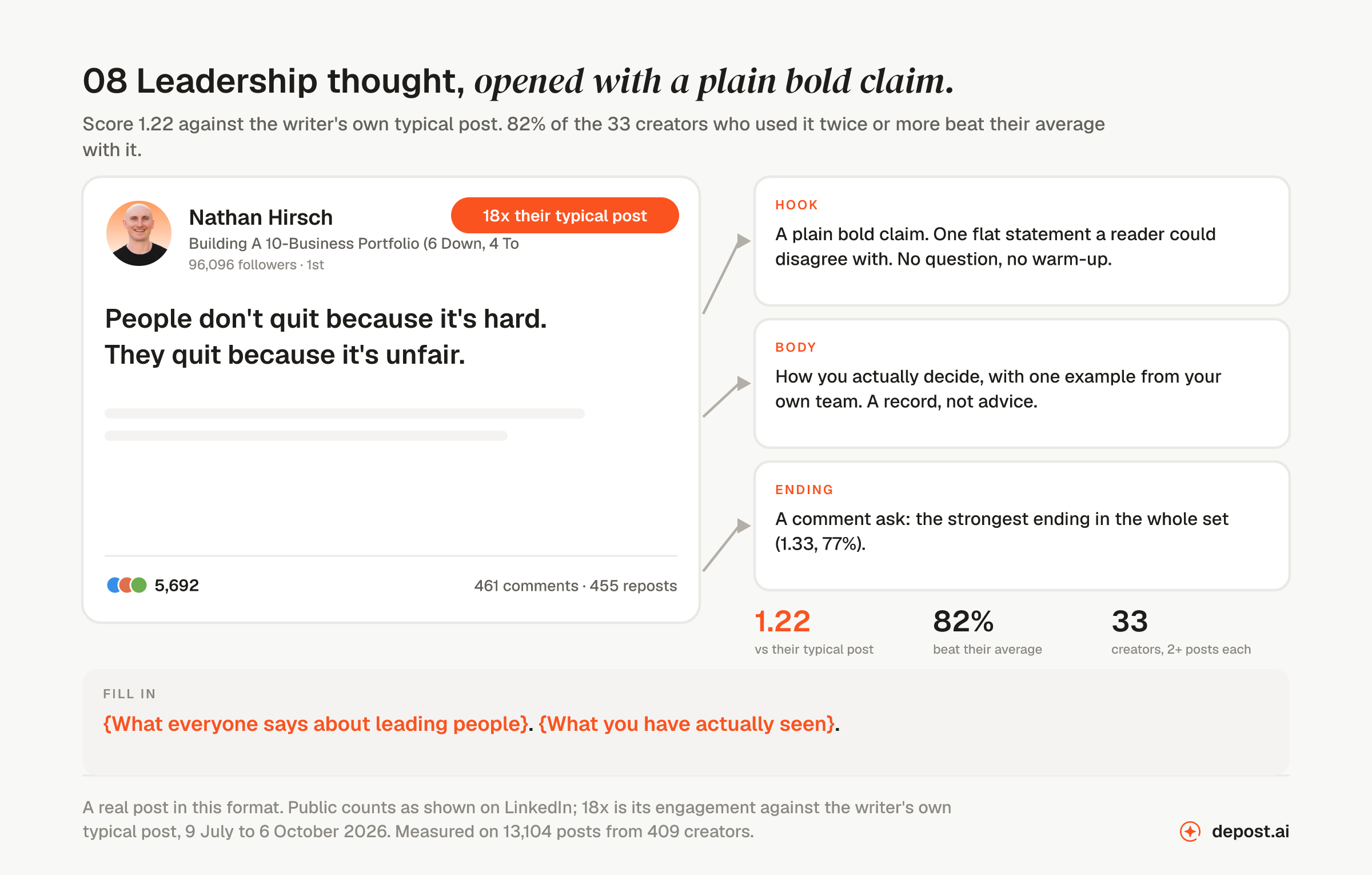
Seen working. Nathan Hirsch: “People don’t quit because it’s hard. They quit because it’s unfair.” 5,692 reactions, 461 comments and 455 reposts, 18 times their typical post.
Why it works. 82% of 33 creators beat their own average with it, and as a single image it is the strongest shape-and-format pair in the whole test (1.31).
What sinks it. Advice instead of a record. The posts that win describe a decision, not a principle.
Image or text. As a single image it scores 1.31 (86% of 37 creators). The ending. A comment ask: the strongest ending in the whole set (1.33, 77%).
9. Before and after, opened with a transformation
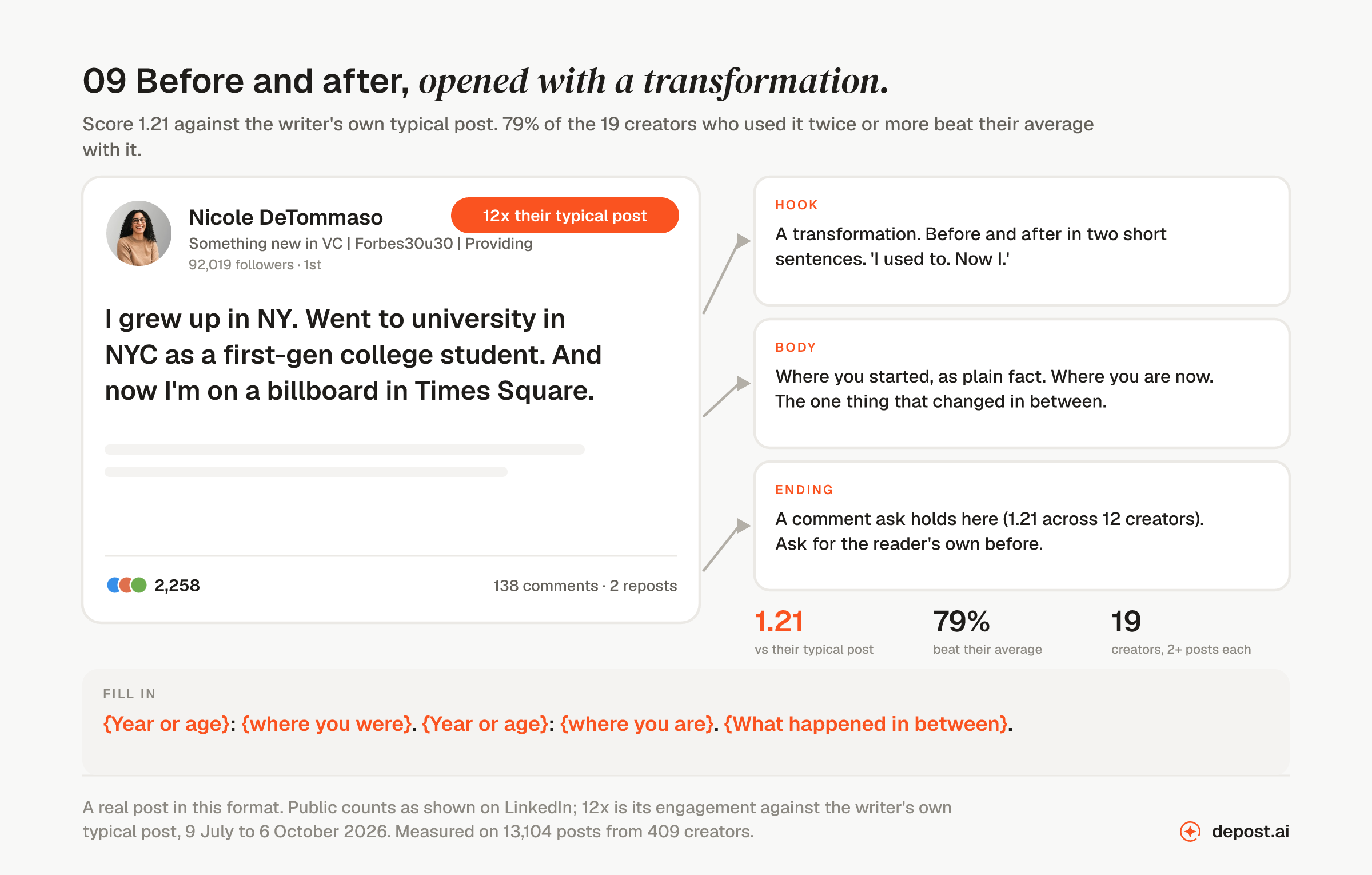
Seen working. Nicole DeTommaso: “I grew up in NY. Went to university in NYC as a first-gen college student. And now I’m on a billboard in Times Square.” 2,258 reactions, 138 comments and 2 reposts, 12 times their typical post.
Why it works. The transformation opener is average everywhere else (1.00). On a before-and-after it fits the shape exactly, and 79% of 19 creators beat their average.
What sinks it. Softening the before. “I didn’t start with much” is a claim; “things were tough” is not.
Image or text. As a single image it scores 1.20 (70% of 47 creators). The ending. A comment ask holds here (1.21 across 12 creators). Ask for the reader’s own before.
10. Contrarian opinion, opened with a contrarian line
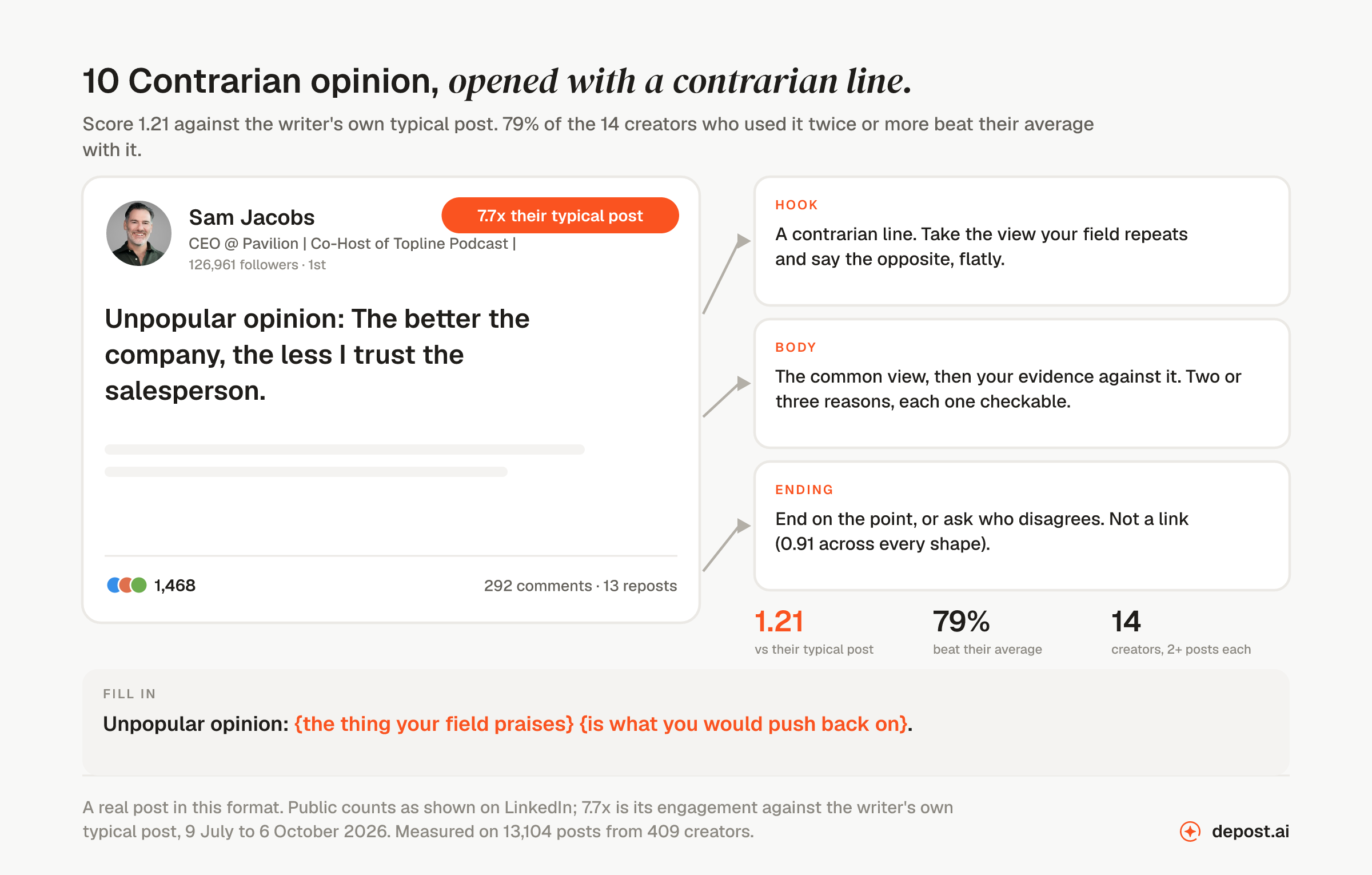
Seen working. Sam Jacobs: “Unpopular opinion: The better the company, the less I trust the salesperson.” 1,468 reactions, 292 comments and 13 reposts, 7.7 times their typical post.
Why it works. The opener names the fight and the body has to win it. 79% of 14 creators beat their average; the same shape opened with a plain claim only reaches 1.05.
What sinks it. A contrarian line on an ordinary body. The opener writes a cheque the evidence has to cash.
Image or text. As a single image it scores 1.12 (62% of 26 creators). As text only it scores 1.11 (60% of 15 creators). The ending. End on the point, or ask who disagrees. Not a link (0.91 across every shape).
11. Mindset post, opened with an order
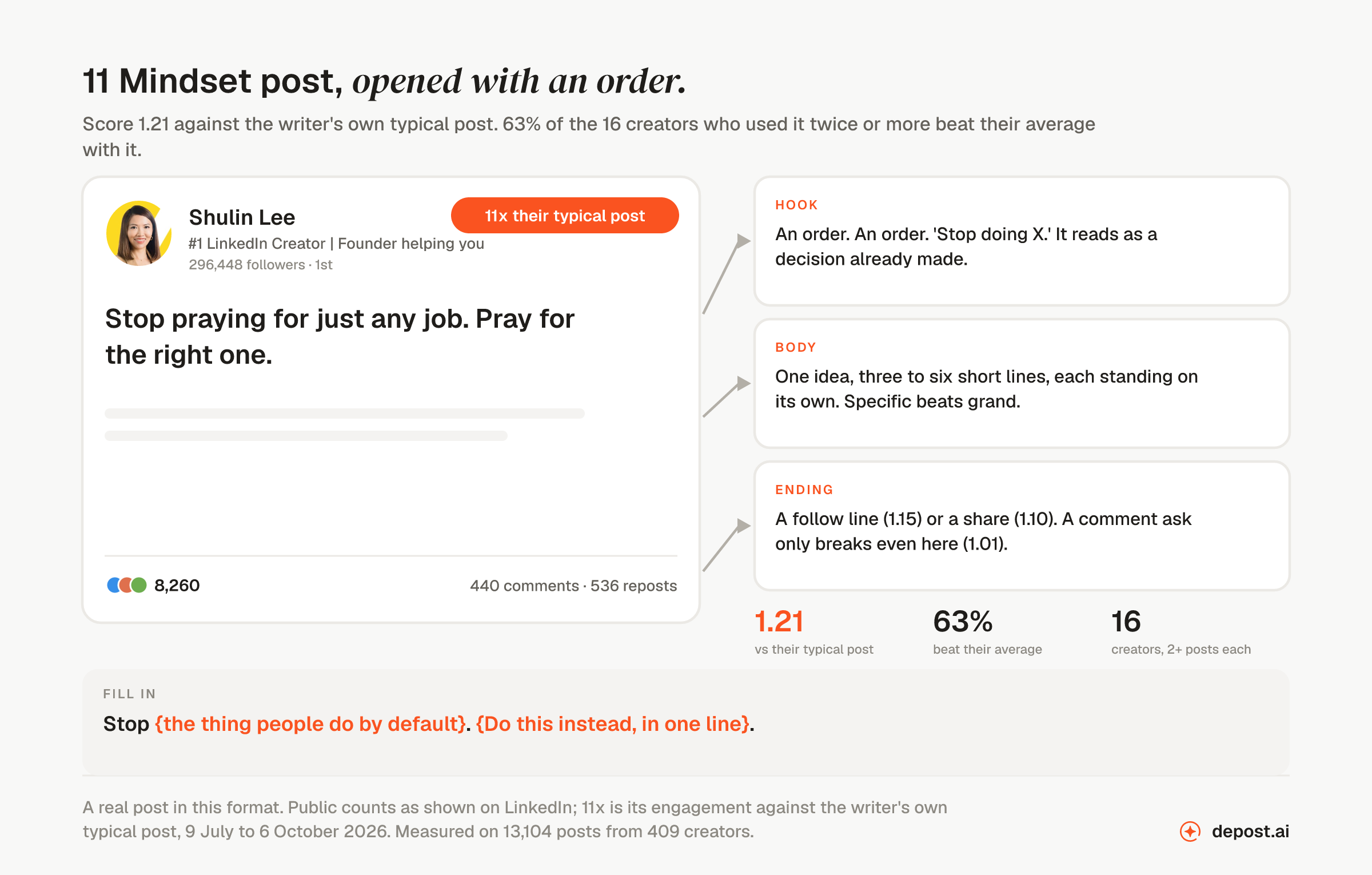
Seen working. Shulin Lee: “Stop praying for just any job. Pray for the right one.” 8,260 reactions, 440 comments and 536 reposts, 11 times their typical post.
Why it works. An order reads as a decision already made. Across every shape the order is the joint strongest opener (1.11); on a mindset post it reaches 1.21.
What sinks it. Being general. “Keep going” is the average post; “the first month looks ordinary” is the one that wins.
Image or text. As a single image it scores 1.09 (60% of 133 creators). As video it scores 0.99 (42% of 26 creators). As text only it scores 0.90 (41% of 17 creators). The ending. A follow line (1.15) or a share (1.10). A comment ask only breaks even here (1.01).
12. Personal milestone, opened with a curiosity gap
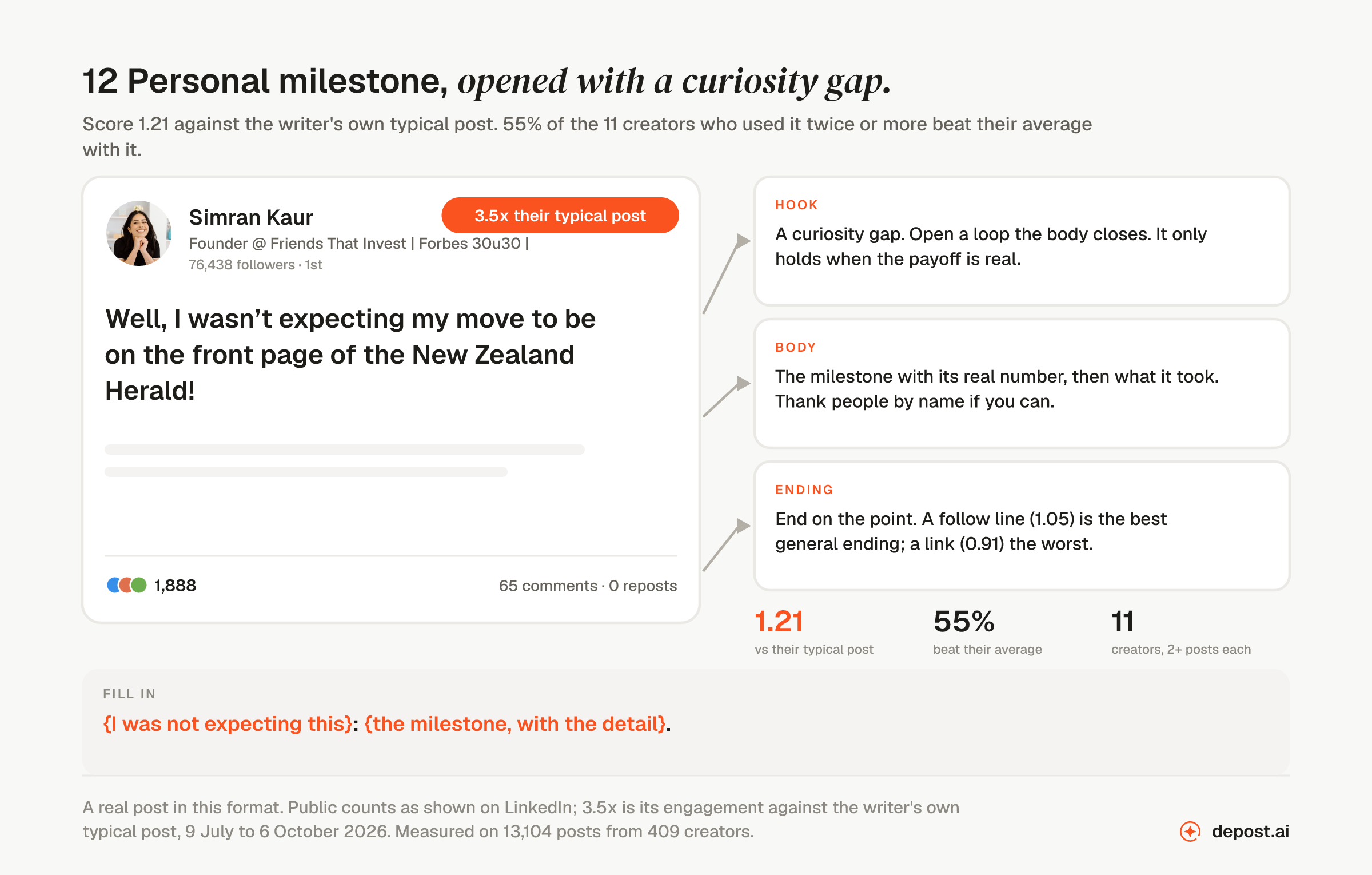
Seen working. Simran Kaur: “Well, I wasn’t expecting my move to be on the front page of the New Zealand Herald!” 1,888 reactions, 65 comments and 0 reposts, 3.5 times their typical post.
Why it works. The gap works here because the payoff is real and immediate. The same opener on a how-to runs under average (0.92).
What sinks it. Leaving out the number, or thanking nobody.
Image or text. As a single image it scores 1.26 (69% of 68 creators). The ending. End on the point. A follow line (1.05) is the best general ending; a link (0.91) the worst.
Tier two: 1.08 to 1.19
Five formats. Two of them are how-to posts rescued by their first line, and one is the most common winning format in the library.
13. Hot take, opened with a plain bold claim
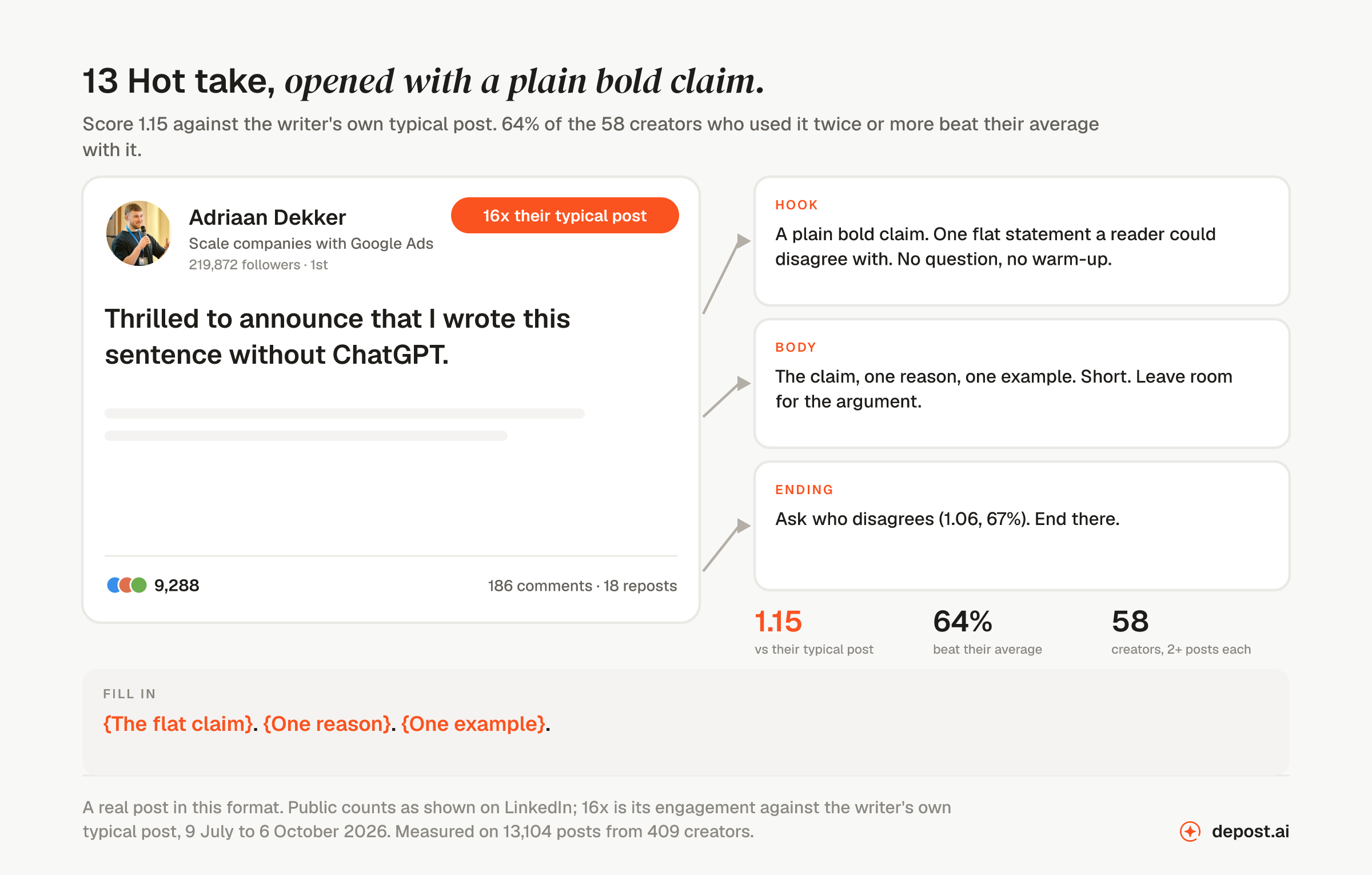
Seen working. Adriaan Dekker: “Thrilled to announce that I wrote this sentence without ChatGPT.” 9,288 reactions, 186 comments and 18 reposts, 16 times their typical post.
Why it works. The second most used winning pair in the set: 58 creators, 64% of them above their own average. Short, arguable, no setup.
What sinks it. Explaining too much. This format wins short.
Image or text. As text only it scores 1.20 (76% of 21 creators). As a single image it scores 1.18 (68% of 56 creators). The ending. Ask who disagrees (1.06, 67%). End there.
14. How-to, opened with the pain, then the promise
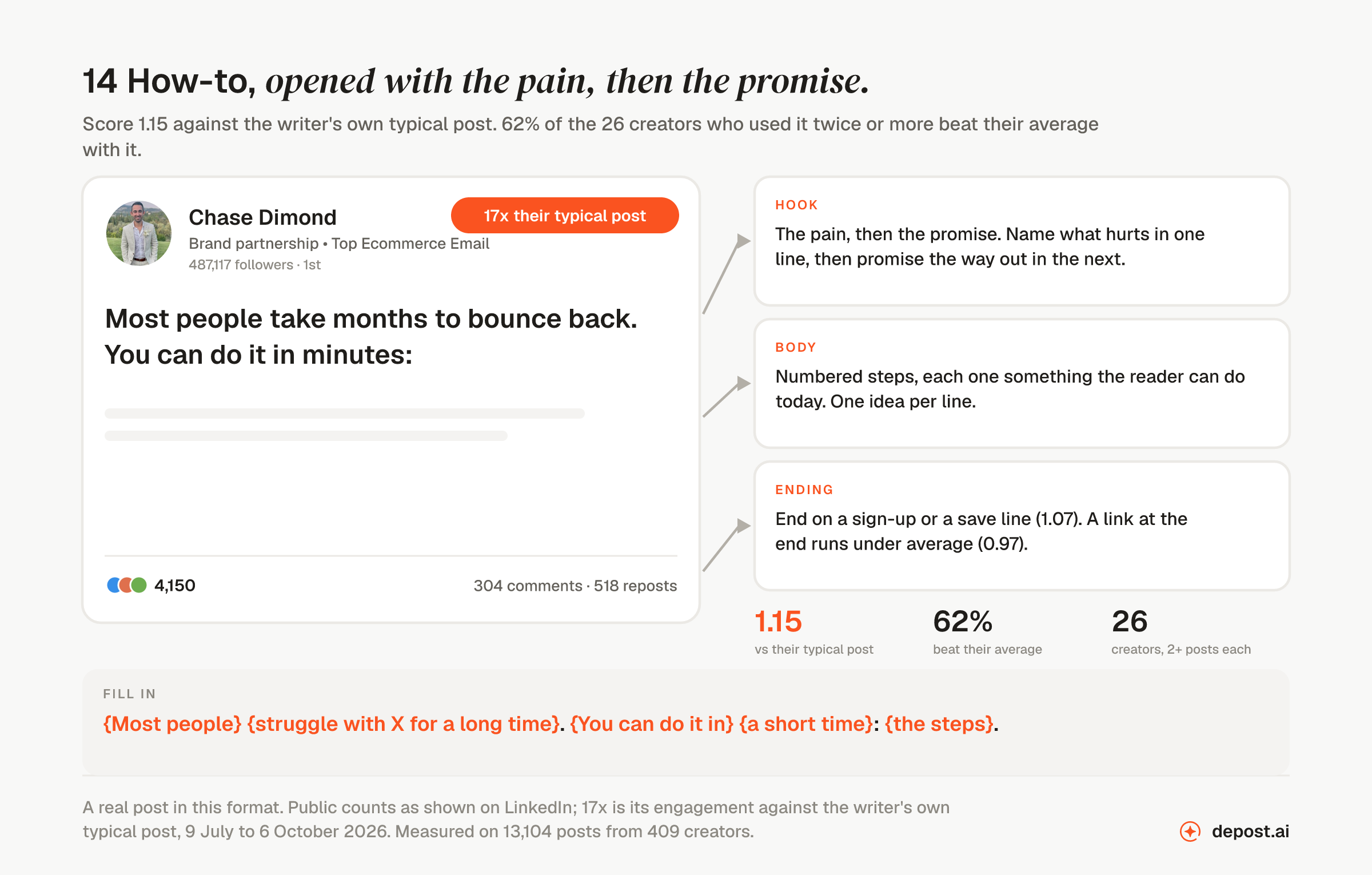
Seen working. Chase Dimond: “Most people take months to bounce back. You can do it in minutes:” 4,150 reactions, 304 comments and 518 reposts, 17 times their typical post.
Why it works. Pain-then-promise is the most taught opener and only average on its own. In front of real steps it earns 1.15 for 62% of 26 creators.
What sinks it. Ending with a link (0.97) or opening with a question (0.89).
Image or text. As a single image it scores 1.04 (58% of 158 creators). As video it scores 1.01 (55% of 31 creators). As text only it scores 0.98 (48% of 21 creators). As a carousel it scores 0.79 (36% of 14 creators). The ending. End on a sign-up or a save line (1.07). A link at the end runs under average (0.97).
15. How-to, opened with a contrarian line
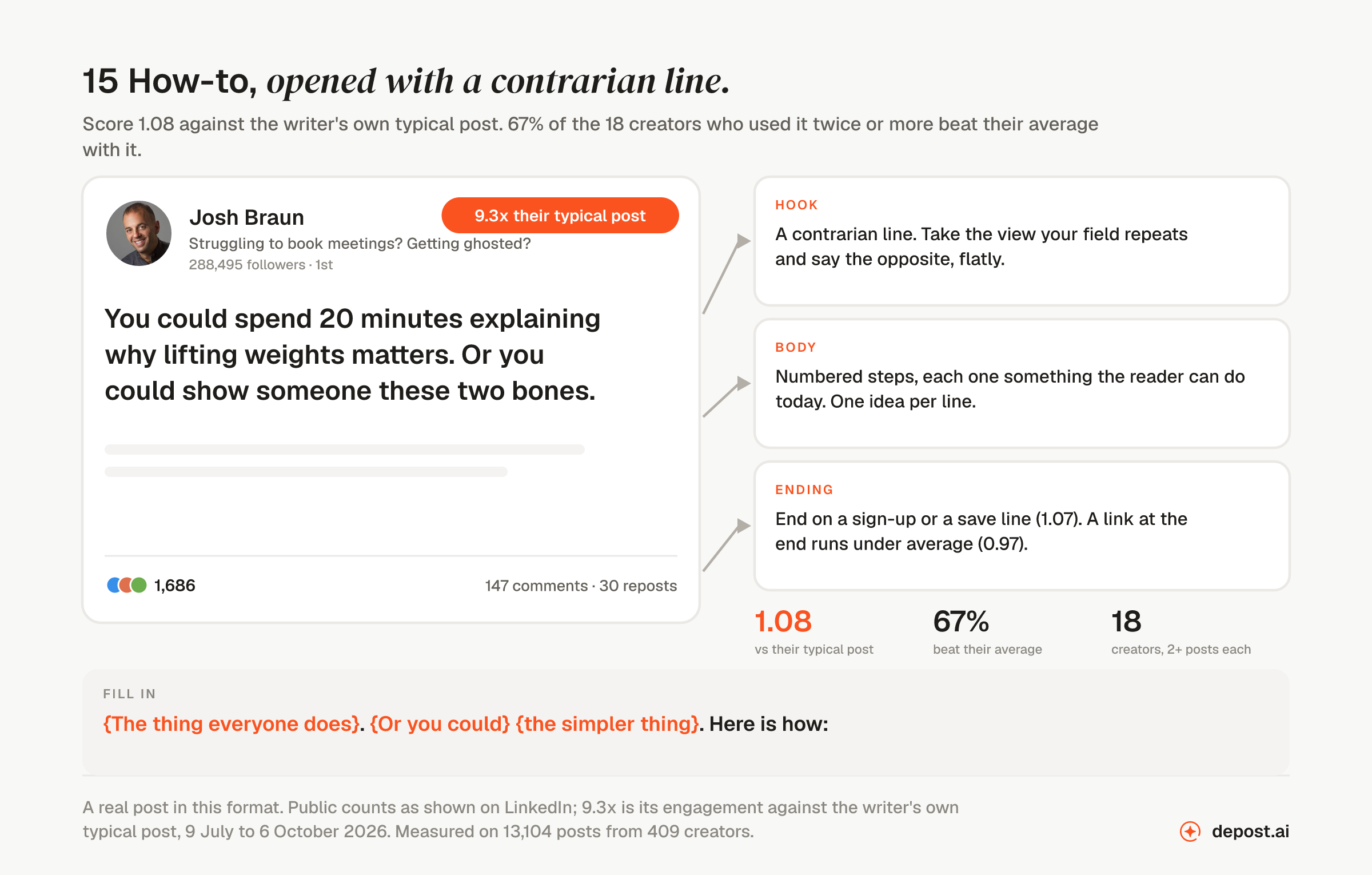
Seen working. Josh Braun: “You could spend 20 minutes explaining why lifting weights matters. Or you could show someone these two bones.” 1,686 reactions, 147 comments and 30 reposts, 9.3 times their typical post.
Why it works. The contrarian line gives a how-to the one thing it usually lacks, a reason to keep reading. 67% of 18 creators beat their average.
What sinks it. Ending with a link (0.97) or opening with a question (0.89).
Image or text. As a single image it scores 1.04 (58% of 158 creators). As video it scores 1.01 (55% of 31 creators). As text only it scores 0.98 (48% of 21 creators). As a carousel it scores 0.79 (36% of 14 creators). The ending. End on a sign-up or a save line (1.07). A link at the end runs under average (0.97).
16. Mindset post, opened with a plain bold claim
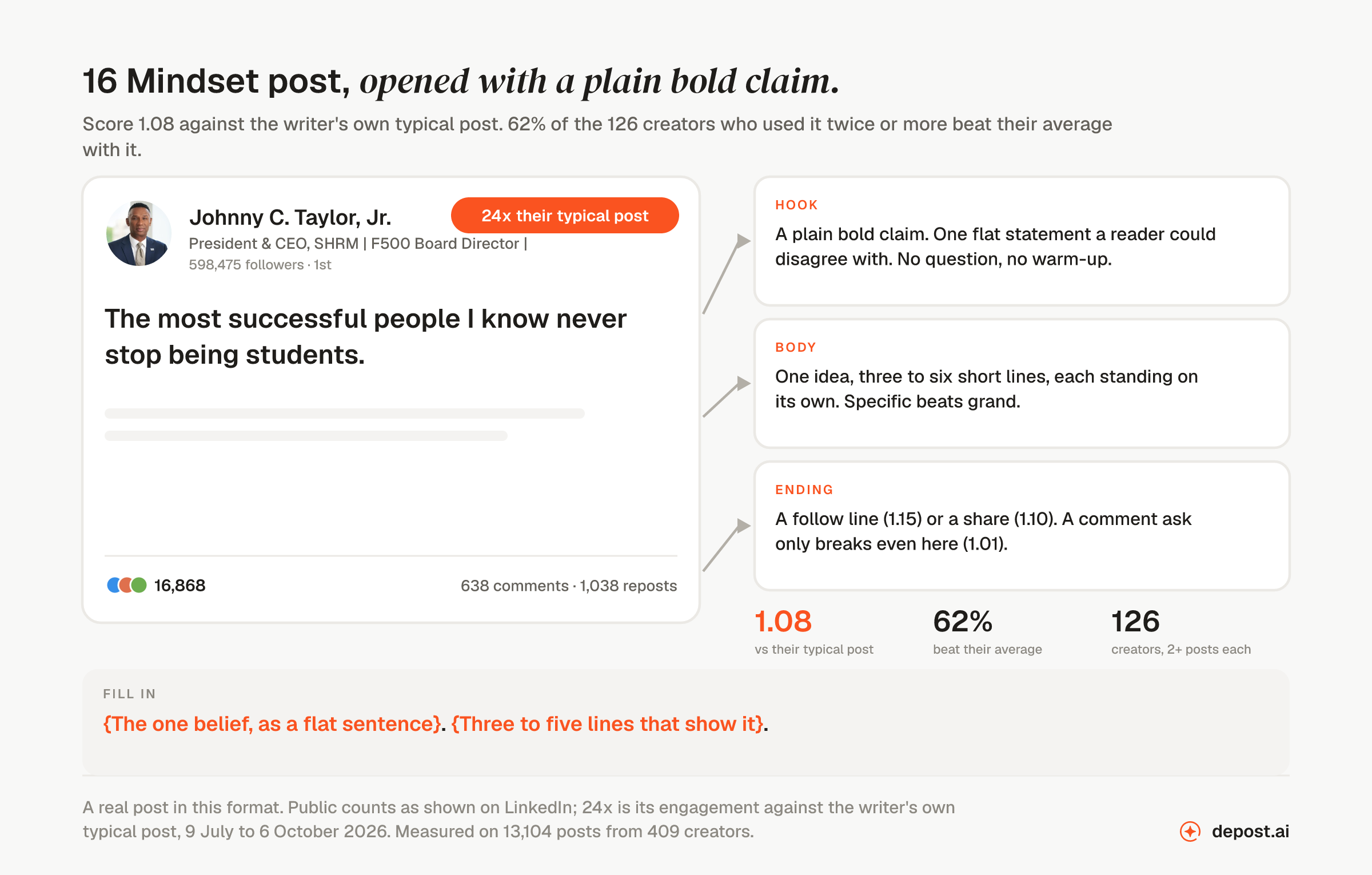
Seen working. Johnny C. Taylor: “The most successful people I know never stop being students.” 16,868 reactions, 638 comments and 1,038 reposts, 24 times their typical post.
Why it works. The most common winning format in the library: 126 creators, 62% of them above their own average. Average when the claim is vague, strong when it is specific.
What sinks it. Being general. “Keep going” is the average post; “the first month looks ordinary” is the one that wins.
Image or text. As a single image it scores 1.09 (60% of 133 creators). As video it scores 0.99 (42% of 26 creators). As text only it scores 0.90 (41% of 17 creators). The ending. A follow line (1.15) or a share (1.10). A comment ask only breaks even here (1.01).
17. Mindset post, opened with a transformation
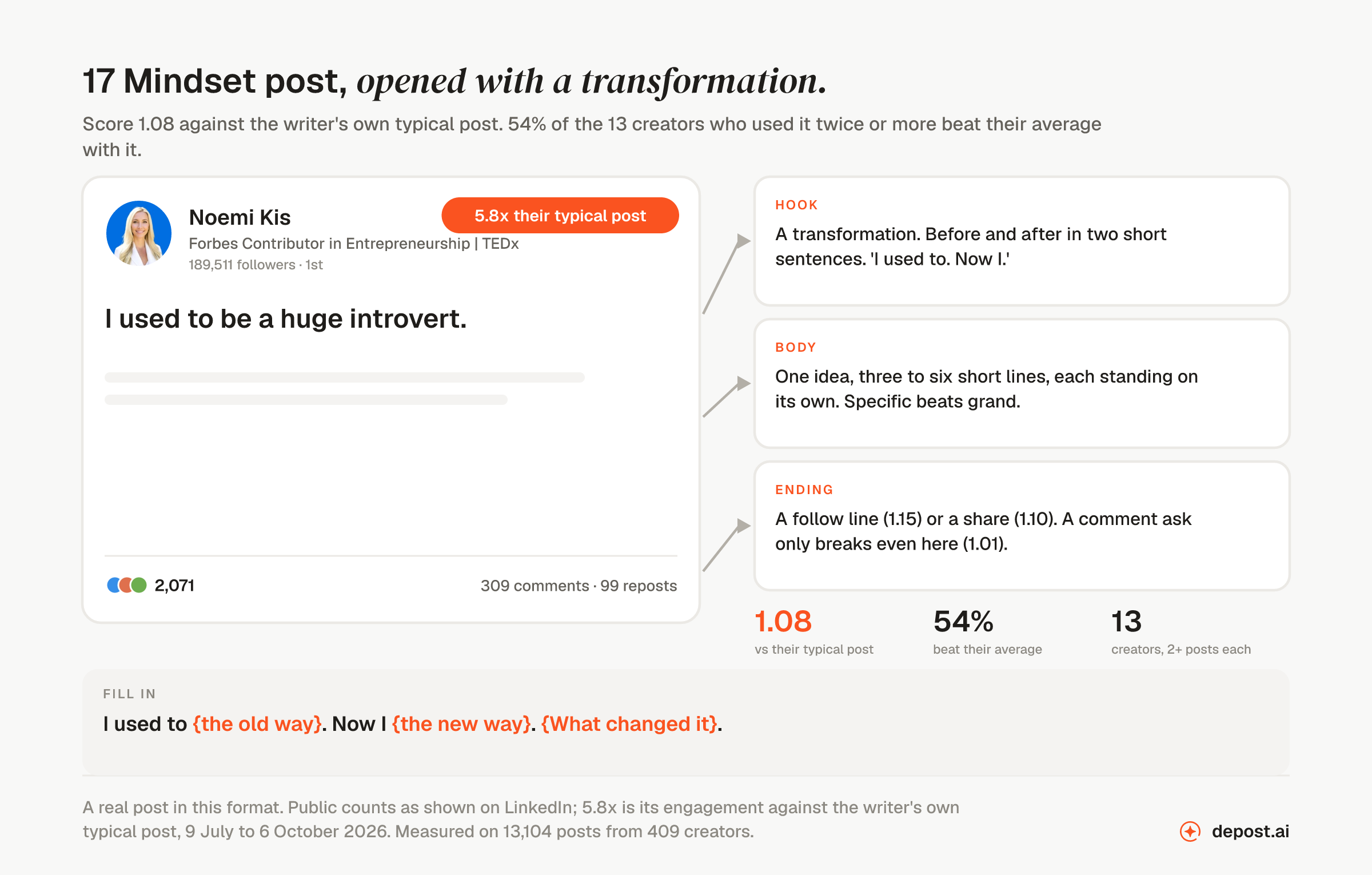
Seen working. Noemi Kis: “I used to be a huge introvert.” 2,071 reactions, 309 comments and 99 reposts, 5.8 times their typical post.
Why it works. Transformation is average on its own (1.00). On a mindset post it earns 1.08, because the before and after is the whole argument.
What sinks it. Being general. “Keep going” is the average post; “the first month looks ordinary” is the one that wins.
Image or text. As a single image it scores 1.09 (60% of 133 creators). As video it scores 0.99 (42% of 26 creators). As text only it scores 0.90 (41% of 17 creators). The ending. A follow line (1.15) or a share (1.10). A comment ask only breaks even here (1.01).
Tier three: 1.00 to 1.07
Thirteen formats that clear the writer’s typical post by a little. Worth writing when the material fits; not worth forcing.
18. Data-backed insight, opened with a plain bold claim
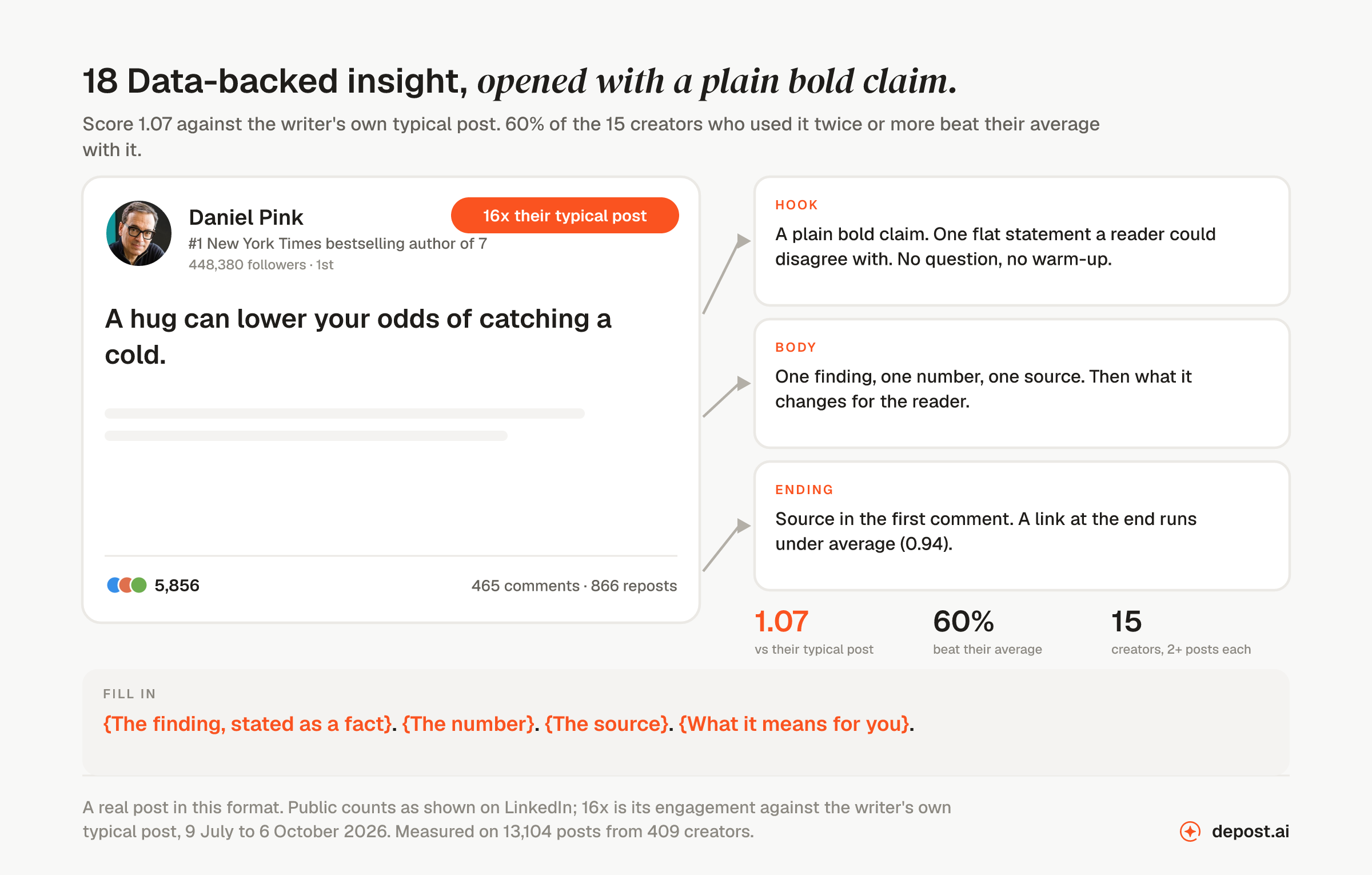
Seen working. Daniel Pink: “A hug can lower your odds of catching a cold.” 5,856 reactions, 465 comments and 866 reposts, 16 times their typical post.
Why it works. A data post from someone who sells usually reads as a pitch (0.97 for the shape). Opened with the finding as a plain sentence, not a statistic, it rises to 1.07.
What sinks it. Opening with the statistic (0.94). State the finding as a sentence; the number comes second.
Image or text. As a single image it scores 1.01 (52% of 27 creators). The ending. Source in the first comment. A link at the end runs under average (0.94).
19. Tools and resources, opened with the pain, then the promise
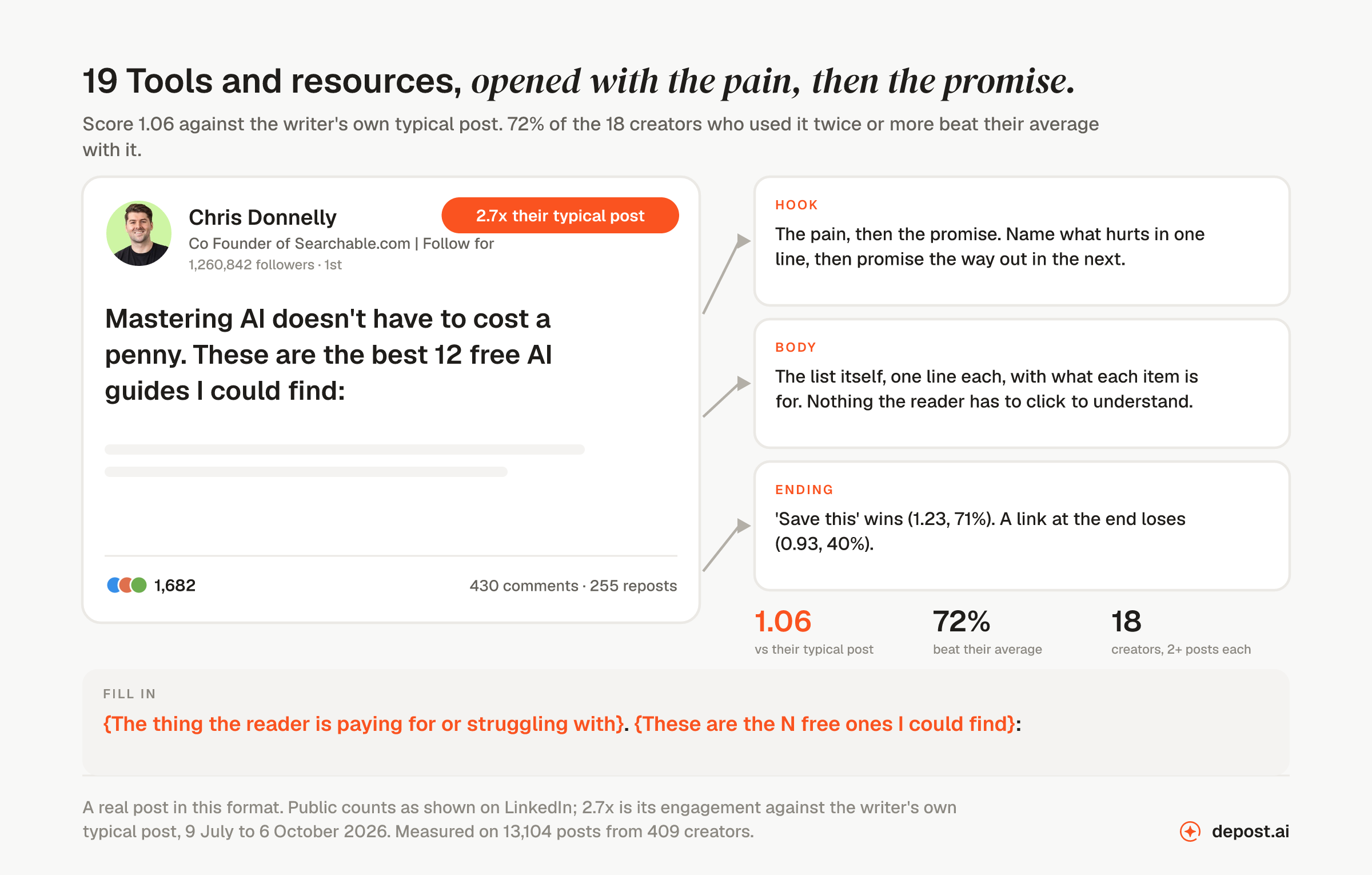
Seen working. Chris Donnelly: “Mastering AI doesn’t have to cost a penny. These are the best 12 free AI guides I could find:” 1,682 reactions, 430 comments and 255 reposts, 2.7 times their typical post.
Why it works. 72% of 18 creators beat their average with it. The pain line says why the list exists; the list does the rest.
What sinks it. A list the reader has to click to understand, and a link at the end (0.93).
Image or text. As a single image it scores 1.04 (61% of 87 creators). As video it scores 0.96 (41% of 44 creators). The ending. ‘Save this’ wins (1.23, 71%). A link at the end loses (0.93, 40%).
20. Contrarian opinion, opened with a plain bold claim
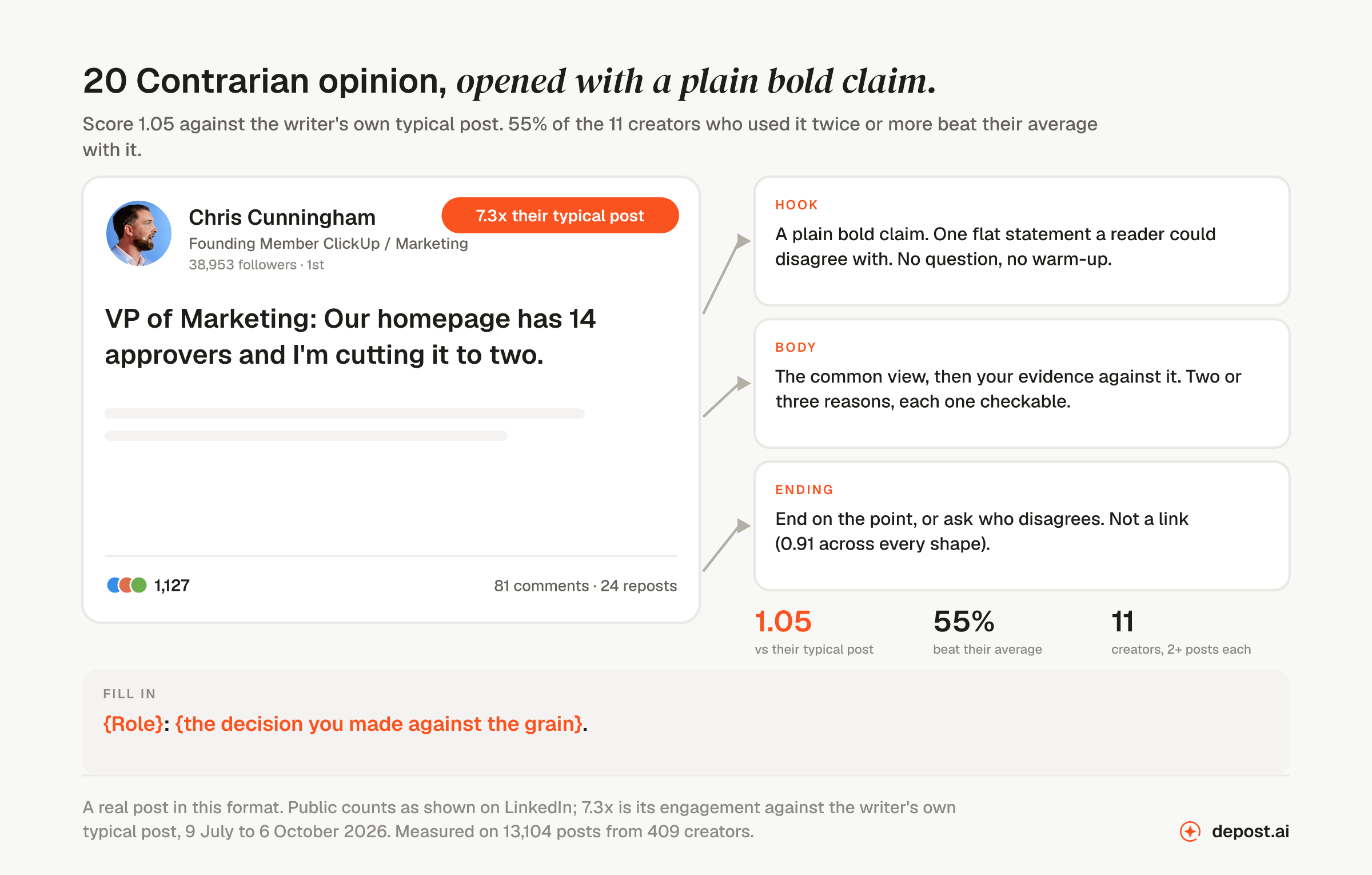
Seen working. Chris Cunningham: “VP of Marketing: Our homepage has 14 approvers and I’m cutting it to two.” 1,127 reactions, 81 comments and 24 reposts, 7.2 times their typical post.
Why it works. A contrarian opinion stated as a plain fact, with the reasoning in the body. 55% of 11 creators beat their average; the explicit contrarian opener does better (1.21).
What sinks it. A contrarian line on an ordinary body. The opener writes a cheque the evidence has to cash.
Image or text. As a single image it scores 1.12 (62% of 26 creators). As text only it scores 1.11 (60% of 15 creators). The ending. End on the point, or ask who disagrees. Not a link (0.91 across every shape).
21. Framework, opened with a plain bold claim
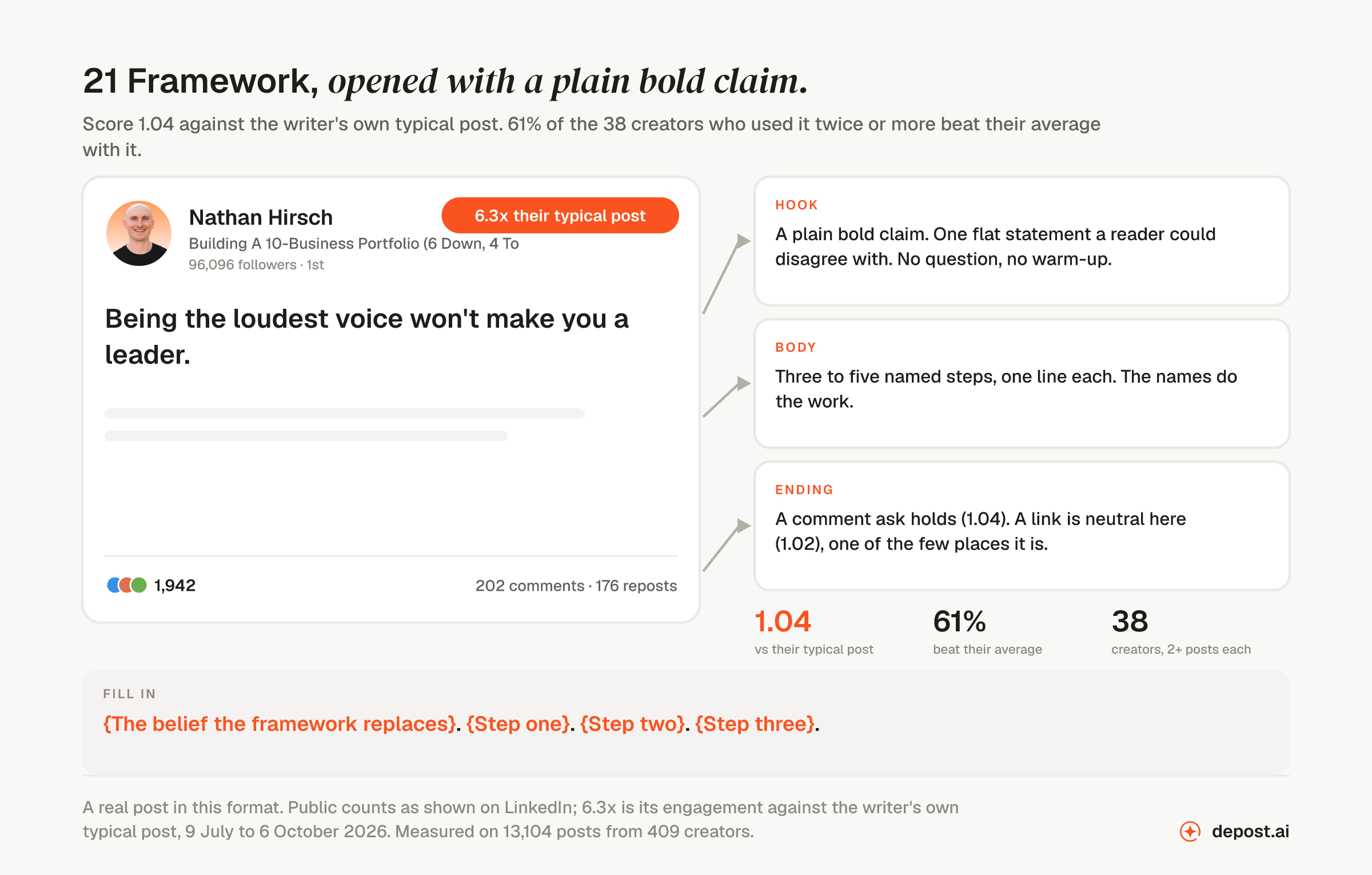
Seen working. Nathan Hirsch: “Being the loudest voice won’t make you a leader.” 1,942 reactions, 202 comments and 176 reposts, 6.2 times their typical post.
Why it works. Frameworks break even across the library (0.99). Opened with a claim rather than a name, they rise to 1.04 for 61% of 38 creators.
What sinks it. Naming the framework before earning it.
Image or text. As a single image it scores 0.99 (49% of 65 creators). The ending. A comment ask holds (1.04). A link is neutral here (1.02), one of the few places it is.
22. Case study, opened with a plain bold claim
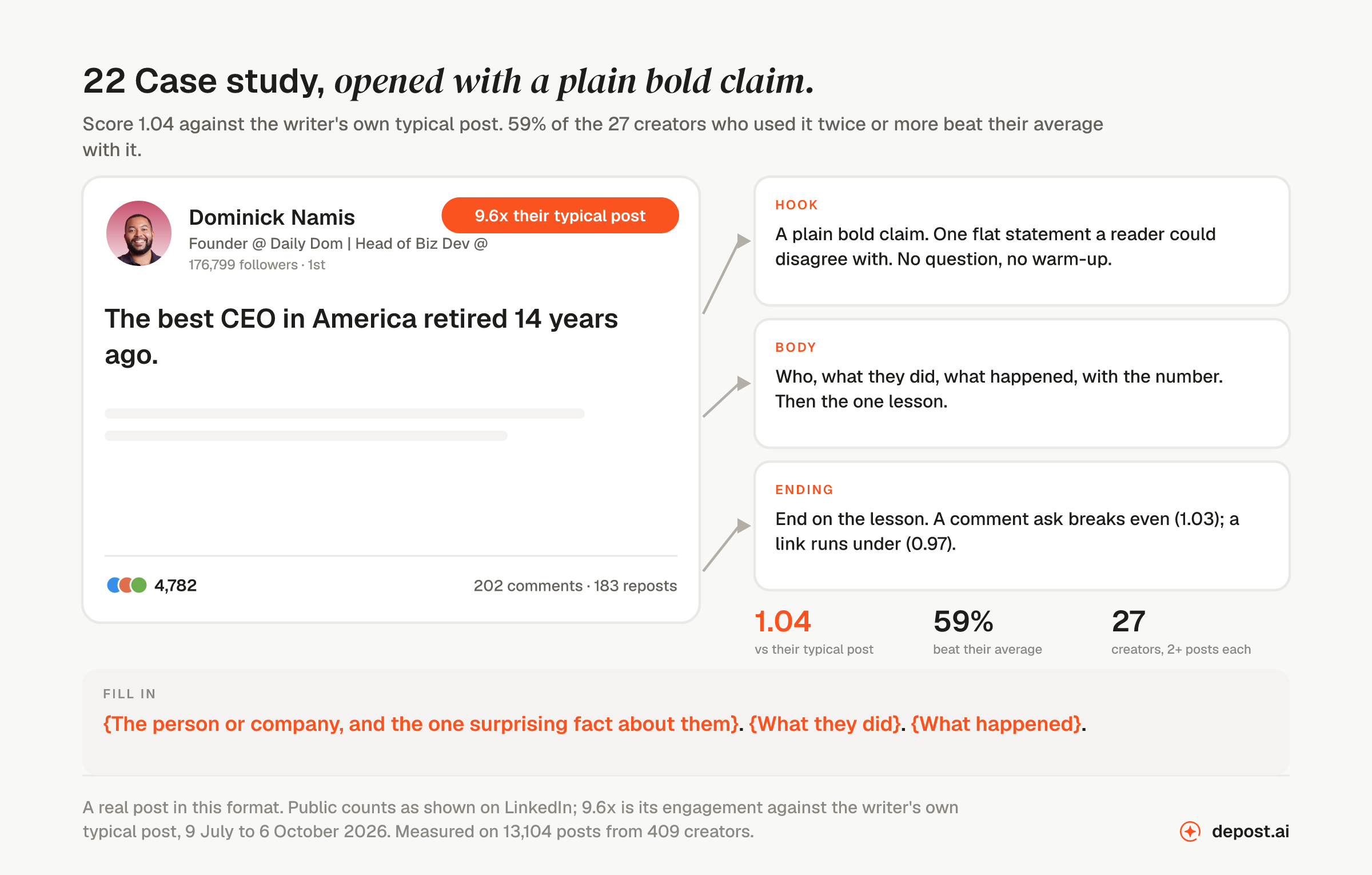
Seen working. Dominick Namis: “The best CEO in America retired 14 years ago.” 4,782 reactions, 202 comments and 183 reposts, 9.6 times their typical post.
Why it works. Case studies run under average as a shape (0.95). A plain opener about the subject, not about you, is what lifts them: 59% of 27 creators.
What sinks it. Making yourself the subject. The ones that win are about someone else.
Image or text. As a single image it scores 0.97 (47% of 55 creators). The ending. End on the lesson. A comment ask breaks even (1.03); a link runs under (0.97).
23. Trend read, opened with a curiosity gap
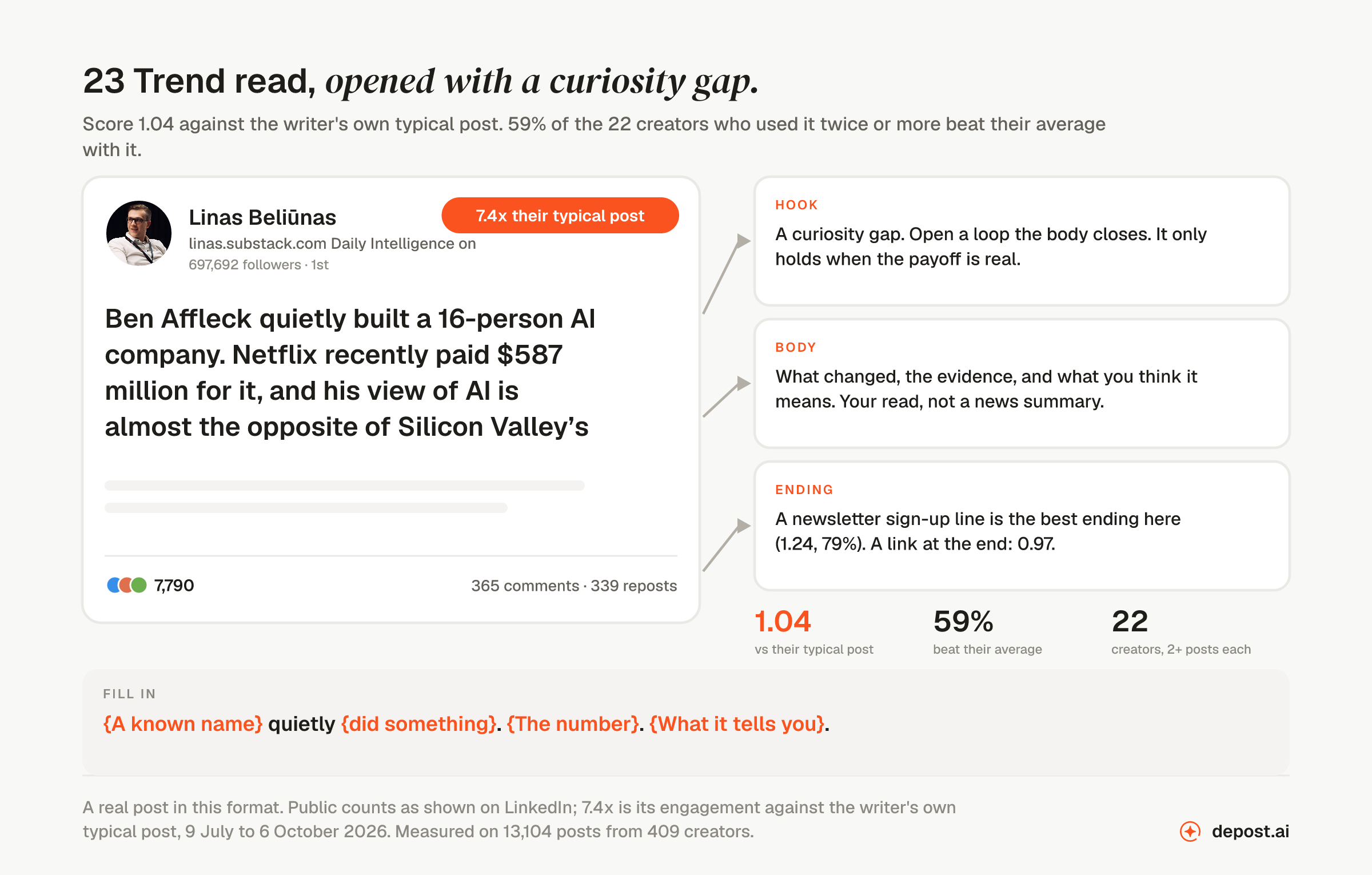
Seen working. Linas Beliūnas: “Ben Affleck quietly built a 16-person AI company. Netflix recently paid $587 million for it, and his view of AI is almost the opposite of Silicon Valley’s” 7,790 reactions, 365 comments and 339 reposts, 7.4 times their typical post.
Why it works. The gap is earned when the payoff is a real number. 59% of 22 creators beat their average; the same shape opened with a claim only just clears the line (1.01).
What sinks it. Summarising the news instead of reading it.
Image or text. As a single image it scores 1.05 (56% of 89 creators). As text only it scores 1.04 (53% of 15 creators). As video it scores 0.98 (45% of 20 creators). The ending. A newsletter sign-up line is the best ending here (1.24, 79%). A link at the end: 0.97.
24. How-to, opened with a plain bold claim
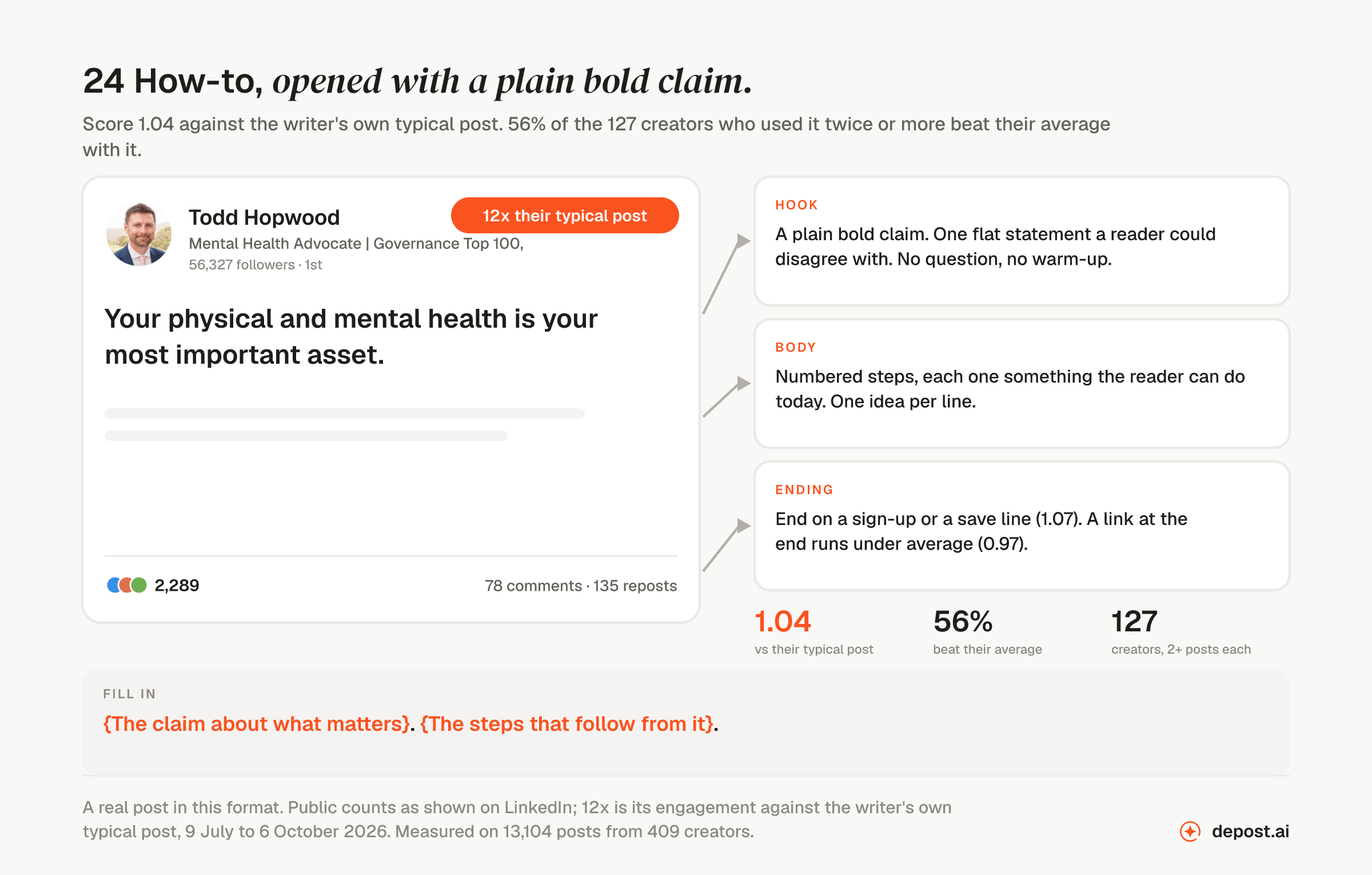
Seen working. Todd Hopwood: “Your physical and mental health is your most important asset.” 2,289 reactions, 78 comments and 135 reposts, 12 times their typical post.
Why it works. The most used format in the library: 127 creators. It wins for 56% of them, better than the how-to shape on its own (48%).
What sinks it. Ending with a link (0.97) or opening with a question (0.89).
Image or text. As a single image it scores 1.04 (58% of 158 creators). As video it scores 1.01 (55% of 31 creators). As text only it scores 0.98 (48% of 21 creators). As a carousel it scores 0.79 (36% of 14 creators). The ending. End on a sign-up or a save line (1.07). A link at the end runs under average (0.97).
25. Vulnerable moment, opened with a curiosity gap
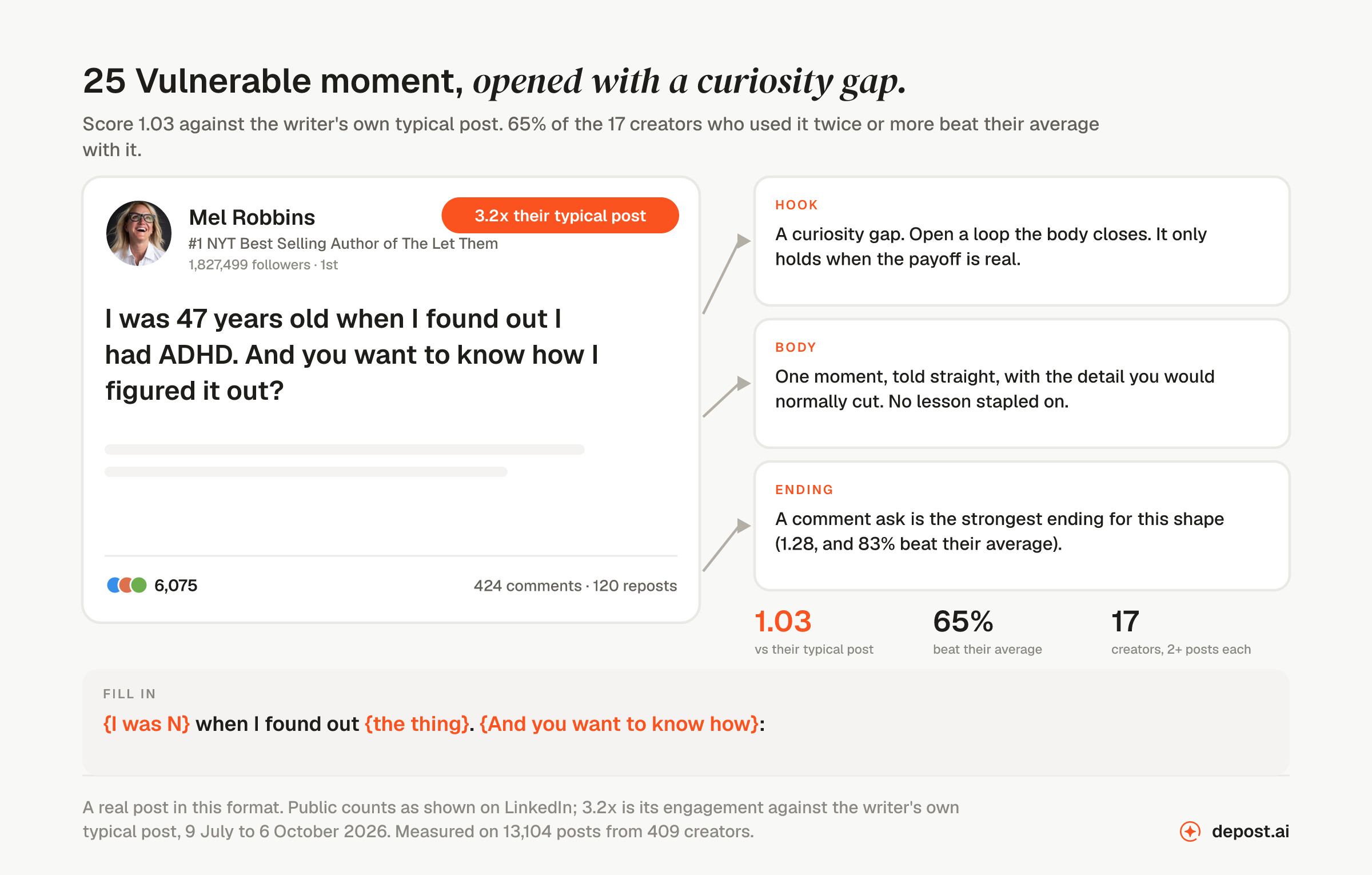
Seen working. Mel Robbins: “I was 47 years old when I found out I had ADHD. And you want to know how I figured it out?” 6,075 reactions, 424 comments and 120 reposts, 3.2 times their typical post.
Why it works. The gap holds here because the moment is real. 65% of 17 creators beat their average; opened with a plain claim the same shape reaches 1.44.
What sinks it. Ending with a lesson. The moment is the post.
Image or text. As a single image it scores 1.19 (78% of 50 creators). The ending. A comment ask is the strongest ending for this shape (1.28, and 83% beat their average).
26. Mindset post, opened with a curiosity gap
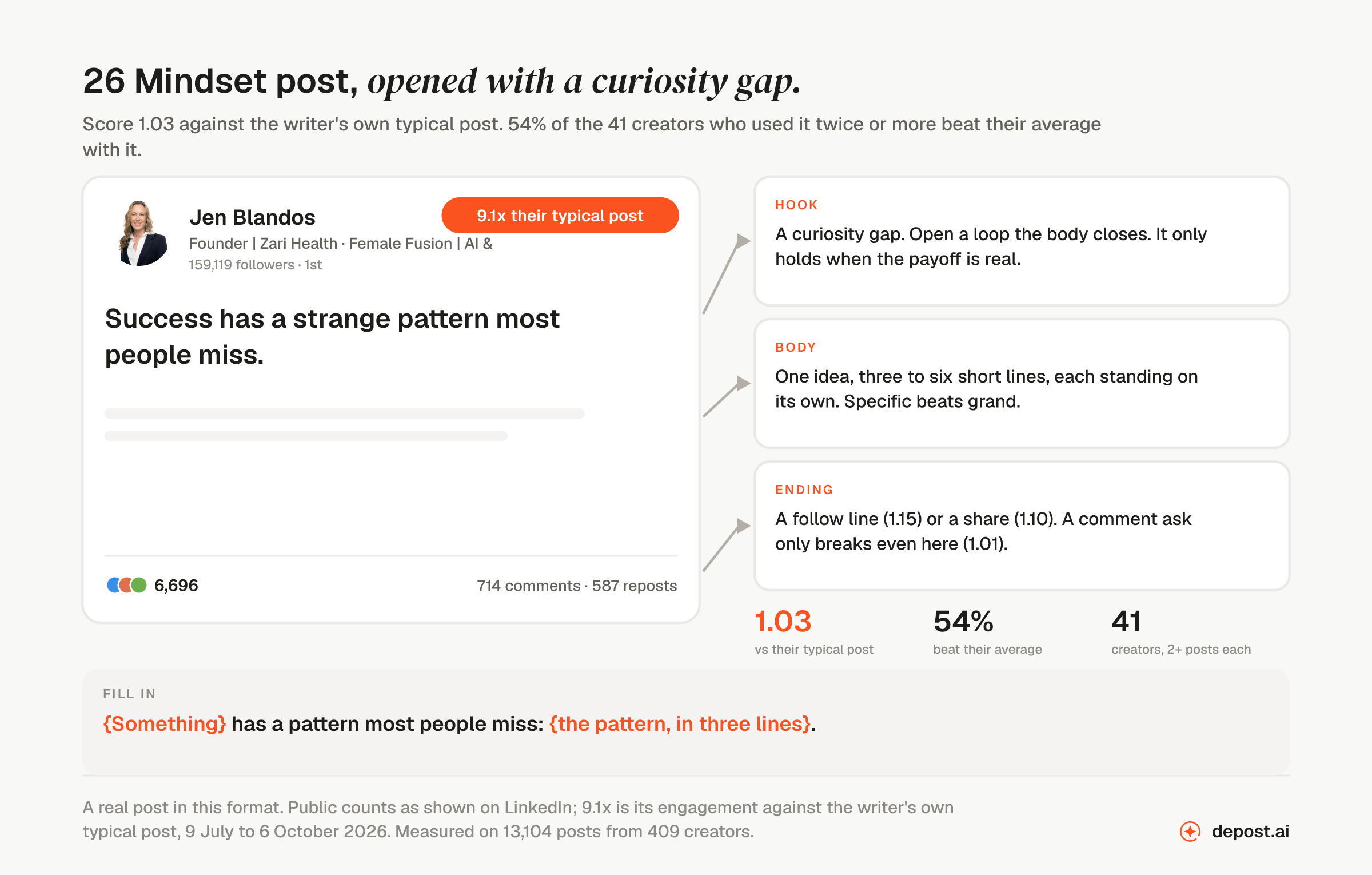
Seen working. Jen Blandos: “Success has a strange pattern most people miss.” 6,696 reactions, 714 comments and 587 reposts, 9.1 times their typical post.
Why it works. 54% of 41 creators above their own average. The weakest of the mindset openers; the order (1.21) and the pain line (1.32) both beat it.
What sinks it. Being general. “Keep going” is the average post; “the first month looks ordinary” is the one that wins.
Image or text. As a single image it scores 1.09 (60% of 133 creators). As video it scores 0.99 (42% of 26 creators). As text only it scores 0.90 (41% of 17 creators). The ending. A follow line (1.15) or a share (1.10). A comment ask only breaks even here (1.01).
27. Giveaway, opened with a plain bold claim
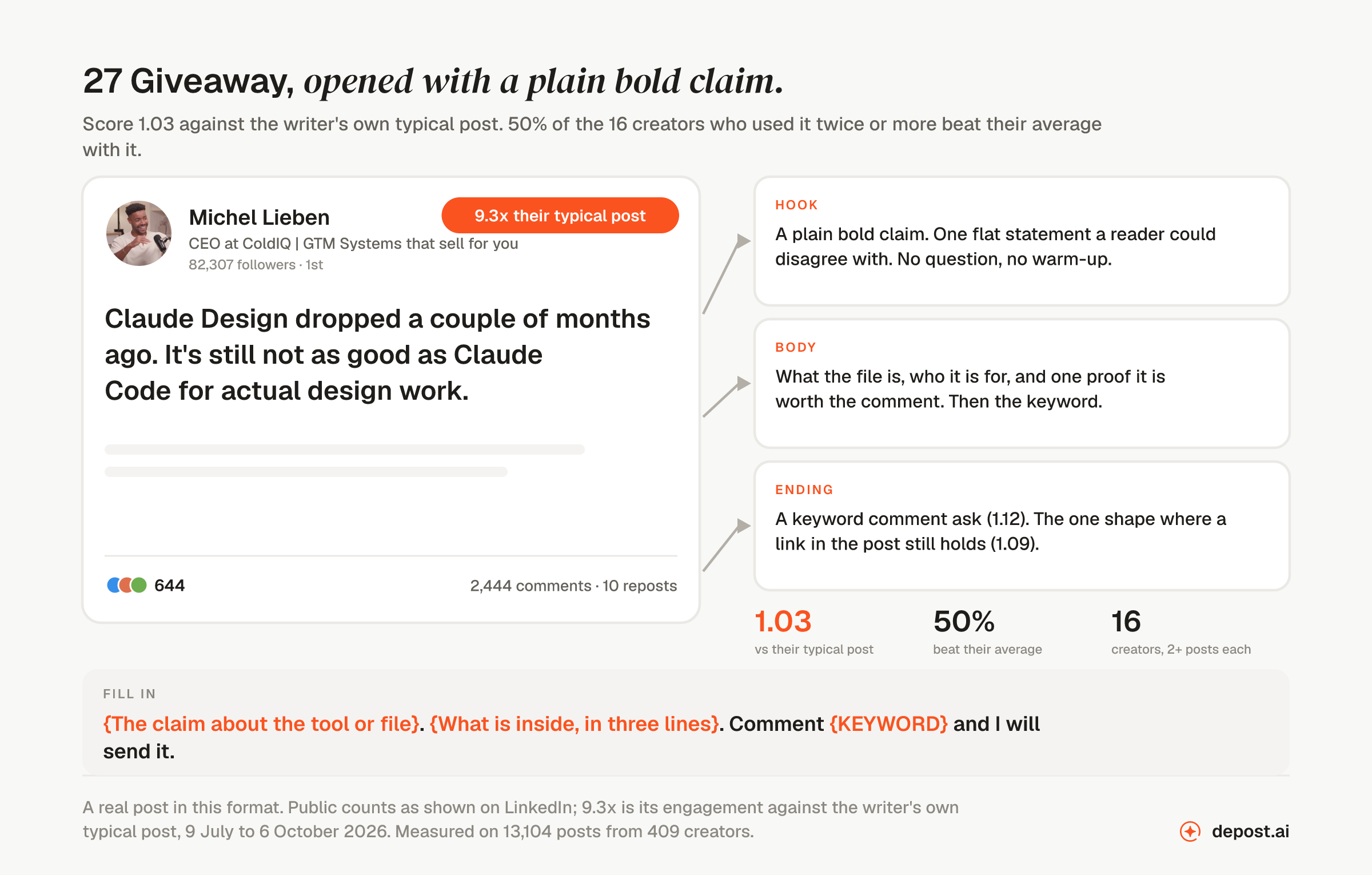
Seen working. Michel Lieben: “Claude Design dropped a couple of months ago. It’s still not as good as Claude Code for actual design work.” 644 reactions, 2,444 comments and 10 reposts, 9.3 times their typical post.
Why it works. The giveaway is the one shape where a keyword comment ask (1.12) and a link in the post (1.09) both hold. Opened with a claim, half of 16 creators beat their average.
What sinks it. A file nobody can picture. Say what is inside, in counts.
Image or text. As a single image it scores 1.10 (63% of 30 creators). The ending. A keyword comment ask (1.12). The one shape where a link in the post still holds (1.09).
28. How-to, opened with a transformation
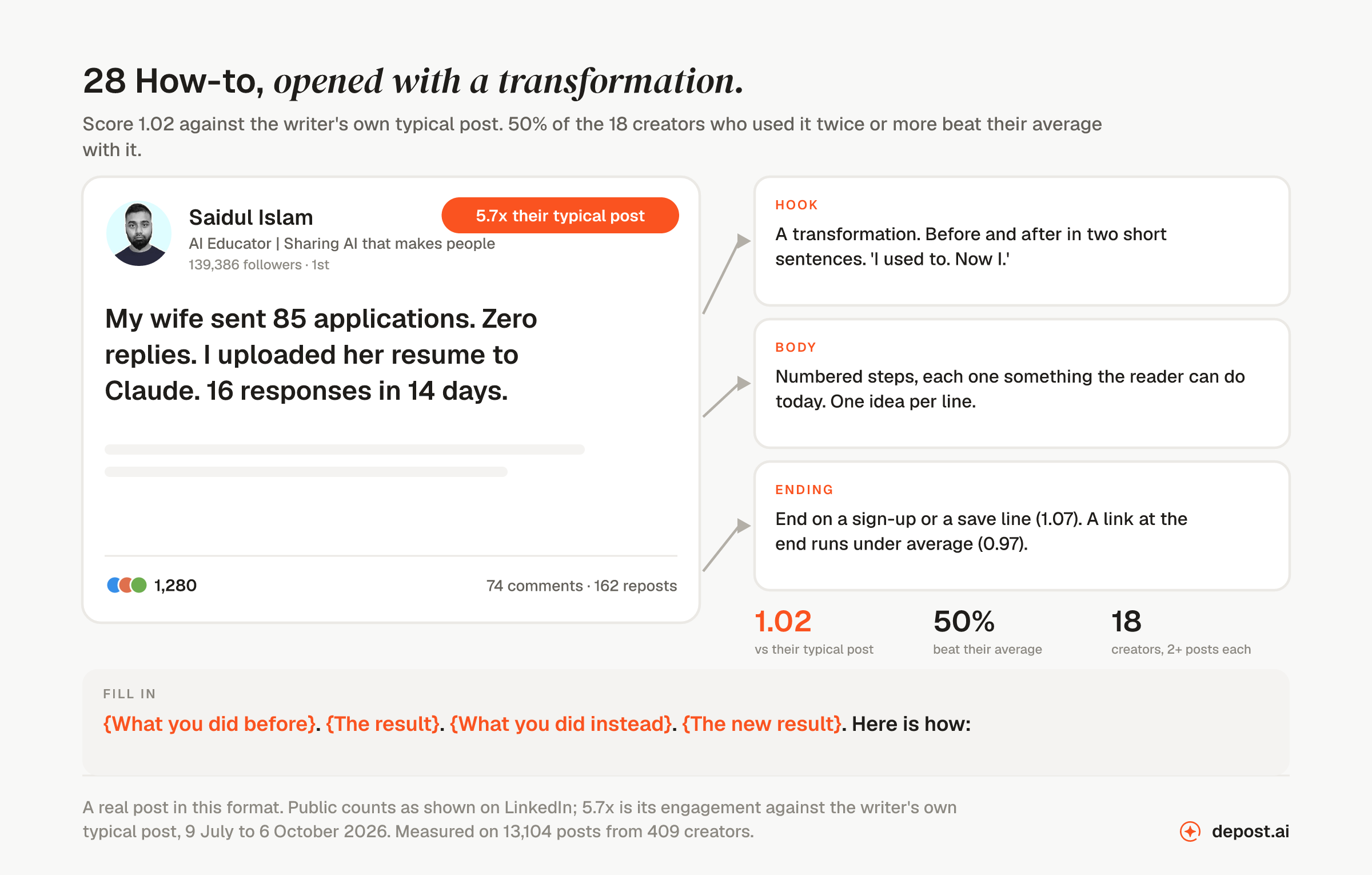
Seen working. Saidul Islam: “My wife sent 85 applications. Zero replies. I uploaded her resume to Claude. 16 responses in 14 days.” 1,280 reactions, 74 comments and 162 reposts, 5.7 times their typical post.
Why it works. A how-to with a before and after in the first two lines. It breaks even for half of 18 creators; the how-to line (1.30) is the better opener for this shape.
What sinks it. Ending with a link (0.97) or opening with a question (0.89).
Image or text. As a single image it scores 1.04 (58% of 158 creators). As video it scores 1.01 (55% of 31 creators). As text only it scores 0.98 (48% of 21 creators). As a carousel it scores 0.79 (36% of 14 creators). The ending. End on a sign-up or a save line (1.07). A link at the end runs under average (0.97).
29. Trend read, opened with a plain bold claim
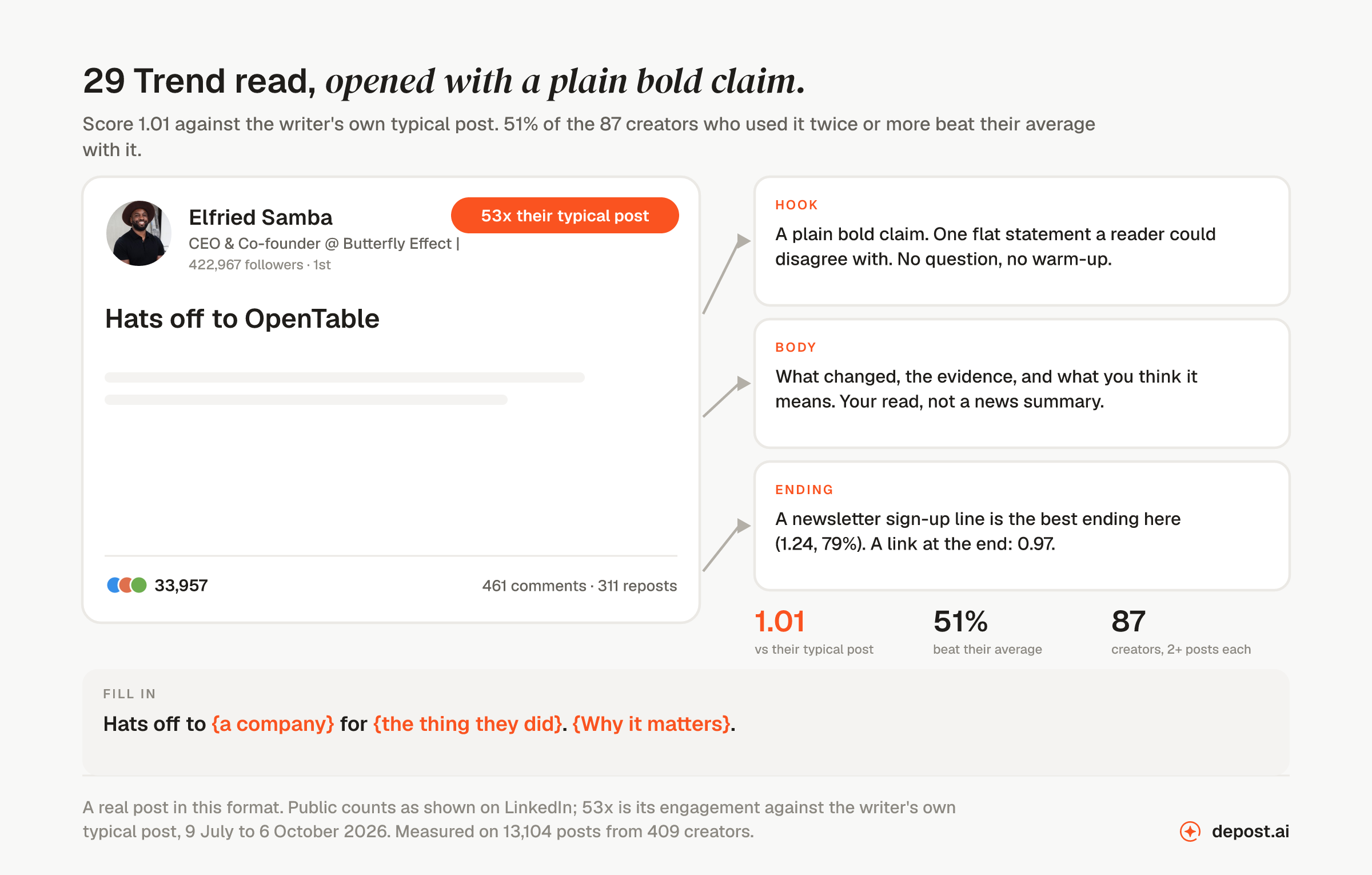
Seen working. Elfried Samba: “Hats off to OpenTable” 33,957 reactions, 461 comments and 311 reposts, 53 times their typical post.
Why it works. The most used trend format (87 creators) and just above the line (1.01). The curiosity gap (1.04) edges it on the same shape.
What sinks it. Summarising the news instead of reading it.
Image or text. As a single image it scores 1.05 (56% of 89 creators). As text only it scores 1.04 (53% of 15 creators). As video it scores 0.98 (45% of 20 creators). The ending. A newsletter sign-up line is the best ending here (1.24, 79%). A link at the end: 0.97.
30. Mindset post, opened with a contrarian line
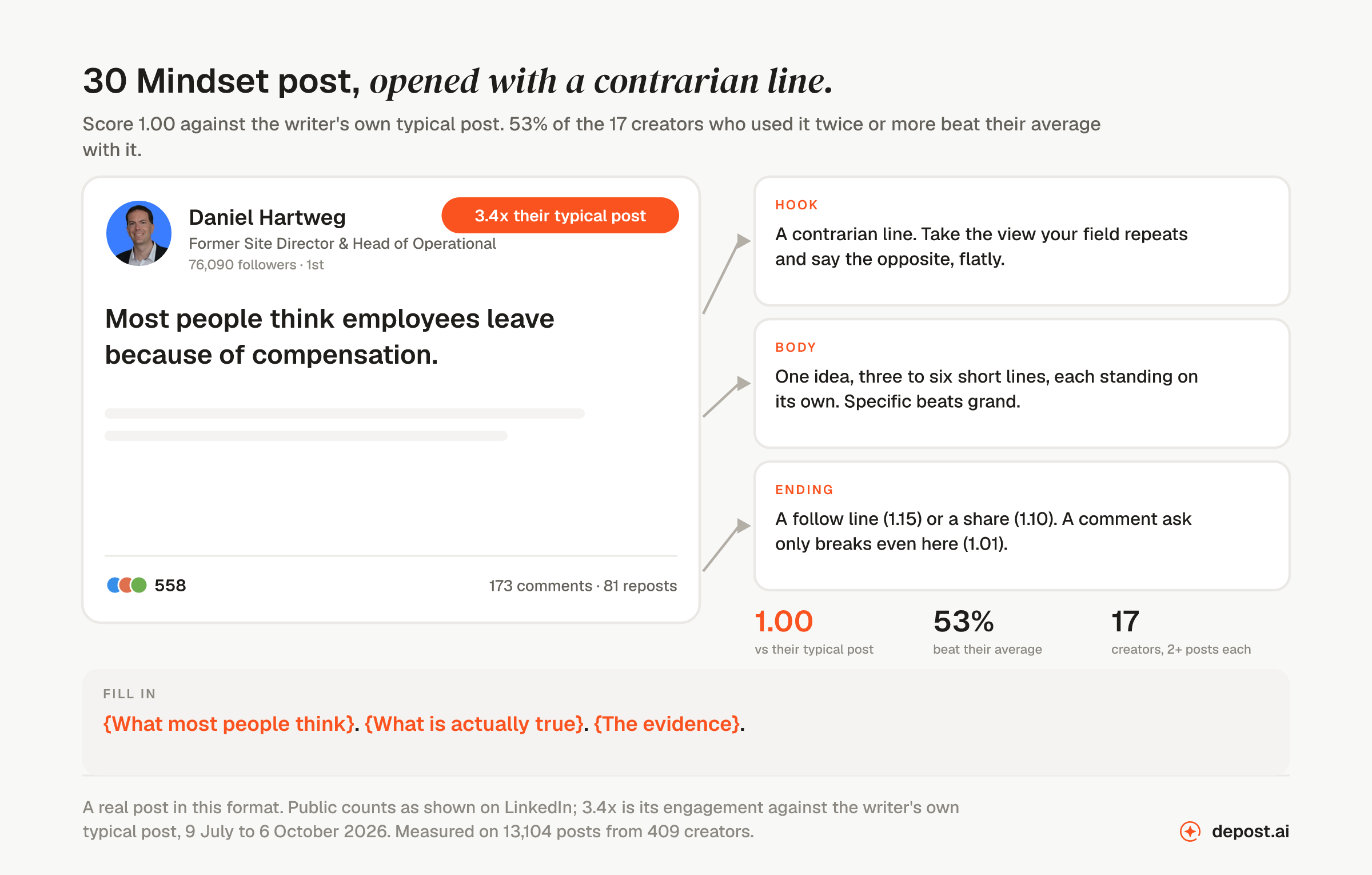
Seen working. Daniel Hartweg: “Most people think employees leave because of compensation.” 558 reactions, 173 comments and 81 reposts, 3.4 times their typical post.
Why it works. The last format above the line: 53% of 17 creators beat their average with it. The order (1.21) and the pain line (1.32) are safer openers for the same shape.
What sinks it. Being general. “Keep going” is the average post; “the first month looks ordinary” is the one that wins.
Image or text. As a single image it scores 1.09 (60% of 133 creators). As video it scores 0.99 (42% of 26 creators). As text only it scores 0.90 (41% of 17 creators). The ending. A follow line (1.15) or a share (1.10). A comment ask only breaks even here (1.01).
The 13 formats that do not win
Below the line, in order. The last column is what to write instead, taken from the 30 above.
| Format | Score | Beat their average | Creators | Write instead |
|---|---|---|---|---|
| How-to, opened with a number | 1.00 | 51% | 59 | Open the how-to with a how-to line (1.30). |
| Tools and resources, opened with a plain bold claim | 0.99 | 49% | 69 | Lead with the number (1.23). |
| Launch, opened with a plain bold claim | 0.98 | 50% | 34 | Tell the launch as a before-and-after (1.56) or a milestone (1.32). |
| Diary entry, opened with a curiosity gap | 0.96 | 33% | 15 | Open the diary with a plain claim (1.28). |
| Tools and resources, opened with a curiosity gap | 0.95 | 35% | 20 | Lead with the number (1.23) or the pain line (1.06). |
| How-to, opened with a statistic | 0.94 | 40% | 15 | A how-to line (1.30). |
| Data-backed insight, opened with a statistic | 0.94 | 27% | 11 | State the finding as a sentence, number second (1.07). |
| How-to, opened with a curiosity gap | 0.92 | 39% | 31 | A how-to line (1.30) or the pain, then the promise (1.15). |
| Mindset post, opened with a question | 0.91 | 26% | 23 | An order (1.21) or the pain, then the promise (1.32). |
| Offer, opened with a plain bold claim | 0.90 | 25% | 16 | Write the milestone or the before-and-after, and put the offer in the first comment. |
| News update, opened with a plain bold claim | 0.89 | 41% | 17 | A trend read with your own view in it (1.04). |
| How-to, opened with a question | 0.89 | 29% | 14 | A how-to line (1.30). |
| Event invite, opened with a plain bold claim | 0.69 | 23% | 13 | No opener saves it. Put the invite in the comment of a post that stands on its own. |
Three of the 13 are the same shape, the how-to, with the three openers that fail it: a statistic, a curiosity gap, a question. Two more are the openers that fail everywhere: a question as the first line scores 0.93 across 116 creators, and a statistic 0.96 across 104. The event invite is the worst post anyone in the library published, at 0.69 with 23% of its writers above their average, and no opener changes that.
The opening line that wins for each shape
The same shape opens best with different lines. The table gives, for every shape with ten or more writers, the opener that scored highest on it.
| Shape | Open it with | Score | Beat their average | Creators |
|---|---|---|---|---|
| Before and after | A plain bold claim | 1.56 | 83% | 12 |
| Vulnerable moment | A plain bold claim | 1.44 | 72% | 29 |
| Personal milestone | A plain bold claim | 1.32 | 83% | 29 |
| Mindset post | The pain, then the promise | 1.32 | 64% | 14 |
| How-to | A how-to line | 1.30 | 67% | 18 |
| Diary entry | A plain bold claim | 1.28 | 76% | 21 |
| Tools and resources | A number | 1.23 | 66% | 32 |
| Leadership thought | A plain bold claim | 1.22 | 82% | 33 |
| Contrarian opinion | A contrarian line | 1.21 | 79% | 14 |
| Hot take | A plain bold claim | 1.15 | 64% | 58 |
| Data-backed insight | A plain bold claim | 1.07 | 60% | 15 |
| Case study | A plain bold claim | 1.04 | 59% | 27 |
| Trend read | A curiosity gap | 1.04 | 59% | 22 |
| Framework | A plain bold claim | 1.04 | 61% | 38 |
| Giveaway | A plain bold claim | 1.03 | 50% | 16 |
| Launch | A plain bold claim | 0.98 | 50% | 34 |
| Offer | A plain bold claim | 0.90 | 25% | 16 |
| News update | A plain bold claim | 0.89 | 41% | 17 |
| Event invite | A plain bold claim | 0.69 | 23% | 13 |
Across every shape at once, the order is: a how-to line 1.11 (60% of 35 creators), an order 1.11 (61% of 64), a hot take 1.06, a number 1.02, a plain claim 1.02 (56% of 366 creators, the most used opener by far), a contrarian line 1.01, a transformation 1.00, the pain then the promise 1.00, a curiosity gap 0.98, a statistic 0.96 and a question 0.93 (37% of 116 creators).
The plain claim is average on its own and the best opener for eight of the top twelve formats. That is not a contradiction. The claim does nothing by itself; it does a great deal in front of a personal shape, because a flat statement of something true about you is the thing the feed has least of.
Image, video, text or carousel, by shape
Across every shape, a single image scores 1.02 (65% of 237 creators beat their average with one), video 0.89, text only 0.88 and a carousel 0.83. By shape it is less even.
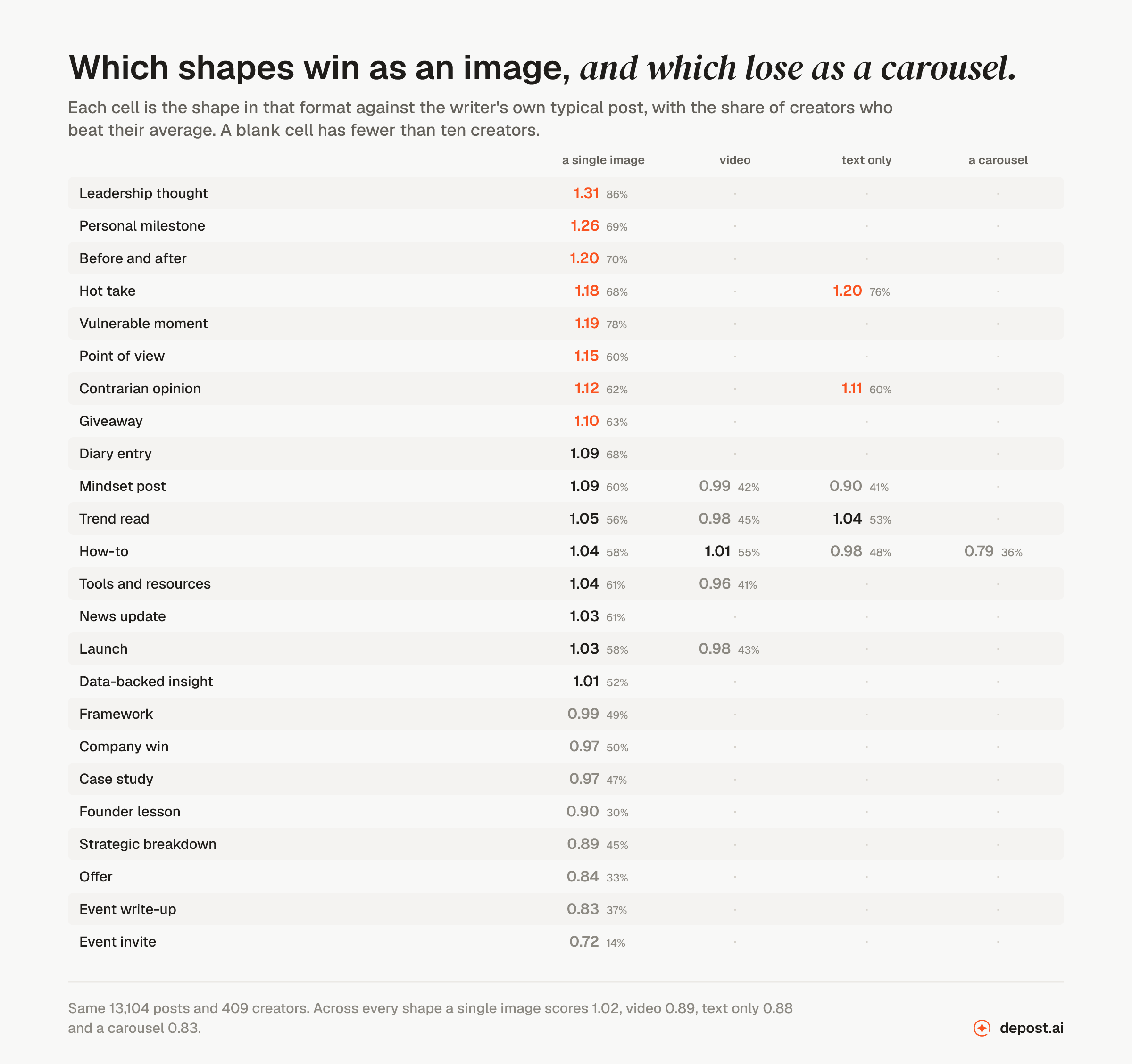
A leadership thought as a single image is the strongest shape-and-format pair in the whole test: 1.31, and 86% of the 37 writers who posted one beat their own average. A milestone as an image is 1.26, a before-and-after 1.20, a vulnerable moment 1.19. The hot take is the one shape that does better as plain text (1.20, 76% of 21 writers) than as an image (1.18). The how-to as a carousel is 0.79, and only 36% of the 14 writers who tried it beat their average.
One caution from the earlier test: for Depost AI users measured against their own posts, the carousel reversed and became the best format. The accounts in this library are mostly large; if yours is not, the only way to know is to measure your own.
How a post ends
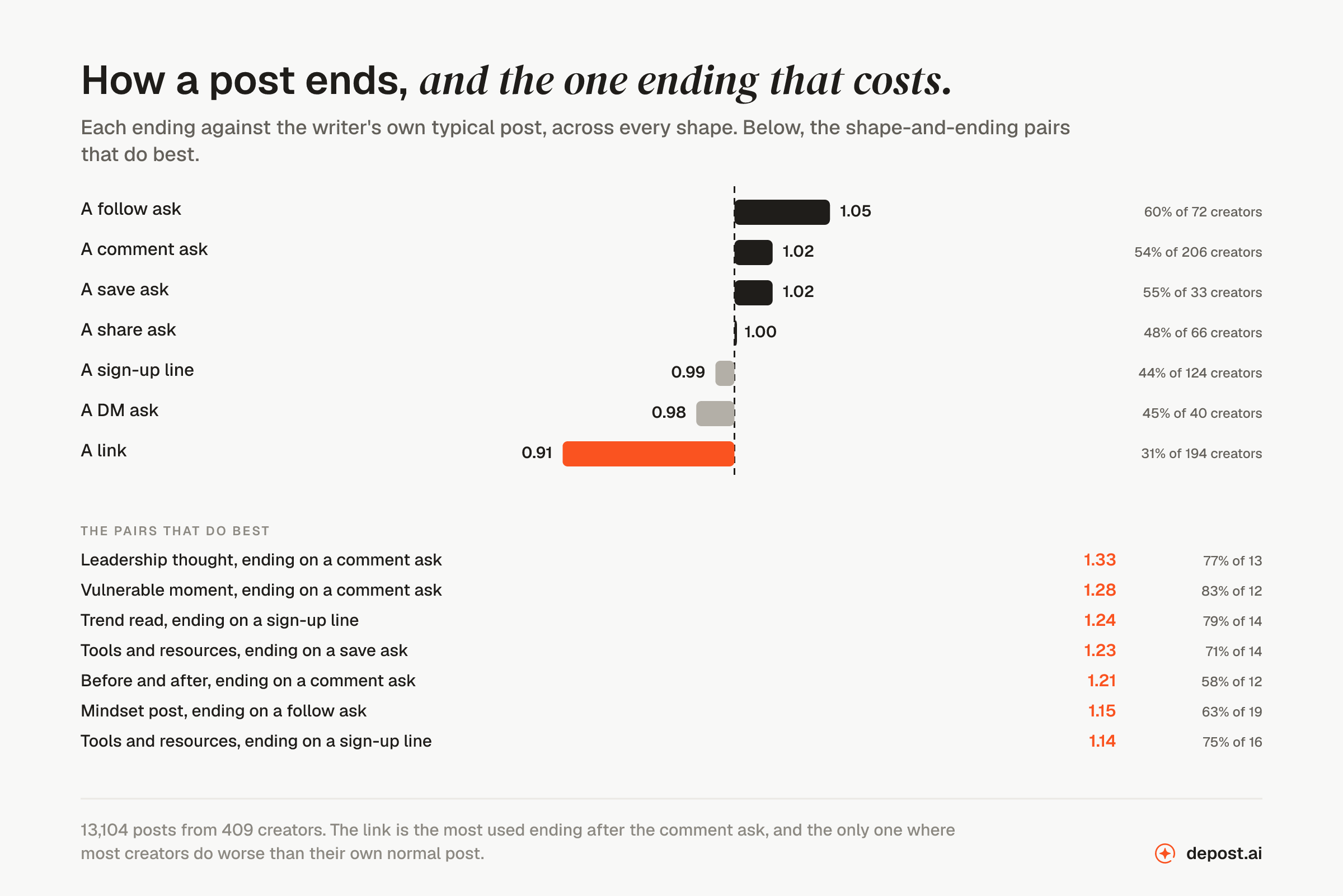
A follow ask is the best general ending (1.05, 60% of 72 writers), a comment ask breaks even (1.02 across 206 writers, the most used ending), a save and a share sit at 1.02 and 1.00, a sign-up line at 0.99, a DM ask at 0.98. The link is 0.91, and it is the only ending where most writers do worse than their own normal post.
The pairs matter more than the averages. A leadership thought that ends on a comment ask is 1.33 (77% of 13 writers). A vulnerable moment with a comment ask is 1.28 (83% of 12). A trend read that ends in a newsletter sign-up is 1.24 (79% of 14). A tools post that ends on “save this” is 1.23 (71% of 14). The giveaway is the one shape where a link in the post still holds (1.09), because the link is the point of the post.
How to write any of these from your own facts
Four steps, in order.
1. Pick the shape from your own history, not from this list. Take your last twenty posts, divide each one’s engagement by your median, and look at which shapes cleared 1.00 for you. The library says a leadership thought wins; your twenty posts say whether it wins for you.
2. Open with the line that wins for that shape. The table above. A plain claim for the personal shapes, a how-to line for a how-to, the number for a list, an order or the pain line for a mindset post. Not a question, whatever the shape.
3. Fill the template with a fact you have. Every first line in the 30 above carries one: a grade, a year, a price, a count, a name. Where you do not have the number, write around it. A number that is not yours reads as a pitch and is the fastest way to lose the trust the shape earned.
4. End the way the shape ends. A comment ask on a leadership thought or a vulnerable moment, “save this” on a list, a follow line on a mindset post, nothing at all when the point is made. The link goes in the first comment.
Inside Depost AI
The four steps are what Depost AI does when you give it an idea. It runs the same test as this page for your niche at your audience size, and its ideas start from the formats that won there rather than from a blank prompt. Each idea names the format it rests on and the post that proved it, so you can check the evidence rather than trust the suggestion. Once three of your own posts sit behind a kind of post, it scores that kind against your own typical post and says so when it cannot tell yet. And it writes around a number it does not have rather than inventing one.
The analysis of your own posts is the part that makes the rest true, and it is free: connect LinkedIn, and Depost AI reads your history in about a minute and shows your best and weakest posts as multiples of your own typical post, the kinds that work for you and the kinds to stop. On a profile with nothing imported it is working from the general patterns on this page, the same ones any model could be told. The difference starts when your history is in.
What this cannot tell you
Engagement is not revenue. A format that lifts reactions and comments may or may not lift the thing you post for. Correlation, not cause: the writers who use the winning formats may differ from the ones who do not in ways the test cannot see. One season, one platform, English only. The scores are medians, so one viral post cannot carry a format, but a format with twelve writers rests on twelve people’s habits. “Creator” means an account in the library with four or more posts in the window; most are large accounts, and the carousel result above is the reminder that large accounts and small ones can disagree. The first lines are quoted as published, with emoji removed.
Save this page
The print view keeps the article and every figure and drops the rest of the site.
FAQ
What is the best LinkedIn post format in 2026?
Measured against each writer’s own typical post, a before-and-after opened with a plain claim: 1.56, with 83% of the writers who used it twice or more beating their own average. A vulnerable moment opened with a plain claim is 1.44 and a personal milestone opened with a plain claim is 1.32. All three are personal shapes with a flat first line.
Which LinkedIn post formats get the most engagement?
Thirty of 43 formats beat the writer’s own typical post in this test. The top tier, at 1.20 and above, is twelve formats: before-and-after, vulnerable moment, personal milestone, mindset post, how-to, diary entry, tools-and-resources, leadership thought and contrarian opinion, each with the opening line that suits it. The common thread is a personal shape opened with a plain claim, an order, or the pain followed by the promise.
Do how-to posts still work on LinkedIn?
They break even. The how-to is the most common shape in the library, written by 188 of 409 creators, and it scores 1.00: 48% of its writers beat their own typical post with it. The first line decides the outcome. Opened with a how-to line it scores 1.30; opened with a question, 0.89.
Should a LinkedIn post end with a link?
Not in the post. A link at the end scores 0.91 across 194 creators, and only 31% of them beat their typical post with it, the worst of any ending. A follow ask (1.05), a comment ask (1.02) or no ask at all do better. The trade-off is real: a link in the first comment protects the post and earns fewer clicks. The giveaway is the one shape where a link in the post still holds (1.09).
Is a question a good first line for a LinkedIn post?
No. A question as the opening line scores 0.93 across 116 creators, and 37% of them beat their typical post with it. On a how-to it is 0.89 and on a mindset post 0.91. A plain claim, an order or a how-to line all do better on every shape measured.
How was this measured?
13,104 LinkedIn posts published between 9 July and 6 October 2026 by 409 creators with four or more posts in that window, drawn from a library of 144,913 posts. Each post’s engagement (reactions, comments and reposts) was divided by the same writer’s median post over the three months, so 1.00 is that writer’s typical post. A format is a shape plus an opening-line type as labelled by the library’s classifier. A format’s score is the median across the writers who used it at least twice and did something else at least twice, with the share of those writers who beat their own median beside it. A format needed ten or more writers to appear.