LinkedIn Engagement Pods in 2026: What LinkedIn Said, What They Cost, and What to Do Instead
LinkedIn's own words on pods, the rules they break, what a pod costs a post and an account in 2026, which of the numbers going around have no source, and what works instead.

· 10 min read
On this page
Search for LinkedIn engagement pods and most of what you find is one of two things. An invitation to join one, or a warning with a percentage attached that nobody can trace. This post is neither. It is LinkedIn’s own words on pods, dated, the rules a pod breaks, what the platform says it does about them, and what the measurements say to do instead.
What a pod is
An engagement pod is a group that agrees to react to and comment on each other’s posts, usually within the first hour, to push each post further than it would travel alone. The manual kind lives in a WhatsApp, Telegram, Slack or Discord group. Someone drops a link, the others like and comment. The automated kind is a browser extension or a tool that signs in as each member and does the clicking.
Both rest on the same bet. That LinkedIn’s ranking system treats early engagement as a signal of quality, and cannot tell a reader from a member of a group. In 2026 LinkedIn has said, in several ways, that it can.
What LinkedIn has said, dated
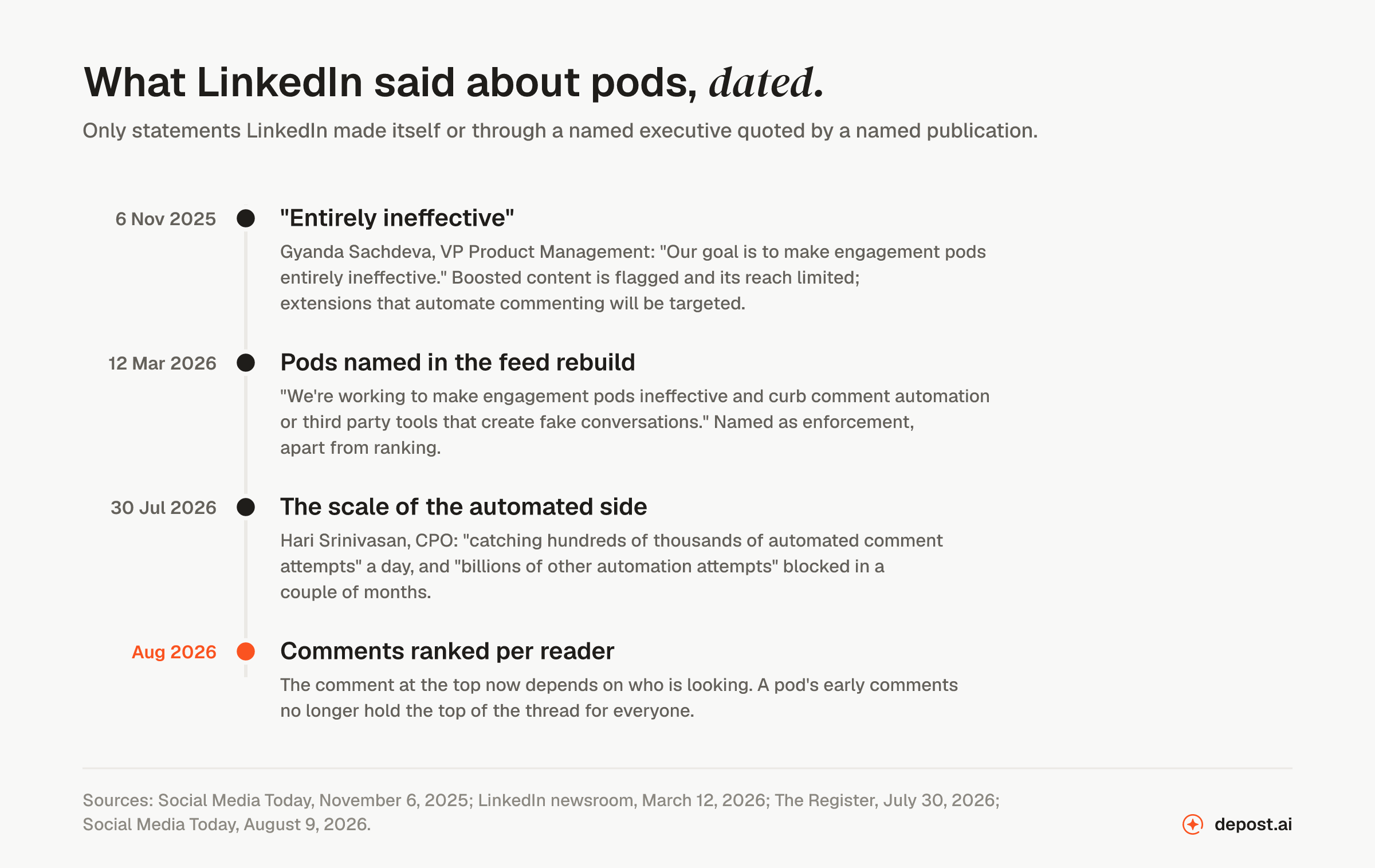
November 2025: “entirely ineffective.” Gyanda Sachdeva, LinkedIn’s VP of Product Management, told Social Media Today: “Our goal is to make engagement pods entirely ineffective.” On detection: “We are increasing the number of ways we detect these pods and the suspicious behavior that happens in these pods.” On what happens to a post: “We are increasingly flagging any artificially boosted content internally, and then also, we are limiting the reach of this content.” On tools: “we’re going to crack down on any third party tools, like a browser extension or a plug-in, that’s automating any kind of manipulation by commenting on a bunch of posts at the same time.”
12 March 2026: pods named in the feed rebuild. In the post announcing its rebuilt feed, LinkedIn wrote: “We’re working to make engagement pods ineffective and curb comment automation or third party tools that create fake conversations, so real people and real perspectives stand out.” How the LinkedIn algorithm works in 2026 covers the rest of that announcement. The line that matters here is that pods and comment automation are named as enforcement, apart from the ranking changes.
30 July 2026: the scale of the automated side. Hari Srinivasan, LinkedIn’s Chief Product Officer, told The Register: “Everyday we are now catching hundreds of thousands of automated comment attempts, and have blocked billions of other automation attempts (posting at scale, slop) in the last couple months alone.”
August 2026: comments ranked per reader. LinkedIn began ordering the comments under a post by relevance to each reader, instead of showing everyone the same order. The old pod playbook relied on early comments pinning to the top for every viewer. Now the comment at the top depends on who is looking. A comment from someone with no connection to the subject or the reader has no reason to be there. The algorithm post above has the detail and LinkedIn’s own figure on comment reading time.
The rules a pod breaks
Three documents. The first is more direct than most people expect.
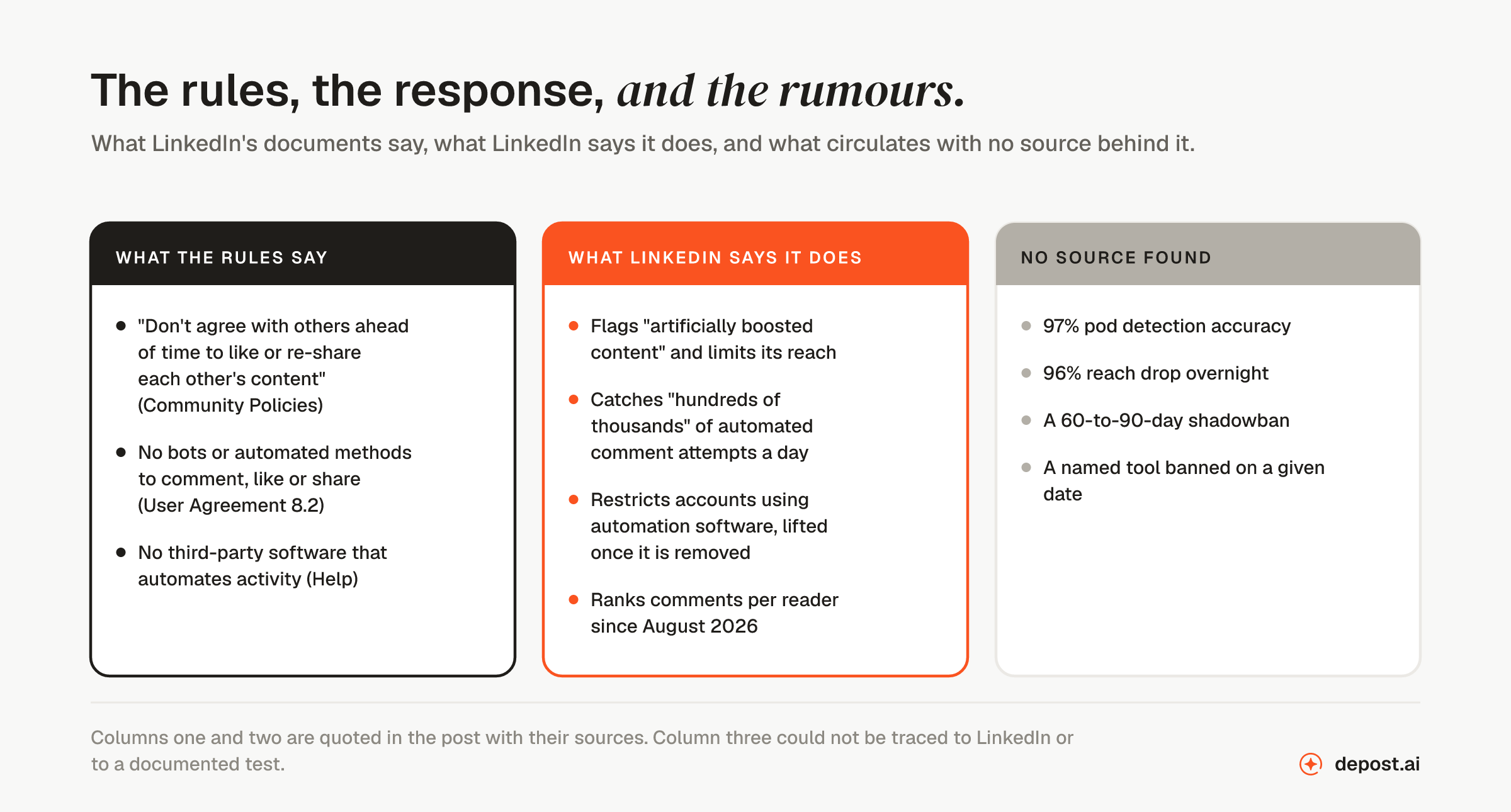
The Professional Community Policies, which every member agrees to, say: “Don’t do things to artificially increase engagement with your content.” They also carry the plainest description of a manual pod LinkedIn has written: “Respond authentically to others’ content and don’t agree with others ahead of time to like or re-share each other’s content.” That sentence covers the WhatsApp group with no software involved at all.
The User Agreement, effective 3 November 2025, section 8.2, bars members from using “bots or other unauthorized automated methods to access the Services, add or download contacts, send or redirect messages, create, comment on, like, share, or re-share posts, or otherwise drive inauthentic engagement.” The same section bars using “browser plugins and add-ons or any other technology” to scrape the service. It also bars using “another’s account (such as sharing log-in credentials or copying cookies),” which is how some pod tools operate.
The help page “Automated activity on LinkedIn”, updated two weeks before this was written, says: “We don’t allow the use of third-party software or browser extensions that scrape, modify the appearance of, or automate activity on LinkedIn’s website.” It describes the consequence, an account restriction, and the way out. Once the software is removed, the account is “automatically re-enabled at the time specified on the suspension notification.” The glossary entry on account restrictions explains the range, from one feature refusing to work to permanent closure.
So a manual pod breaks the community policies. An automated one breaks the User Agreement as well. The distinction matters for what happens next.
What a pod costs
Two different costs, for the two kinds of pod.
The post, for a manual pod. The stated consequence is on the content. LinkedIn says it flags “artificially boosted content” and limits its reach. A post lifted by people who did not read it earns engagement from the wrong people. A ranking system that reads who engaged, not just how many, learns the wrong thing about who the post is for. Since August 2026 that group’s comments do not even hold the top of the thread.
The account, for an automated pod. The consequence LinkedIn describes is enforcement: an account restriction for the software, and the tool itself being targeted. Sachdeva’s “crack down on any third party tools” and Srinivasan’s “hundreds of thousands of automated comment attempts” a day describe that side. This is the same category as comment bots and unauthorized schedulers. It is the one that can cost you the account rather than the post.
What nobody has published. You will read that LinkedIn detects pods with 97% accuracy. That flagged accounts lose 96% of their reach overnight. That a shadowban lasts sixty to ninety days. That a named pod tool was removed from a browser store on a given date. We could not trace any of those to a LinkedIn statement or to a documented test. They come from pages that sell automation, or sell protection from it. The honest version is weaker and still enough: LinkedIn says it limits the reach of boosted posts and restricts accounts that use automation, and it has not published a number for either.
Why pods stopped paying before LinkedIn said so
Even without enforcement, the economics changed.
A comment count without readers does not lift a post. Our test of 12,791 posts against each writer’s own average found that asking for a comment earns 0.96 of a typical post once the writer is compared with themselves. Engagement that does not come from readers is the same thing measured from the other end. A pod produces the count without the reader. The count is not what moves a post any more. Who engaged, and whether they stayed, is.
LinkedIn now counts the comments that pay. It reports “knowledge-oriented comments” as a headline figure in its quarterly results, up 11% year on year in the quarter it reported in April 2026. It has also said that time spent reading comments rose 18%. The comment that pays is one a reader stops for. “Great post!” from a pod member is the opposite, and since August it is ranked accordingly.
What to do instead
Four things that produce the signal a pod imitates, from real readers.
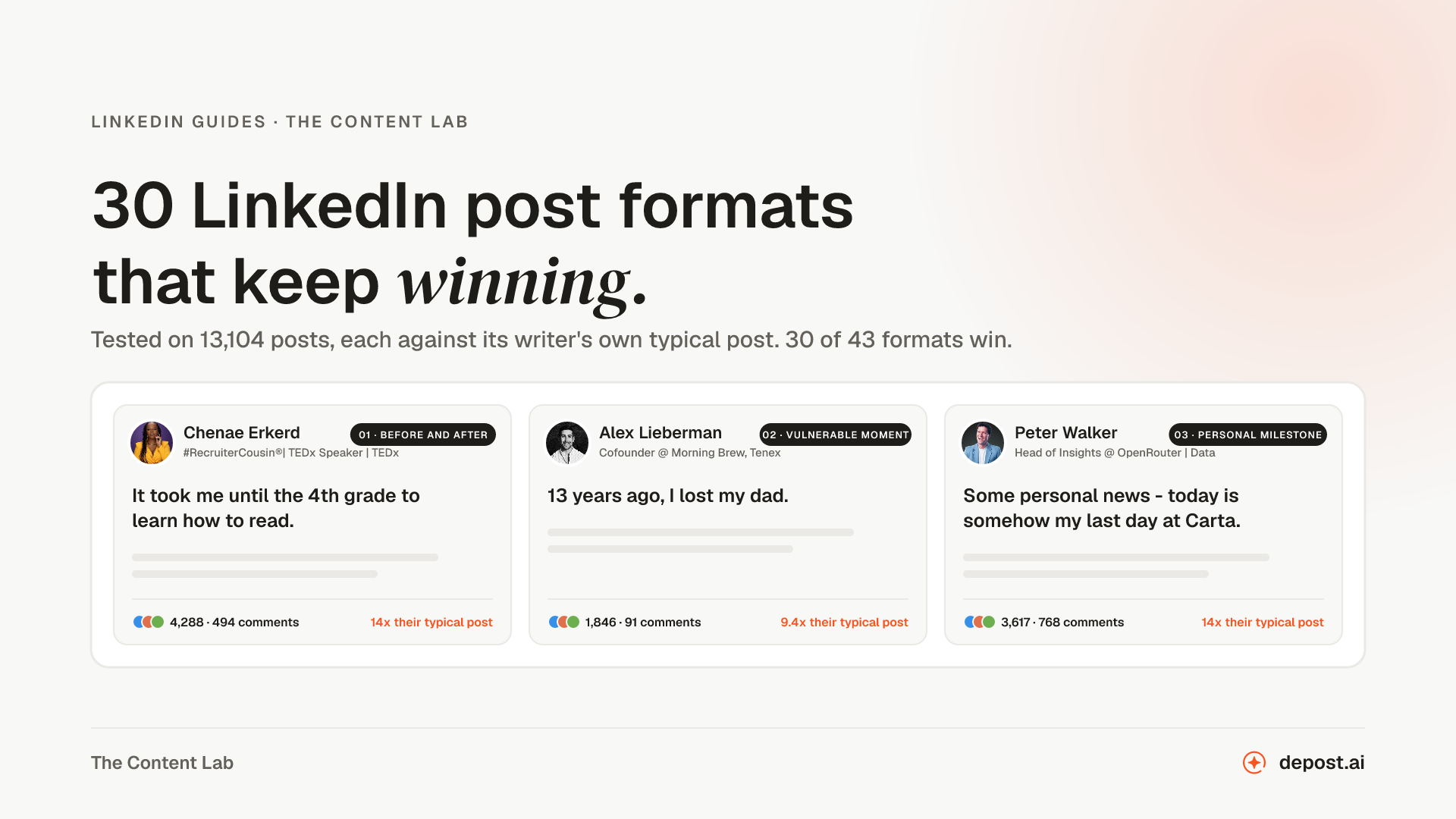
- Write the post that earns the comment. The shapes that beat a writer’s own average in the test above are a personal story, a plain claim a reader could disagree with, and a before-and-after with numbers. Those are the ones people answer without being asked. A pod exists to rescue the post that gave them nothing to say.
- Be in the comments yourself for the first hour. Replies from the author are fresh engagement while the post is still being tested. A thread the author is answering pulls other readers in. This is the one thing pods got right about timing, done honestly.
- Comment on other people’s posts, by hand, where you have something to add. LinkedIn’s own metric is “knowledge-oriented” comments, and its ranking now puts a comment near the top for the readers it is relevant to. Twenty comments on posts you have nothing to say about do less than three where you do. How many comments a day is safe covers where the line sits for a person commenting by hand.
- Use tools only on the drafting side. A tool that drafts a reply you read and send is a writing tool. A tool that sends it for you is the thing in section 8.2. The difference is who presses the button.
That last line is how Depost AI is built. It plans and drafts from what has already worked on your own account. It builds targeted feeds of the conversations worth joining and drafts replies in your voice. Every reply, comment and connection note is sent by you, never by a bot, and nothing publishes without your approval. It is also why we will not claim a post from it cannot be flagged, or that any competitor gets people banned. LinkedIn has named no tool. The rule is about what the tool does, not whose it is.
FAQ
Are LinkedIn engagement pods against the rules?
Yes. LinkedIn’s Professional Community Policies say “don’t agree with others ahead of time to like or re-share each other’s content,” which covers a manual pod. The User Agreement bars “bots or other unauthorized automated methods” to comment on, like or share posts, which covers an automated one. LinkedIn’s VP of Product Management confirmed in November 2025 that pod activity violates its terms.
Do LinkedIn engagement pods still work in 2026?
LinkedIn says it is “flagging any artificially boosted content internally” and “limiting the reach of this content.” Since August 2026 it ranks comments per reader, so a pod’s early comments no longer hold the top of a thread for everyone. It has published no figure for how much reach a pod costs. The measured finding on our side is that comment counts without readers do not lift a post against the writer’s own average.
Can you get banned for using an engagement pod on LinkedIn?
For a manual pod, the consequence LinkedIn describes is on the post: flagged and reach-limited. For software that automates liking or commenting, LinkedIn’s help page describes an account restriction that is lifted once the software is removed, and its executives have said it will act against the tools themselves. LinkedIn has not published penalty durations, and the “60-to-90-day shadowban” figure has no source.
How does LinkedIn detect engagement pods?
LinkedIn has said it is “increasing the number of ways we detect these pods and the suspicious behavior that happens in these pods,” and that it catches hundreds of thousands of automated comment attempts a day. It has not published how detection works or how accurate it is. The 97% accuracy figure circulating online is not LinkedIn’s.
Is a WhatsApp or Telegram pod safer than a pod tool?
Safer for the account, not for the post. A manual group involves no unauthorized software, so the User Agreement’s automation clause does not apply. The community policies’ line against agreeing in advance to engage does apply, and LinkedIn says it limits the reach of boosted content however it was boosted.
What should I do instead of joining a pod?
Write posts that give readers something to answer, reply to comments yourself in the first hour, and comment by hand on posts where you have something to add. Keep any tool on the drafting side, so that you are the one who sends. Those produce the signal a pod imitates, from the readers LinkedIn’s ranking is actually looking for.