LinkedIn Storytelling in 2026: The 7 Story Types That Beat Their Writer's Own Average
We scored fourteen kinds of LinkedIn story against each writer's own typical post, across 49,488 posts from 567 writers over twelve months. Seven beat it and seven did not, and the format every guide recommends to founders finished last of all fourteen.

· 15 min read
On this page
Every guide written for founders says the same thing. Tell the story of what you learned.
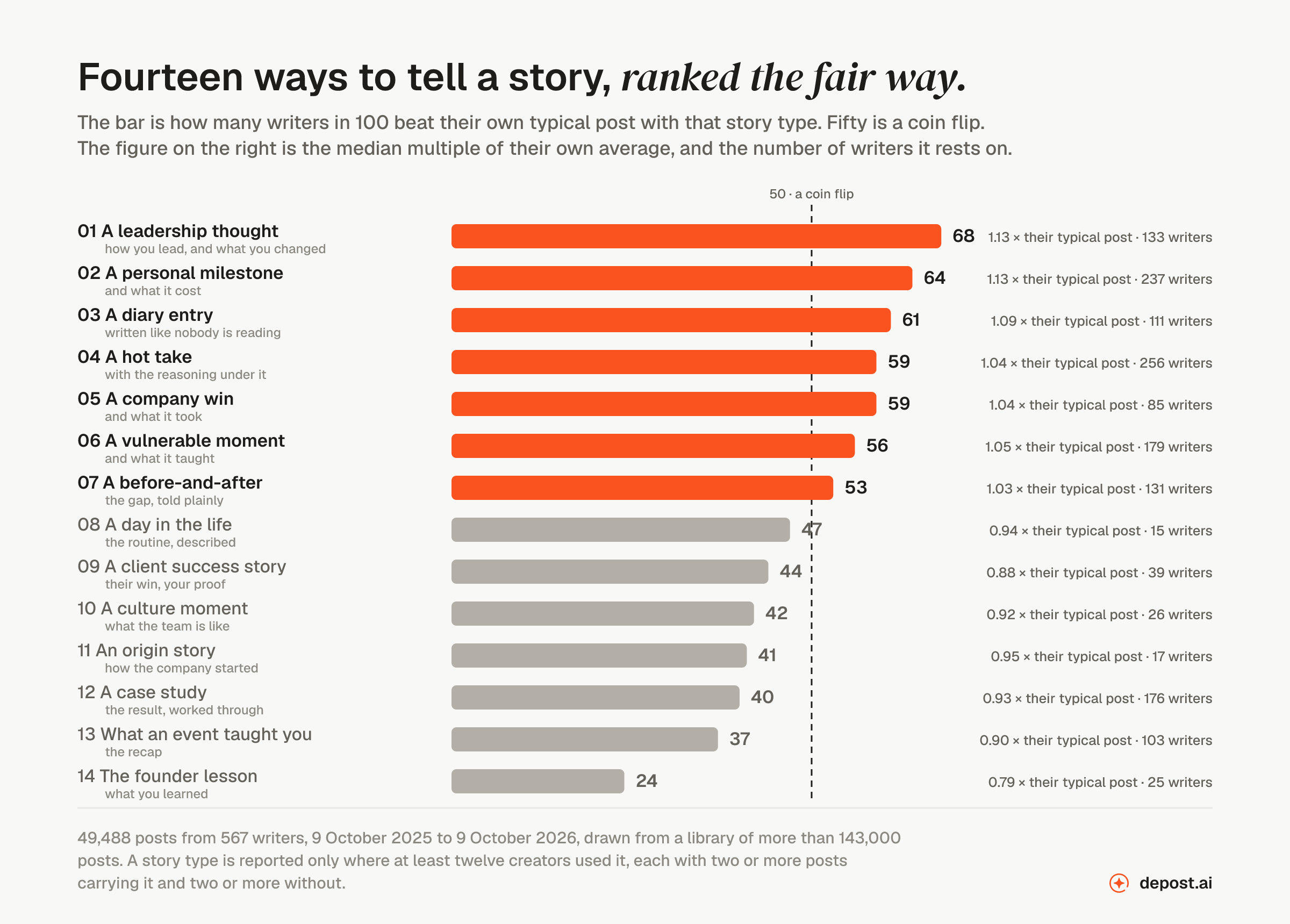
We tested it. Across 49,488 LinkedIn posts from 567 writers, the founder lesson finished last of fourteen ways to tell a story. Twenty-four writers in 100 beat their own average with one.
The format that won sits next to it in any content calendar: a leadership thought, how you lead and what you changed. Sixty-eight in 100.
Below are all fourteen, the seven that work and the seven that do not, each winner with a real post that proves it and the shape underneath it you can reuse. If you want the shorter version of the same method applied to post shapes and opening lines together, that is the 43 formats test.
How this was measured
A story type here is the kind of post, not the opening line. A milestone, a diary entry, a case study. The library’s classifier labels one for every post it holds.
The problem with ranking any of them is that a quiet week for one account is the best month of another. Comparing raw reaction counts across writers measures audience size and almost nothing else.
So every post is scored against the person who wrote it. Take one writer, find the median engagement across everything they published in the window, then divide each of their posts by that median. A score of 1.00 is that writer’s normal post. Above it, the post did better than they usually do. Below it, worse.
That makes a 3,000 follower account and a 300,000 one directly comparable, because both are being measured against themselves.
The window is 9 October 2025 to 9 October 2026. Only writers with at least four posts in it are included, which leaves 567 of them and 49,488 scored posts. A story type only appears below if at least twelve different writers used it, and each of those writers has at least two posts with it and two without, so nobody’s single lucky post can carry a whole category.
Two numbers are reported for each. The score is the median writer’s multiple of their own typical post. The share is how many writers in 100 came out above 1.00 with that type, which is the more honest figure, because it says how often the thing works rather than how big one outlier was.
The seven that work
1. A leadership thought: 68 writers in 100
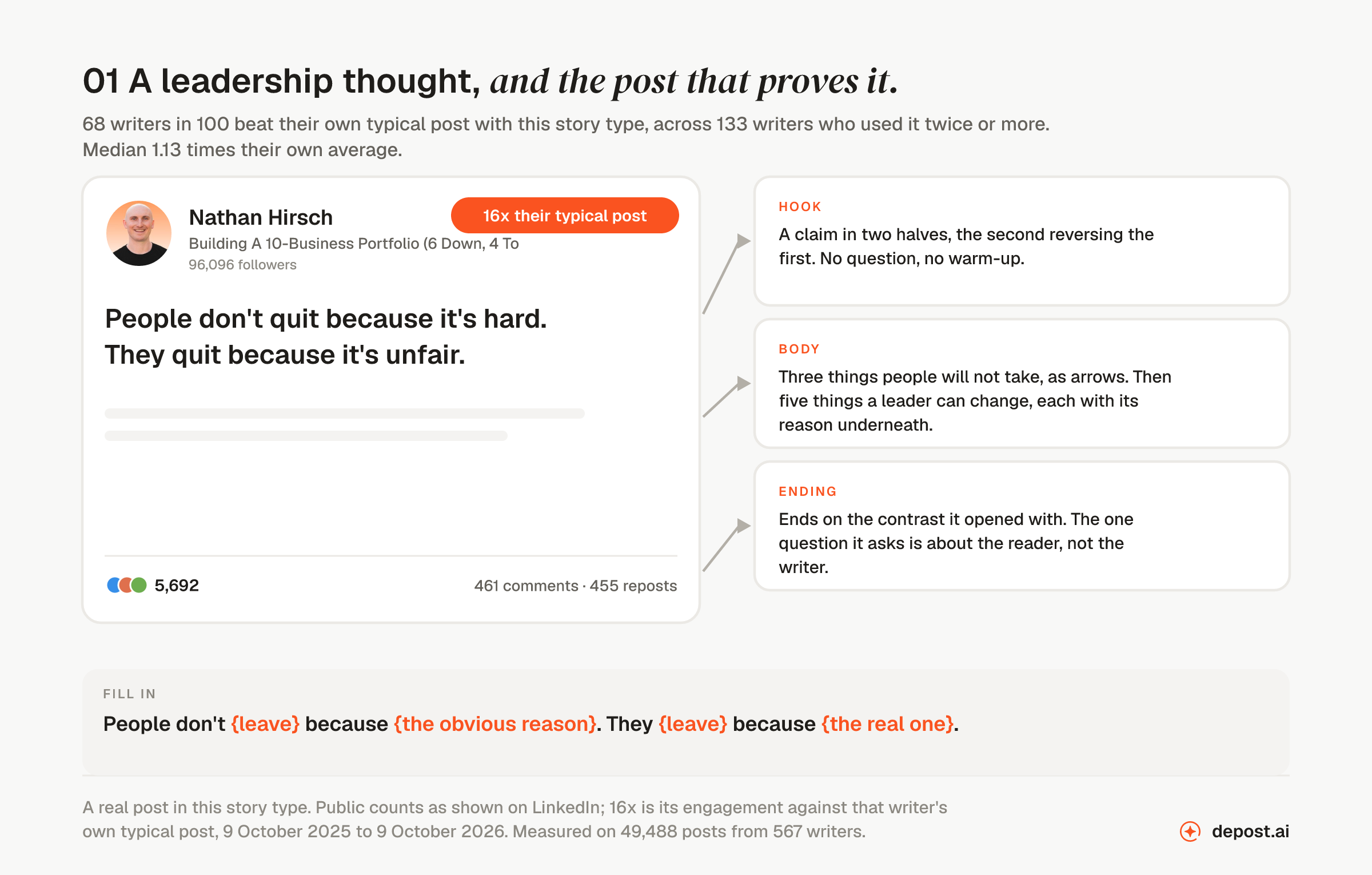
Score 1.13, across 133 writers and 2,018 posts. The highest share of the fourteen.
How you lead, what you changed, what you got wrong first. Not advice about leadership in general, which is a different thing and does not place here.
“People don’t quit because it’s hard. They quit because it’s unfair.”
Nathan Hirsch, 96,096 followers. 5,692 reactions, 461 comments, 455 reposts, sixteen times his own typical post.
The post names three things people will not take, then five things a leader can change, each with the reason underneath it. It opens on a claim in two halves where the second reverses the first, and it never once says the word leadership.
The shape. People don’t [leave] because [the obvious reason]. They [leave] because [the real one]. Then three things they will not take, then what you changed, each with its reason.
2. A personal milestone: 64 writers in 100
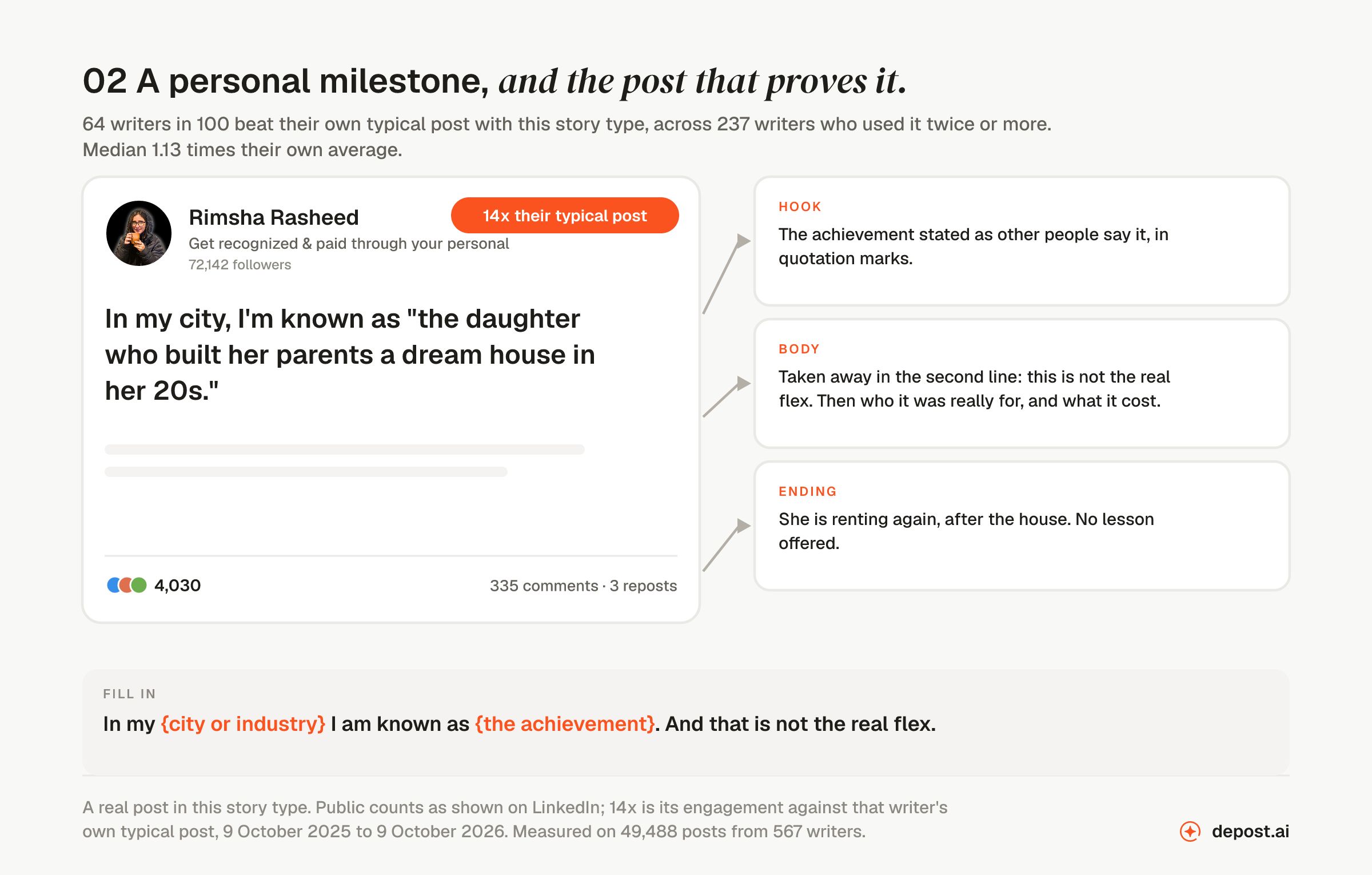
Score 1.13, across 237 writers and 1,540 posts. The second-largest sample in the whole test.
The milestone is the shape most people who sell underrate, because it feels like bragging. The writers who do it well take the achievement away in the second line.
“In my city, I’m known as ‘the daughter who built her parents a dream house in her 20s.’”
Rimsha Rasheed, 72,142 followers. 4,030 reactions, 335 comments, fourteen times her own typical post.
The next line is “and this is not the real flex.” The real one, she writes, is her parents being proud of it. She ends the post renting a flat with her husband, after the house.
The shape. In my [city or industry] I am known as [the achievement]. And that is not the real flex. Then who it was really for, and what it cost you.
3. A diary entry: 61 writers in 100
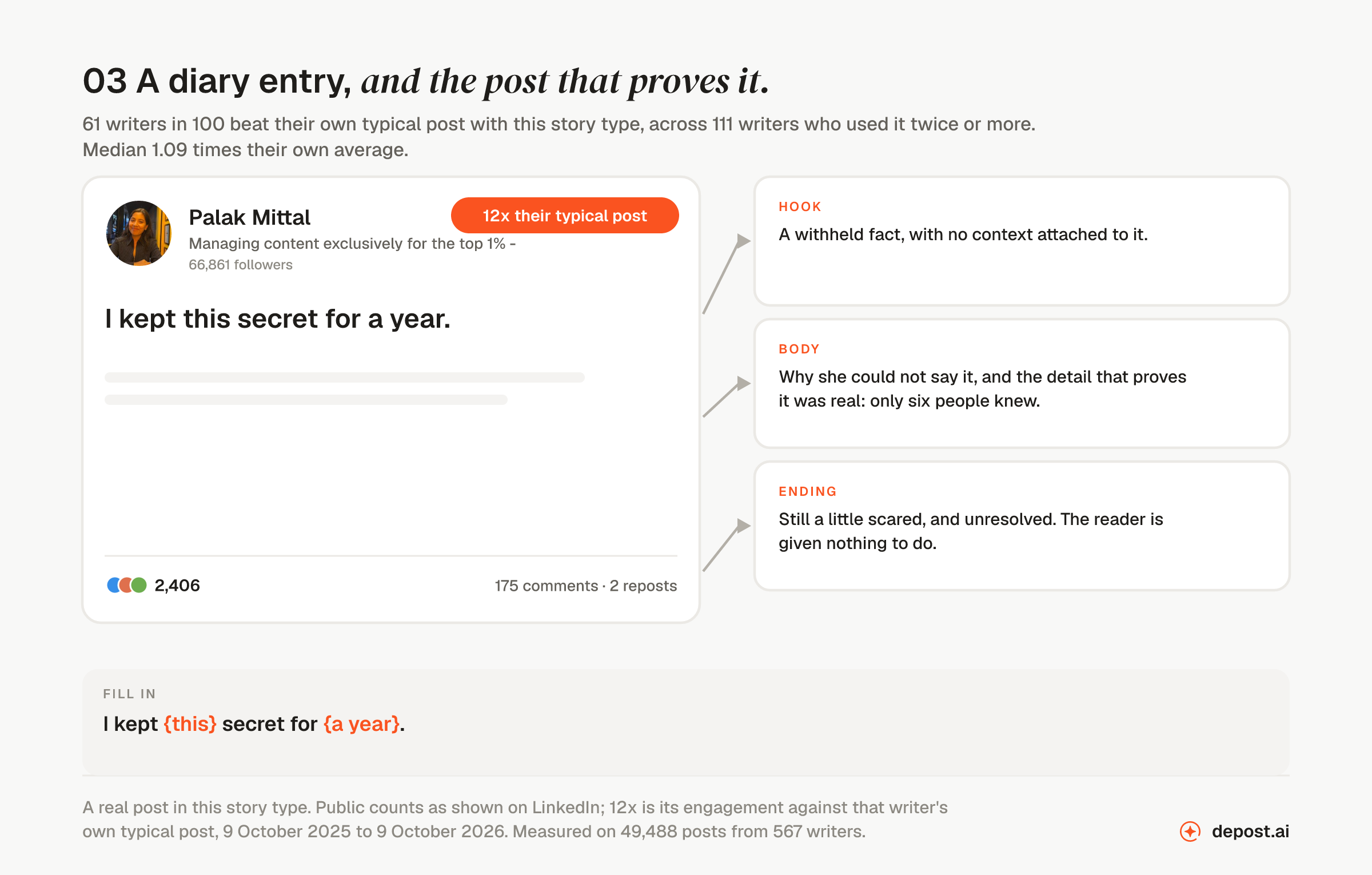
Score 1.09, across 111 writers and 477 posts.
A record rather than a lesson. The distinguishing feature of the ones that work is that they do not resolve.
“I kept this secret for a year.”
Palak Mittal, 66,861 followers. 2,406 reactions, twelve times her own typical post.
A withheld fact as the first line with no context attached. Then the detail that proves it was genuinely secret, that only six people knew. It ends on being a little scared about what comes next, and offers the reader nothing to do.
The shape. I kept [this] secret for [a year]. Why you could not say it, how few people knew, and an ending that is still open.
4. A hot take: 59 writers in 100
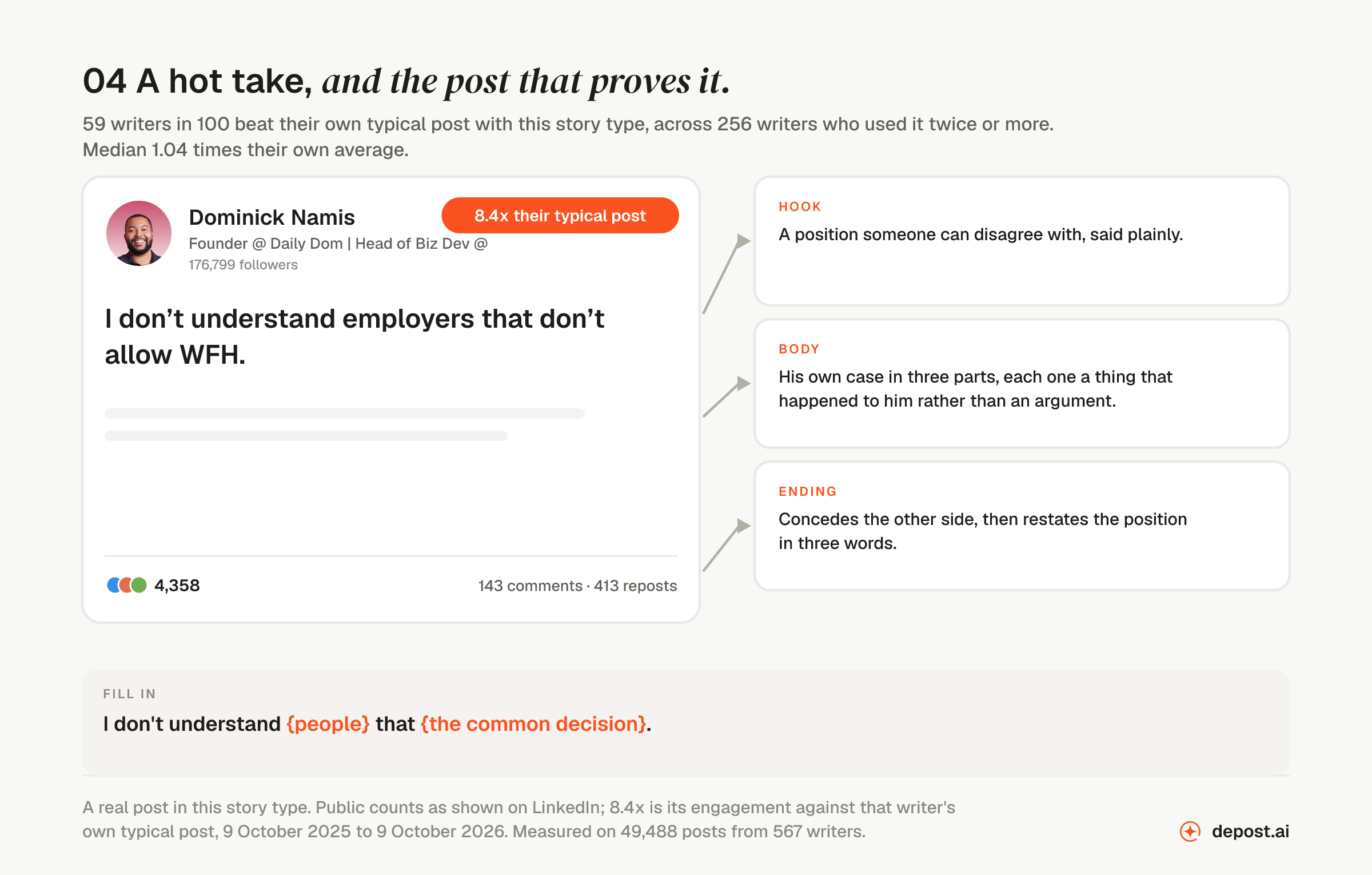
Score 1.04, across 256 writers and 2,400 posts. The largest sample here.
A position someone can disagree with, carrying the reasoning underneath. The reasoning is the part that separates this from a complaint.
“I don’t understand employers that don’t allow WFH.”
Dominick Namis, 176,799 followers. 4,358 reactions, 143 comments, 413 reposts, eight times his own typical post.
He then makes his own case in three parts, work, family and health, each with a specific thing that happened to him rather than an argument in the abstract.
The shape. I don’t understand [people] that [the common decision]. Then your own case in three parts, each with the thing it cost or gained.
5. A company win: 59 writers in 100
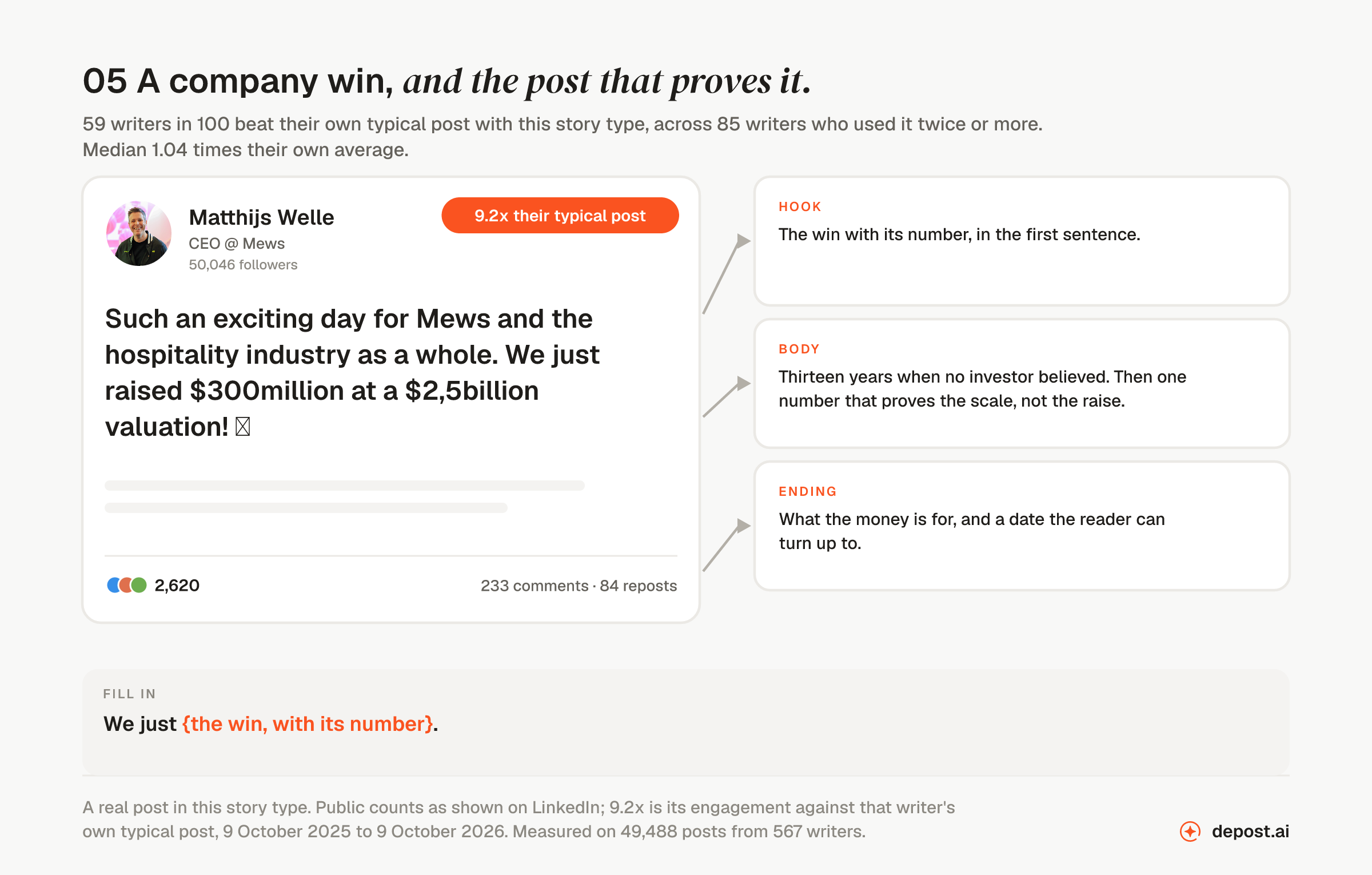
Score 1.04, across 85 writers and 393 posts.
Not the announcement on its own. The announcement plus the years before it.
“We just raised $300million at a $2,5billion valuation”
Matthijs Welle, 50,046 followers. 2,620 reactions, 233 comments, nine times his own typical post.
The second paragraph is about the thirteen years when no investor believed in the company. The number that does the work later is not the raise, it is the transactions processed, because it proves the scale rather than announcing it.
The shape. We just [the win, with its number]. Then the years nobody believed, and one number that proves the scale now.
6. A vulnerable moment: 56 writers in 100
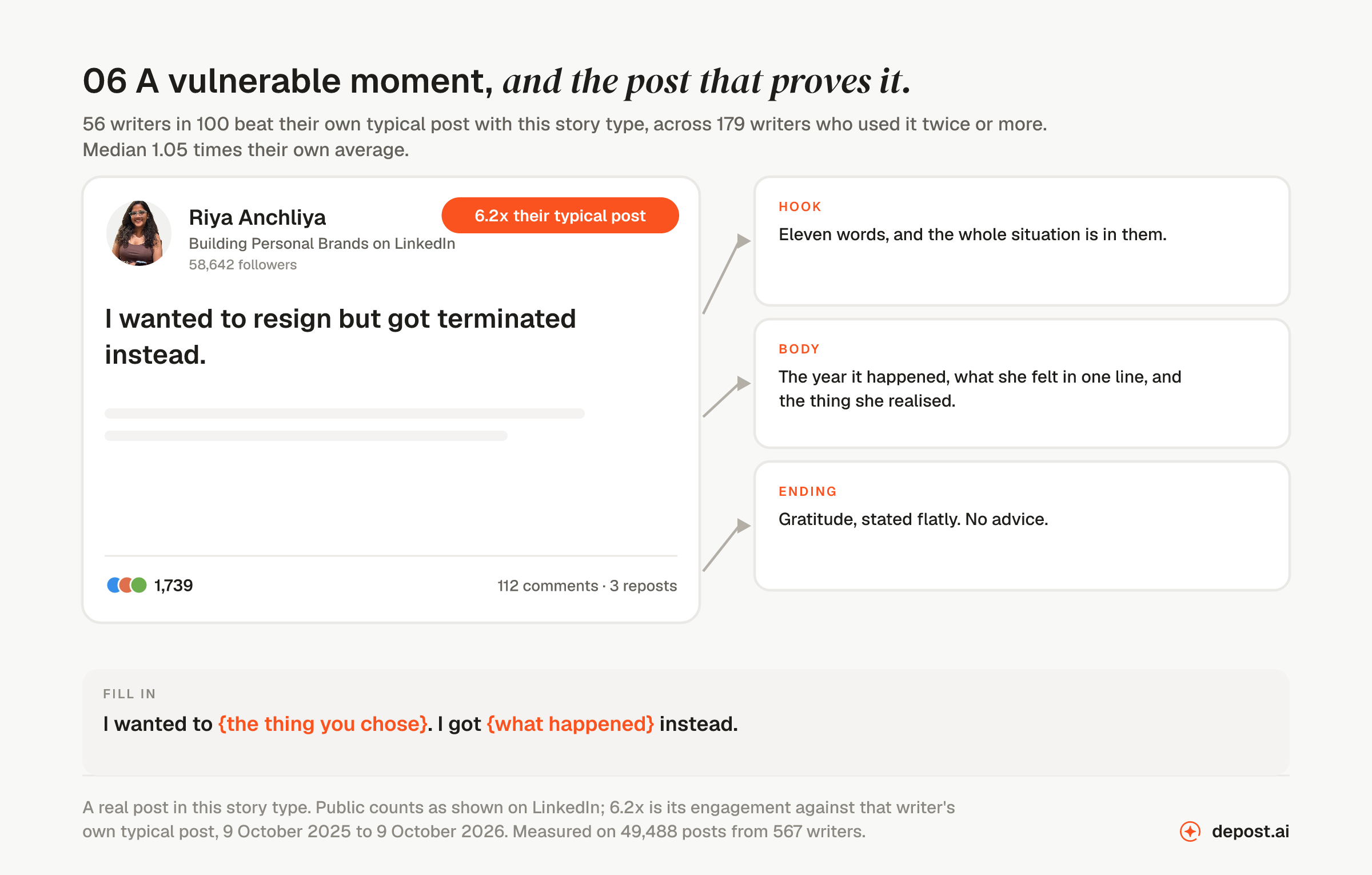
Score 1.05, across 179 writers and 1,395 posts.
“I wanted to resign but got terminated instead.”
Riya Anchliya, 58,642 followers. 1,739 reactions, 112 comments, six times her own typical post.
Eleven words, and the whole situation is in them. The post dates itself to 2023, says what she felt in one line, and ends on what it changed. It does not ask the reader to learn anything.
The shape. I wanted to [the thing you chose]. I got [what happened] instead. The year, one line on how it felt, and what it changed.
7. A before-and-after: 53 writers in 100
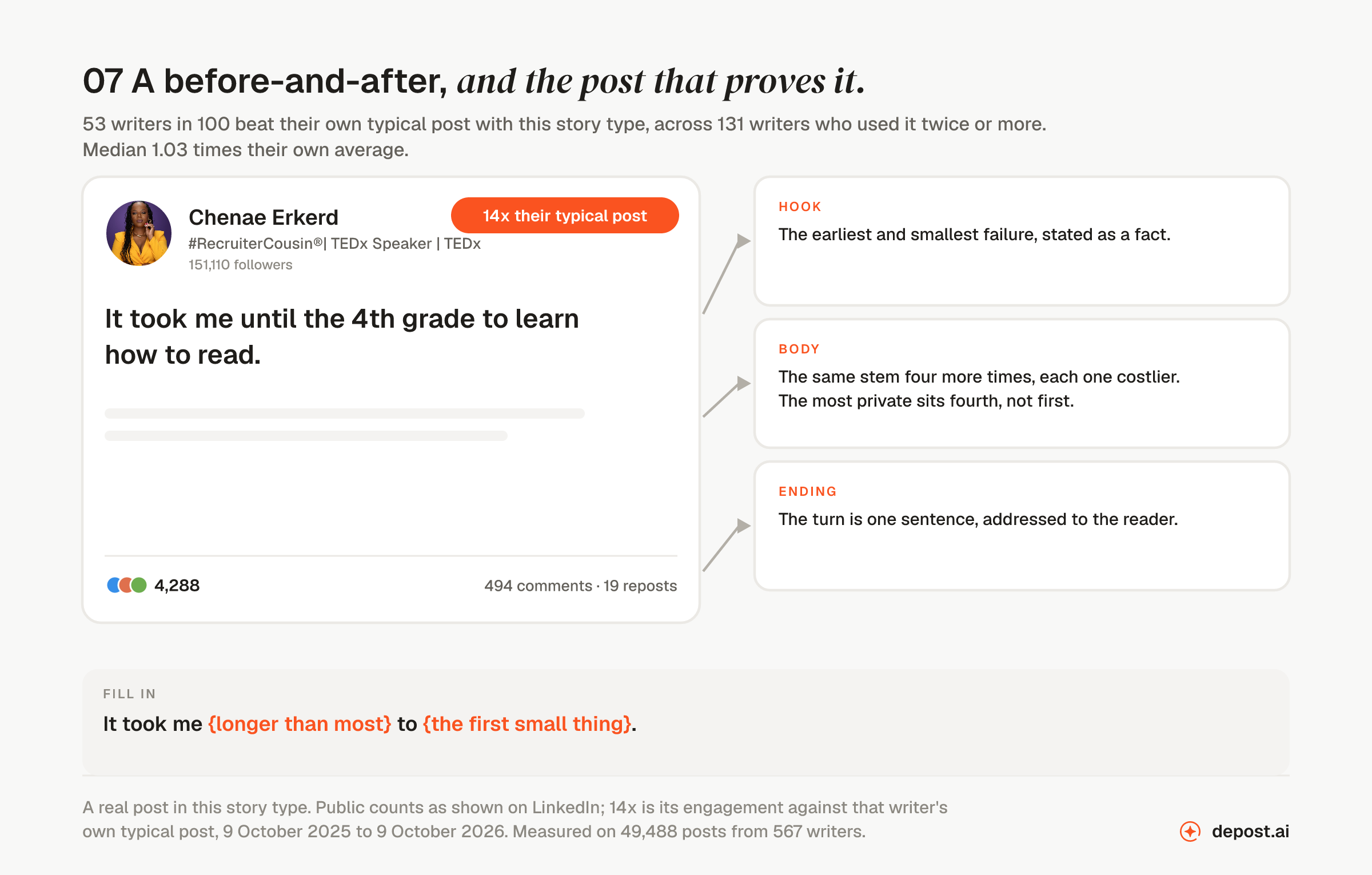
Score 1.03, across 131 writers and 718 posts.
“It took me until the 4th grade to learn how to read.”
Chenae Erkerd, 151,110 followers. 4,288 reactions, 494 comments, fourteen times her own typical post.
The post repeats the same stem five times. It took me four years to graduate law school when most people take three. It took me four years to find my first job. It took me eight years to get pregnant. Each one costs more than the last, and the most private sits fourth, not first. The turn at the end is a single sentence.
The shape. It took me [longer than most] to [the first small thing]. Repeat the stem four more times, each one costlier. Then the turn, in one sentence.
The seven that do not work
| Story type | Writers in 100 who beat their own average | Score |
|---|---|---|
| A day in the life | 47 | 0.94 |
| A client success story | 44 | 0.88 |
| A culture moment | 42 | 0.92 |
| An origin story | 41 | 0.95 |
| A case study | 40 | 0.93 |
| What an event taught you | 37 | 0.90 |
| The founder lesson | 24 | 0.79 |
The case study is the one worth sitting with. It is the single most requested piece of content in B2B marketing, it rests here on 176 writers and 1,019 posts, which is a solid sample, and 40 writers in 100 beat their own average with one. A case study is still worth writing. It is just worth knowing that it is a sales asset rather than a reach asset, and putting it where sales assets go.
What separates the two lists
Read both again and the dividing line is not what the story is about. It is whether anything was at stake.
The seven that win all describe something the writer lost, changed, risked or paid for. A milestone and what it cost. How you lead and what you changed. A thing that went wrong. A position you could be wrong about.
The seven that lose all describe something that already happened and already worked. Here is our culture. Here is how a client succeeded. Here is what the event was like. Here is how we started.
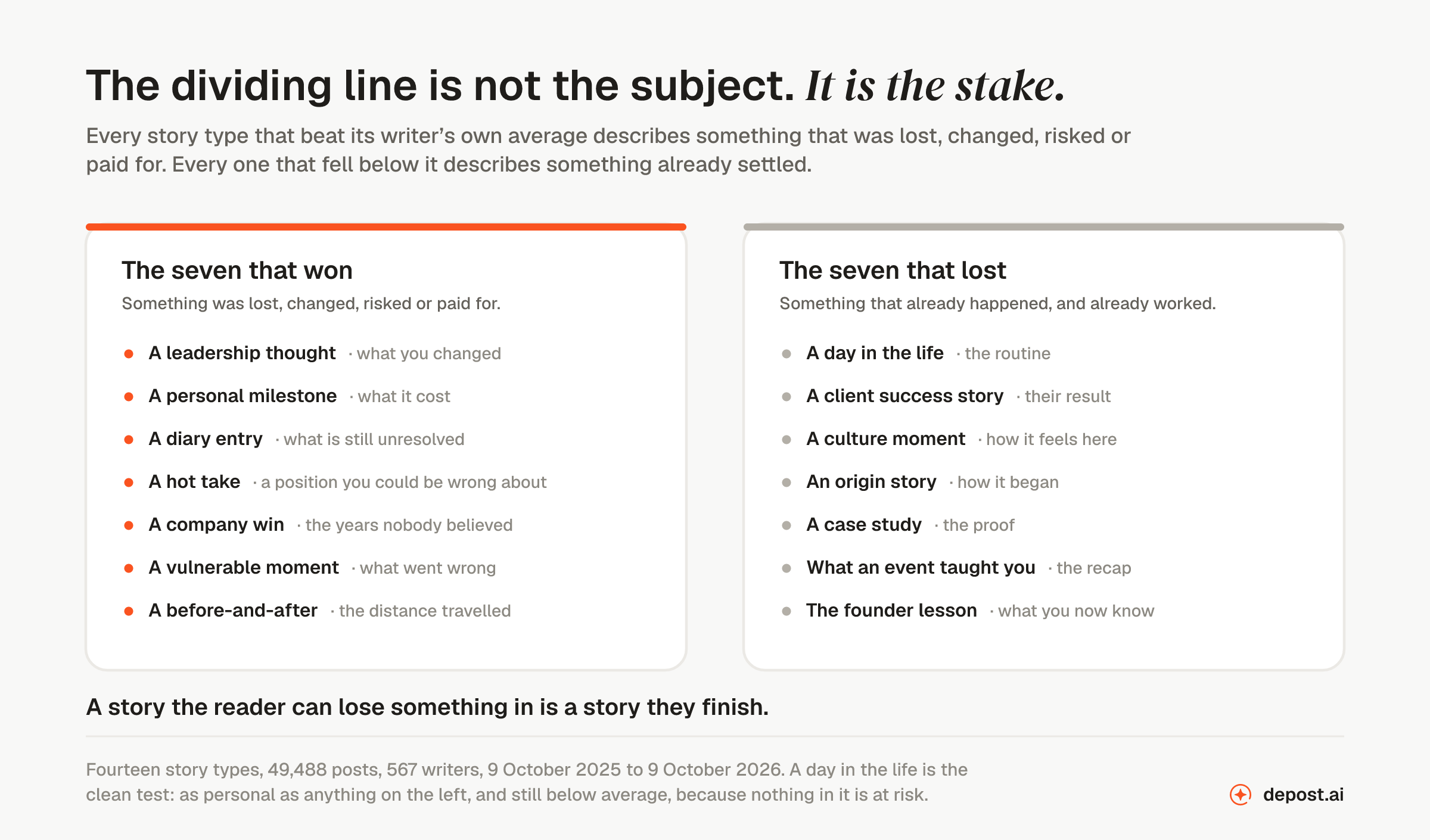
A day in the life is the clean test of this. It is as personal as any post on the winning list, it is about the writer rather than the company, and it still lands at 47 in 100, because nothing in it is at risk.
Two things this test cannot tell you
The founder lesson sits on the thinnest sample here. Twenty-five writers and 70 posts, which clears the bar but only just, and it is the one result that should be treated as a direction rather than a settled fact. It is also uncomfortably close to the leadership thought at the top of the list, and the honest reading is that the classifier may be splitting a fine hair between “what I learned” and “what I changed”. If you write one, write the version where something changed as a result.
None of this is about your account. These are 567 other writers. A story type that wins for most people can still lose for you, and your own rows outrank anything here the moment you have enough posts behind them. The 43 formats test found the same thing about carousels: below average across the library, above average for the accounts we could measure individually.
The useful version of this list is the one where you check it against yourself. The Performance Analyzer in Depost AI scores every kind of post you have published against your own typical post, and it needs three posts behind a type before it says anything about it, for the same reason the test above needs twelve writers.
Getting this for your own account
Everything above is one query against a library of posts. The same question can be asked of your own.
The free Performance Analyzer in Depost AI reads your published history and scores every kind of post you write against your own typical post, the same way this test scored those 567 writers. It needs three posts behind a story type before it will say anything about it, which is the reason most people have never seen this for their own account: the comparison is only honest once there is something to compare.
If you work in Claude, the Depost AI connector puts both halves in one conversation. Your own numbers, and a searchable library where every post carries its multiple of the writer who published it. You can ask for the storytelling posts moving in your niche this week, get them back scored, and find out in the same breath whether that story type has ever worked on your account.
That second number is the one nobody else has. A post with 2,600 reactions from a writer who normally gets 2,800 is not a format to copy, and the raw count will never tell you so.
FAQ
What is the best storytelling format on LinkedIn?
A leadership thought, meaning how you lead and what you changed. Across 133 writers and 2,018 posts, 68 writers in 100 beat their own typical post with one, the highest share of the fourteen story types tested.
Do founder lesson posts work on LinkedIn?
Not well. The founder lesson finished last of fourteen story types, with 24 writers in 100 beating their own average. It rests on the smallest sample in the test, 25 writers and 70 posts, so treat it as a direction rather than a settled fact. The leadership thought, which is the version where something actually changed, is the strongest format in the same test.
How many LinkedIn story formats actually work?
Seven of the fourteen measured beat their writer’s own average: a leadership thought, a personal milestone, a diary entry, a hot take, a company win, a vulnerable moment and a before-and-after. The other seven, including the case study, the origin story and the event recap, fall below it.
Are case studies worth posting on LinkedIn?
As sales assets, yes. As reach, no. A case study beat its writer’s own average for 40 writers in 100 across 176 writers and 1,019 posts, which is a solid sample and a below-average result. Write them, and put them where sales assets go rather than expecting reach from them.
How were these LinkedIn storytelling formats measured?
Every post was scored against the median engagement of the person who wrote it, so a 3,000 follower account and a 300,000 one are directly comparable. The window is 9 October 2025 to 9 October 2026, covering 49,488 posts from 567 writers with at least four posts each. A story type is only reported if at least twelve writers used it, each with at least two posts carrying it and two without.
What makes a LinkedIn story work?
Something has to be at stake. The seven story types that beat their writer’s average all describe something lost, changed, risked or paid for. The seven that lose describe something that already happened and already worked, which is why a day in the life lands at 47 in 100 despite being as personal as anything on the winning list.
Where to start
If you have never deliberately written any of these, start with the milestone. It has the second-largest sample in the test, it beats its writer’s average 64 times in 100, and most people already have one sitting unwritten because it felt like bragging.
Write it the way Rimsha Rasheed did. Lead with the achievement, take it away in the second line, and spend the rest of the post on what it actually cost.