LinkedIn headline generator
Your headline is the line under your name in every feed, comment, search result, and connection request, and you get 220 characters for it. Enter your role, who your work is for, and the result you deliver; you get five headlines that say it in the words a buyer, a founder, or a recruiter would actually search.
Result
This is the shape of what comes back. Fill in the form, or hit "Try an example", and the grey turns into words.
Writing, usually 15 to 30 seconds.


Example run
Five headlines for one fractional CFO
These inputs are the same ones the Try an example button fills in. Each headline is labeled with the angle it takes, and counted against the 220 character limit.
What went in
- Your role or job title
- Fractional CFO
- Who your work is for
- B2B SaaS founders between seed and Series B
- The result you deliver
- Clean books, a believable model, and a board pack investors trust
What came back

Atta Ur Rehman Shah
Fractional CFO for B2B SaaS founders | Seed to Series B
Atta Ur Rehman Shah
Clean books, a believable model, and a board pack investors trust | Fractional CFO for seed to Series B SaaS
Atta Ur Rehman Shah
CFO-level finance for SaaS startups that cannot justify a full-time hire yet
Atta Ur Rehman Shah
Fractional CFO | SaaS financial models | Investor reporting | Seed to Series B
Atta Ur Rehman Shah
Your investors expect a board pack. I build it. Fractional CFO for seed to Series B SaaS
Why it matters
The 220 characters that follow you everywhere.
Your headline travels into every comment, search result, and connection request you send. Buyers read it far more often than they read your profile.
220
characters is all LinkedIn gives the headline. Every one of them is doing sales work.
LinkedIn limit
4in 5
LinkedIn members drive business decisions at their company.
13×
more pay commanded by professionals with top-tier market visibility.
Hinge Marketing
The sourced numbers are LinkedIn’s and Hinge Marketing’s.
Beyond the demo
This page writes from a form. Depost AI writes from your own posts and analytics.
The generator above works with whatever fits in a few fields. Connect LinkedIn to Depost AI, the AI content team B2B founders and teams run on LinkedIn, and the same kind of draft starts from your analytics, your voice, and the buyers you are actually trying to reach.
Drafts that start from your analytics
The agents read your posting history first: the hooks that earned the click, the pillars your audience answers, the rhythm of what worked. The draft sounds like you because it learned from you, not from a form.
A reply ready for every person who matters
Build custom lists of the people you want to stay visible to. Their new posts arrive in one feed with a comment drafted in your voice under each. You edit or approve every one before it goes anywhere.
From draft to published, without the paste
Finished drafts go to the queue and publish through LinkedIn’s official API, with the first comment written alongside. Connection notes and follow-ups are drafted with the context already in place. Nothing goes out until you approve it.
Connect LinkedIn and you have a strategy, your pillars, and your first post ideas in about fifteen minutes.
What to put in the three fields
Name the result, not the job. "Product designer" is a title; "cut onboarding drop-off for B2B software" is a result. The second one produces headlines someone searches for and remembers.
Make the audience narrower than feels comfortable. "Founders" is everyone. "Seed-stage founders selling to enterprise" is a person, and the headline written for them reads as written for them.
Use the words your buyers say. Not your industry's internal vocabulary. If a client would not use the phrase on a call, it will not be typed into search either.
The job a headline does
Nobody reads your profile first. They read your headline, in a comment thread or a search result, and decide whether the profile is worth a click. That makes the headline less a title and more a filter: its job is to make the right people stop and let the wrong people keep scrolling.
The reliable structure is what you do, for whom, with one concrete marker of proof or outcome. "Employment lawyer for tech companies. 200+ policies reviewed" filters better than "Experienced legal professional", not because it is cleverer but because a head of HR searching for exactly that help can recognise it in half a second. The five options above vary the structure, one leading with the outcome, one in the plain "X for Y" form, so you can pick the filter that matches how your audience searches.
What weakens a headline: adjectives doing the work nouns should ("passionate", "innovative", "dynamic"), audience words nobody searches ("stakeholders", "synergies"), and lists of six roles that filter for nothing. If you serve two audiences, pick the one the profile is for. The other one has a company page.
After the headline
A headline earns the click; the About section has to keep it. If you update one, update both, because a sharp headline over a 2014 summary reads like a renovated storefront with the old shop inside. The About generator on this site drafts one from the same few facts, so the two can be rewritten in one sitting.
Questions
- What makes a good LinkedIn headline?
- It says what you do and who you do it for, in words your audience would type into search. "Fractional CFO for B2B SaaS | Seed to Series B" beats "Finance leader passionate about growth" because a founder searching for help finds the first one and scrolls past the second. Titles, keywords, and one concrete outcome carry more weight than adjectives.
- How long can a LinkedIn headline be?
- Up to 220 characters on a personal profile. You do not have to spend them all, but the headline follows your name into every feed, comment, search result, and connection request, so it is the most reused text you own. The generator writes to fit the limit; the character counter tool on this site checks anything you edit afterwards.
- Should I put keywords in my LinkedIn headline?
- Yes, the ones your audience actually searches: your role, your specialty, your market. LinkedIn search and recruiter tools weight the headline heavily, and so do the AI assistants people increasingly ask for recommendations. Keyword stuffing reads badly to humans, though, so the skill is fitting two or three real terms into a sentence a person would say.
- Is this headline generator free?
- Yes. No account, no email, and you get five options per run so you can compare structures rather than accept one guess. A daily cap keeps it available for everyone.
- Will the headlines sound like everyone else’s?
- The generator bans the clichés ("passionate about", "results-driven", rocket emojis) and varies the structure across the five options. But it only knows the three fields you typed. Depost AI writes from your actual profile and your post analytics, which is where a headline stops being generic, because it is built from what your audience already responds to.
- What is sent to your servers when I use this?
- The three form fields, once, to generate the result. They are not stored, and there is no account to attach them to.
From the blog
All posts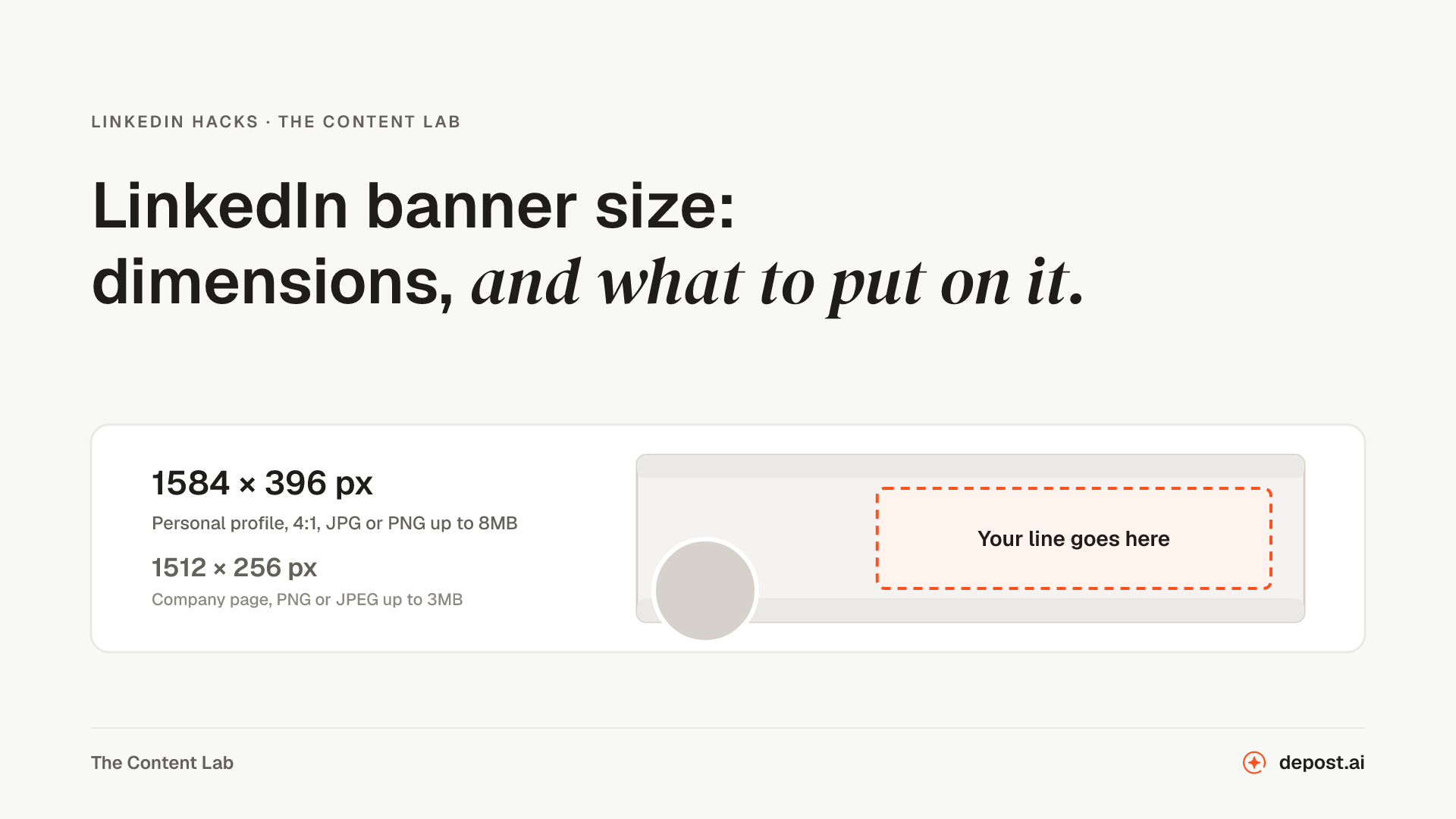 LinkedIn GuidesLinkedIn Banner Size in 2026: Dimensions, Safe Zones, and What to Put on ItThe exact banner size for profiles and company pages, straight from LinkedIn's own specs, where your profile photo covers it, what survives the mobile crop, and the one line worth putting on it.
 Content CreationHow to Build a LinkedIn Presence From ScratchA start-to-finish guide for building a LinkedIn presence: the profile, the first hundred connections, what to post, and how to keep it up past week three.
Next
LinkedIn About Generator
Draft an About section that reads like you wrote it, from your role, your work, and who you want to reach.
LinkedIn Profile URL Finder
Where to find your profile link, the clean public form of it, the short form for a resume, and a check against LinkedIn’s rules for a custom link.
LinkedIn Profile Picture Resizer
Your photo framed in LinkedIn’s circle and exported as a square that uploads the first time, checked against the 8MB limit. Nothing leaves your browser.
Make LinkedIn your
best-performing channel.
Brief your team once. It studies, plans, writes, designs, and schedules. You approve.
Your brief comes with you: once you're set up, it's the team's first job.
7 days free · Strategy in your first 15 minutes · Cancel anytime