11 Best Taplio Alternatives in 2026
Eleven tools worth moving to, what each one covers beyond writing the post, and the question that sorts them fastest: does it remember your brand, or start from nothing every time?

· 15 min read
On this page
Taplio is a menu. You open it, pick a feature, do the work yourself, and close it. That is fine until the day you want the work to already be done, or until you notice you have spent another morning explaining who you are to an empty box.
Eleven tools, then, starting with ours. What each one covers beyond writing the post, and what you would be giving up. If you are shopping the whole category rather than replacing one product, the 15 best LinkedIn AI tools is the wider list.
Three questions that sort the list fast
Taplio has been the default answer to “which LinkedIn tool?” for years. It is a menu: writing help, a post library, carousels, a lead feed, analytics, and scheduling, each a feature you open and operate.
People leave when one of these three answers stops working for them.
Who does the work? A menu you operate is a different product from a loop that runs and hands you the output. Taplio is the first kind. Depost AI is the second. You should know which one you are buying, because the daily experience is nothing alike.
What does it remember? Most tools start from an empty box every time you open them. You paste in context, you get a draft, the context evaporates. A tool that holds your positioning, your voice, what you have already published and how it performed, and the documents you care about will write a third draft that is better than its first. A tool that forgets will not.
What does it send without you? Auto-connect and DM sequences run under your name, whether or not you were watching. That is a category difference, not a setting.
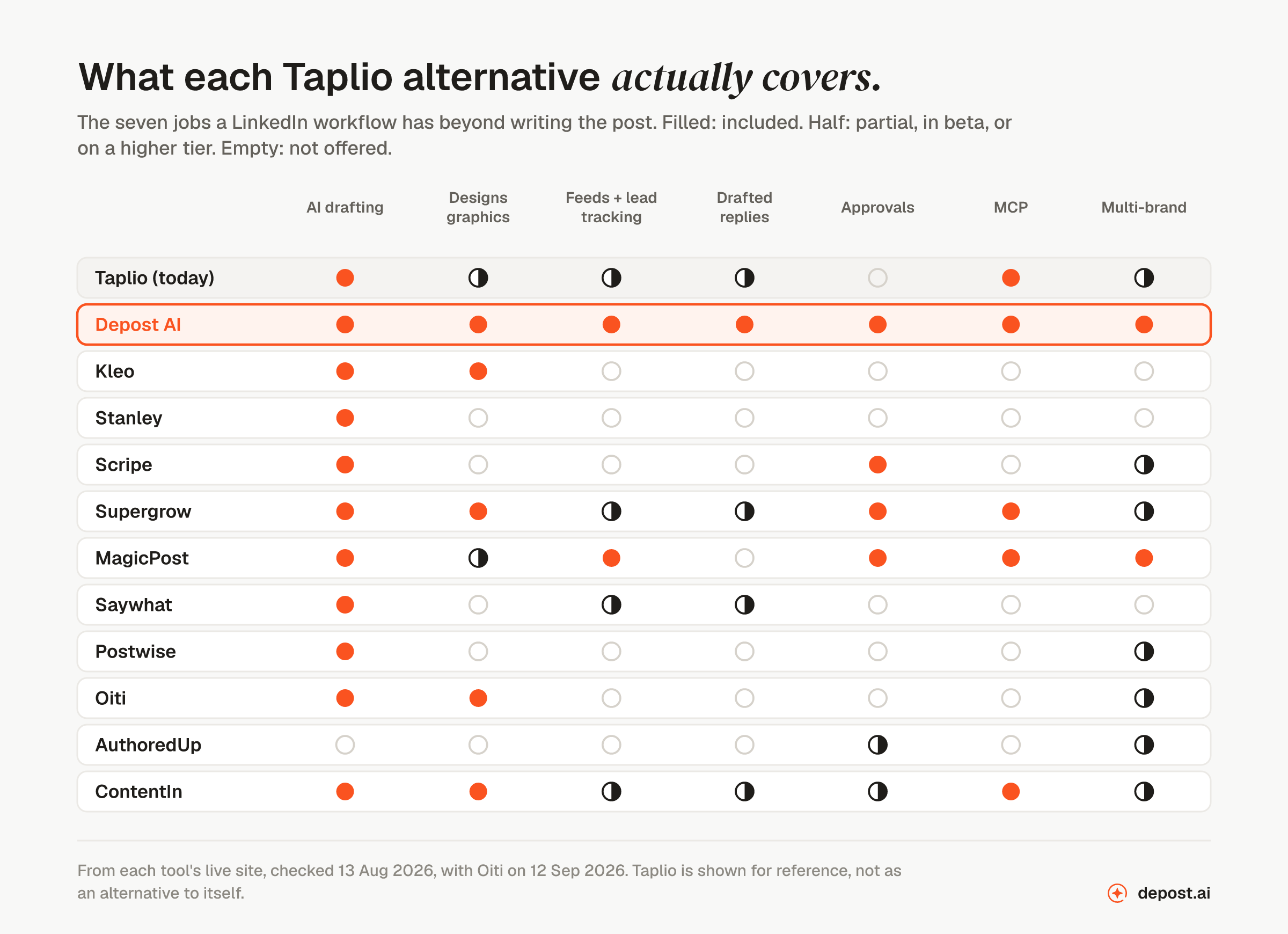
The eleven at a glance
| # | Tool | What it is | What it covers beyond drafting |
|---|---|---|---|
| 1 | Depost AI | Runs the loop and remembers the brand | Graphics, feeds, replies, approvals, MCP, multi-brand |
| 2 | Kleo | Drafting assistant with graphics | Graphics |
| 3 | Stanley | Chat-first drafting | Drafting only |
| 4 | Scripe | Recordings and transcripts to posts | Approvals, company pages |
| 5 | Supergrow | Assisted writing workflow | Graphics, approvals, MCP, partial feeds and replies |
| 6 | MagicPost | Form-driven workflow with link approvals | Feeds, approvals, MCP, multi-brand |
| 7 | Saywhat | Drafting with coaching and a community | Partial feeds and replies |
| 8 | Postwise | X scheduler with LinkedIn attached | Cross-posting to X and Threads |
| 9 | Oiti | Persona built from your posts and site | Graphics |
| 10 | AuthoredUp | Editor and analytics, no drafting | Formatting, previews, post-history analytics |
| 11 | ContentIn | Template library that learns from your edits | Graphics, MCP, partial feeds and replies |
Pricing is on each comparison page linked from the entries below. It changes often enough that a list is the wrong place for it, and it is rarely the thing that decides this.
1. Depost AI
Best for: founders, B2B teams, and agencies who want the week planned, drafted, and designed for them, with approval on every step.
This is ours, so weigh it accordingly. The argument against Taplio is not what is on the feature list. It is that the work arrives done, and that the tool already knows how you write.
Connect LinkedIn and Depost AI builds the brand memory itself: your positioning, a voice learned from what you have published and refreshed weekly, every post with its real numbers, and the posts you save. Nothing has to be typed in by hand. Add documents and notes if you want them read, or do not. Every agent reads that memory before it writes anything, and a Sources panel shows you what each draft drew on. That is the difference between a tool that writes something and a tool that writes something only you could have published.
What a week looks like
Every tool on this list writes a post. The difference is what happens before and after the draft, and who has to do it.
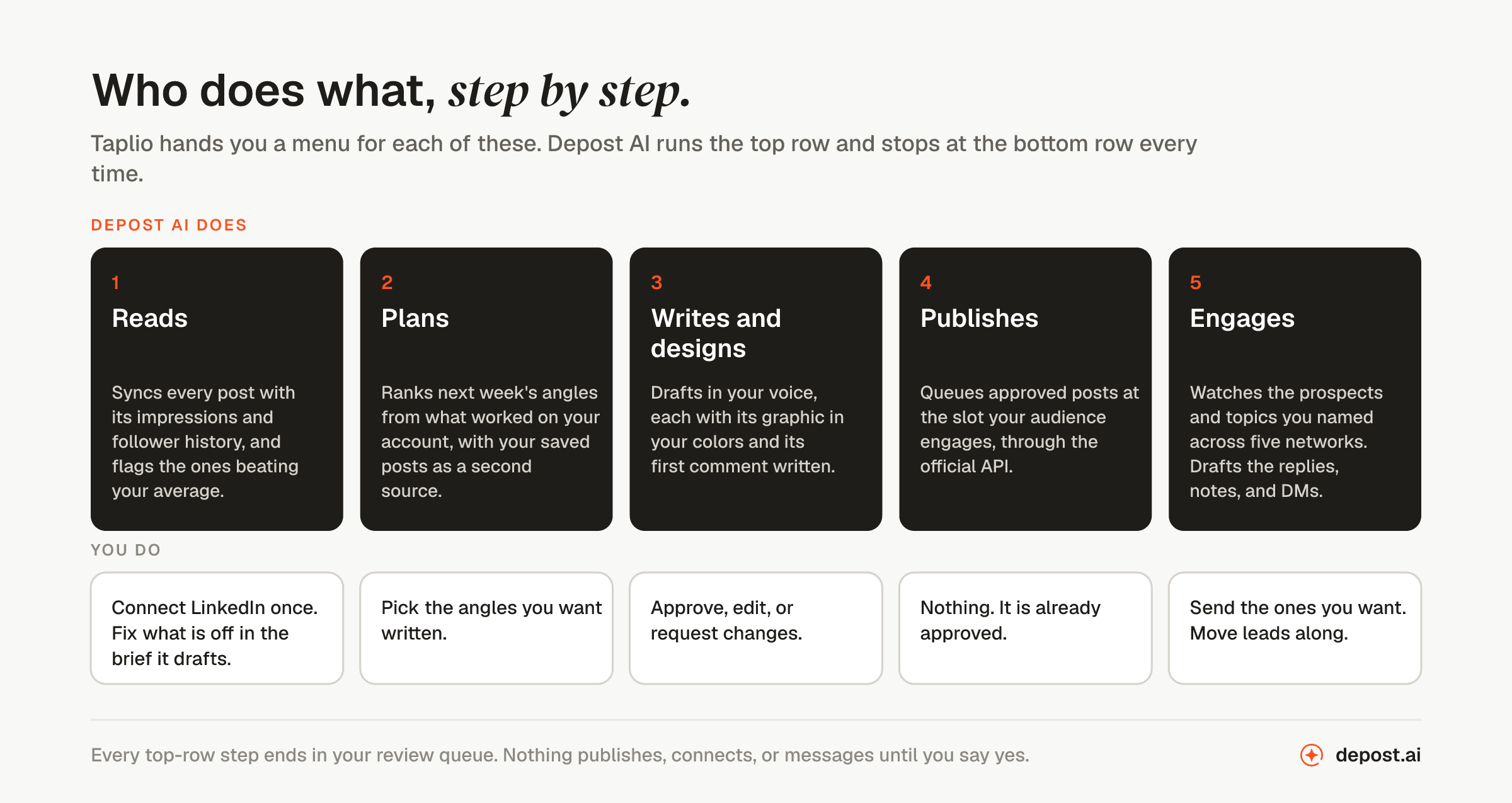
It reads your numbers. Connect LinkedIn and your history syncs: impressions, engagement rate, follower growth, and every post you have published. The Analyst flags the posts beating your own average and works out why: the hook, the format, the topic, the time. Ask “what worked last month?” in chat and the answer comes with the posts attached.
It plans from them. Those lessons go to the Idea Generator, so next week’s angles start from what worked on your account. The inspiration library and the posts you saved are a second source, not the first. Taplio’s viral library shows you what worked for someone else; this starts from what worked for you.
It writes and designs. Drafts arrive in your voice, each with its infographic designed in your colors and type and its first comment already written. A voice note becomes a post. A bookmark, a case study, or a call transcript becomes a post. There is no design tool in the middle and no “I will make the image later”.
It publishes at your yes. Approve, edit, or request changes. Approved posts join the queue at a slot suggested from when your audience actually engages, and go out through LinkedIn’s official API. If a publish fails, it lands in your inbox with one-click retry instead of silently not happening.
It keeps you in the conversation. Targeted feeds around the prospects, niches, and topics you name, across LinkedIn, X, Reddit, Threads, and Facebook. Replies, DMs, and connection notes drafted from what the prospect actually posted. Lead lists with stages, notes, and reminders. You press send, every time.
What that does for the business
- The plan compounds. Each week starts from the posts that beat your average the week before, so the account gets more like its best self rather than more like the feed.
- The hour after publishing gets shorter. The replies are drafted when you sit down, so that hour is spent sending and editing, not composing from nothing while the post cools.
- Comments turn into pipeline. The prospect who commented twice is a lead with a stage, a note, and a reminder for Thursday, not a name you meant to follow up with.
- The profile pulls its weight. Connect the account and it is scored section by section, so the people your posts send to your profile find one that finishes the job.
- A second person costs nothing. On Team, the client who approves, the VA who drafts, and the reviewer who signs off are all invited free, with review rounds, threaded comments, roles per brand, and an audit trail.
- It works where you already are. An MCP server on every plan, with keys scoped to one brand, so Claude, ChatGPT, or Cursor can read your analytics, draft into your calendar, and tell you what is waiting in review.
What it costs as you grow
Solo is $59 a month for one LinkedIn account, with every feature included. Team is $99 a month for the first account and a flat $59 for each additional one, up to 30, with unlimited workspaces and no charge for people. Ten client brands is $630 flat, whether three people or thirty touch them. Both plans carry a 7-day free trial, and yearly billing is two months free. The pricing page has the whole of it.
Taplio bills by the seat, so every reviewer and every client with a login is a line on the invoice. That is the number to compare, not the starting price.
Moving from Taplio
- Your history comes with you. It lives on LinkedIn, not in Taplio. Connect the account and about fifteen minutes later there is a brief: positioning, pillars, audience, and a voice, read from your profile and your last fifty-plus posts. Fix what is off, approve the rest, and the analytics are full from day one.
- The queue does not. Scheduled posts do not transfer between any two tools. Anything already in Taplio’s calendar gets re-created, which is an afternoon, not a week.
- Carousels become graphics. Taplio gives you templates to fill. Depost AI designs the infographic itself, in the ratio the post needs, attached to the draft it belongs to.
- Auto-connect and DM sequences have no replacement. By design. What replaces the workflow is lead lists with stages and reminders, and researched notes you send yourself.
- MCP carries over. Both ship it. Depost AI’s keys are scoped per brand and available on every plan.
Who it is not for
- Anyone who wants the tool to post, connect, or message while they are away. Every step in Depost AI stops at your approval, on purpose, and there is no auto-connect or DM sequence. If that is the Taplio feature you are replacing, nothing on this list replaces it safely.
- Anyone running one queue across five networks. Publishing is LinkedIn. Comments and saved posts reach X, Reddit, Threads, and Facebook, but the scheduler does one network properly rather than five loosely.
The full comparison with Taplio has the feature table side by side. The free trial is seven days on either plan, and the brief it drafts from your account in the first fifteen minutes is the fastest way to know whether it sounds like you.
2. Kleo
What it is: a drafting assistant that designs a graphic alongside the post.
What it covers
- Drafts and graphics in one place.
What to know
- Analytics and team workflow are not part of what it sells.
- No feeds, replies, or approvals, so everything after the draft is a manual job somewhere else.
- One brand at a time, and no MCP.
3. Stanley
What it is: a chat-first drafting tool. You describe what you want and it works the draft into shape with you.
What it covers
- Drafting, and feedback on a draft, in a chat.
What to know
- Drafting only. No graphics, feeds, replies, approvals, or scheduling.
- No public pricing page. The price appears at checkout, which some teams cannot buy against.
4. Scripe
What it is: a recording-first drafting tool. A podcast episode, a webinar, or a voice note goes in, and posts come out.
What it covers
- Posts from recordings and transcripts.
- Approvals, and unlimited users on the Advanced plan.
- Company pages as well as personal profiles.
What to know
- If you do not already record things, the core workflow does not apply to you.
- No graphics, no feeds, no drafted replies.
5. Supergrow
What it is: an assisted writing workflow: interviews that pull ideas out of you, templates, a curated feed, and approvals and MCP on the Teams plan.
What it covers
- Graphics, approvals, and MCP on the Teams plan, with partial feeds and replies.
What to know
- The Teams plan covers four accounts. Past that it is per seat again, so a growing team is a growing bill.
- Its first comment posts automatically, without a review step.
- You still run the loop. It assists, it does not take the work off you.
6. MagicPost
What it is: a form-driven workflow with client approvals over a browser link.
What it covers
- Client approval over a link, with no login for the client.
- Feeds, MCP, and multiple brands.
What to know
- Generated visuals are still in beta.
- No drafted replies, so engagement stays manual.
- Built around one account at a time, so agencies run it client by client rather than in one place.
7. Saywhat
What it is: drafting software sold alongside founder-led strategy sessions, expert feedback on drafts, and a private community.
What it covers
- Sessions, community, and feedback on your writing next to the product.
- Partial feeds and drafted replies.
What to know
- No graphics, approvals, MCP, or multi-brand support.
- Features are metered by tier, so heavier use moves you up a plan.
8. Postwise
What it is: an X scheduler with LinkedIn and Threads attached.
What it covers
- One queue across X, LinkedIn, and Threads.
- One-shot drafting.
What to know
- LinkedIn is the secondary platform, so the LinkedIn side is thinner than the X side.
- Nothing beyond drafting and scheduling: no graphics, feeds, replies, or approvals.
9. Oiti
What it is: a persona built from your posts and your website, with a knowledge base behind it.
What it covers
- A persona from your material rather than a questionnaire.
- A knowledge base the drafts can draw on, and graphics.
What to know
- The persona writes posts. Finding what to reply to, approvals, and MCP are not part of it.
- The memory is Oiti’s own claim. If you trial it, check whether the third draft still sounds like you.
10. AuthoredUp
What it is: a formatting editor with post-history analytics, and no drafting at all, by design.
What it covers
- Formatting, device previews, and analytics on your post history, billed per profile.
What to know
- Nothing writes for you. If the blank page is your problem, this does not touch it.
- No scheduling loop or engagement tooling, so it is one piece of a stack rather than the stack.
11. ContentIn
What it is: a ghostwriting tool with a large template library that learns your voice from your edits.
What it covers
- Templates, graphics, and MCP, with partial feeds and replies.
What to know
- It learns from your edits rather than from your published history, so the first weeks are work.
- Usage tiers mean heavy weeks move you up a plan, and team workflow is thin.
When the switch is worth it
When the second person arrives and the bill is about to double. When you want the work done rather than the tools laid out. When you are tired of explaining who you are to an empty box every morning.
The one real cost is the queue, covered under moving from Taplio above. Everything else comes with you, because it lives on LinkedIn rather than in the tool.
What the other lists get wrong
Two patterns are worth knowing when you read the rest of the results.
Generic review-site lists are not LinkedIn lists. The big review aggregators answer this query with Zoho Social, Buffer, Hootsuite, and Sprout Social. Those are competent social schedulers. None of them writes a LinkedIn post in your voice, reads your LinkedIn analytics, or drafts a reply, which is what you were using Taplio for. A high star rating on a different category of product is not a recommendation.
Vendor lists rank the vendor first. Every page ranking for this search was written by somebody selling a Taplio alternative, and every one of them puts itself at number one. This one does too, and says so in the first line. The useful signal is not the ranking, it is whether the page shows what each tool actually covers, so you can check the claim against the table instead of taking it on trust.
FAQ
What is the best Taplio alternative?
Depost AI. It is the only one here that runs the whole loop and remembers your brand between sessions, so the ideas come from what has already worked on your account, the graphic arrives with the post, and replies are drafted and waiting. Nothing publishes, connects, or messages until you approve it, and the bill follows LinkedIn accounts rather than seats. The ten below are listed by what each one covers, so you can see what you would be giving up.
Is there a free Taplio alternative?
Not a full one. Everything in this category charges, because the drafting costs money to run. What is free is the individual jobs: our free LinkedIn tools cover hooks, headlines, post previews, carousels, and an engagement rate check with no account, and most vendors offer a trial rather than a free tier.
What does brand memory mean, and why does it matter?
It is what the tool knows about you between sessions. In Depost AI that is one record per brand, built from the LinkedIn account you connect: your positioning, a voice learned from what you publish, every post with its real numbers, the posts you save, and any documents you choose to add. Every agent reads it before it writes. Without something like it, you are pasting the same context into an empty box every time, and the third draft is no better than the first.
Which Taplio alternative is safest for my account?
Ask any tool what it sends without you. Tools that publish through LinkedIn’s official API and need a human to approve each post, connection, and message sit in a different risk category from tools running auto-connect and DM sequences on your behalf. What gets a LinkedIn account restricted covers where the line is, and how many comments a day is safe covers the volume side.
Can I move my scheduled posts from Taplio to another tool?
Not automatically, in the general case. Scheduled queues do not transfer, so plan to re-create anything already in one. Your published history lives on LinkedIn rather than in the tool, so analytics rebuild themselves once the new tool syncs your account.
Is Supergrow better than Taplio?
They are the same kind of tool: a workflow you operate. Supergrow covers most of Taplio’s daily workflow and adds approvals and MCP on its Teams plan; Taplio adds the lead feed and automated outreach. Neither runs the loop for you or keeps a brand memory between sessions, which is the difference that decides this list.