How Long Should a LinkedIn Post Be? What 13,104 Posts Say
The limits in LinkedIn's own words, why the published sweet spots disagree, and what 13,104 posts show when each is scored against its own writer's median: length barely moves a post, and the one length to avoid is the medium-short one.

· 14 min read
On this page
Ask Google how long a LinkedIn post should be and the first page gives you ten answers. Under 600 characters. Between 150 and 300. Between 1,200 and 1,800. Between 1,300 and 2,500. From 200 to 300 words. A sweet spot of 200 to 400 words that is also, on the same page, “no sweet spot at all.”
They cannot all be right, and the reason they disagree is more useful than any of them. This post gives the limits in LinkedIn’s own words and explains why the big datasets contradict each other. Then it measures length the fair way: 13,104 posts, each scored against its own writer’s typical post.
The limits, in LinkedIn’s words
A post can hold 3,000 characters. LinkedIn’s help page on posting, updated days before this was written, says: “Posts can contain up to 3,000 characters.” In the library this post is built on, the median post runs 5.9 characters a word, so the limit is about 500 words.
The feed shows roughly three lines before “see more”. LinkedIn publishes no character count for the cut. AuthoredUp, a LinkedIn writing tool, measured it at “only the first ~210 characters on desktop (or ~140 on mobile).” Our own post preview draws the cut so you can see where your first line falls. Those 140 characters are the only part of a post most people read, which is why the first line matters more than anything below it.
LinkedIn’s own advice is 200 to 300 words. Its marketing blog, in June 2026, told writers to “keep posts between 200 and 300 words.” That is advice, not a measurement, and LinkedIn gave no data beside it. Keep it in mind for the end of this post. It turns out to be a reasonable place to land, for a different reason than LinkedIn gives.
Why the big datasets disagree
Three datasets published length findings in 2026, and the two largest contradict the two smallest. The contradiction is in the method.
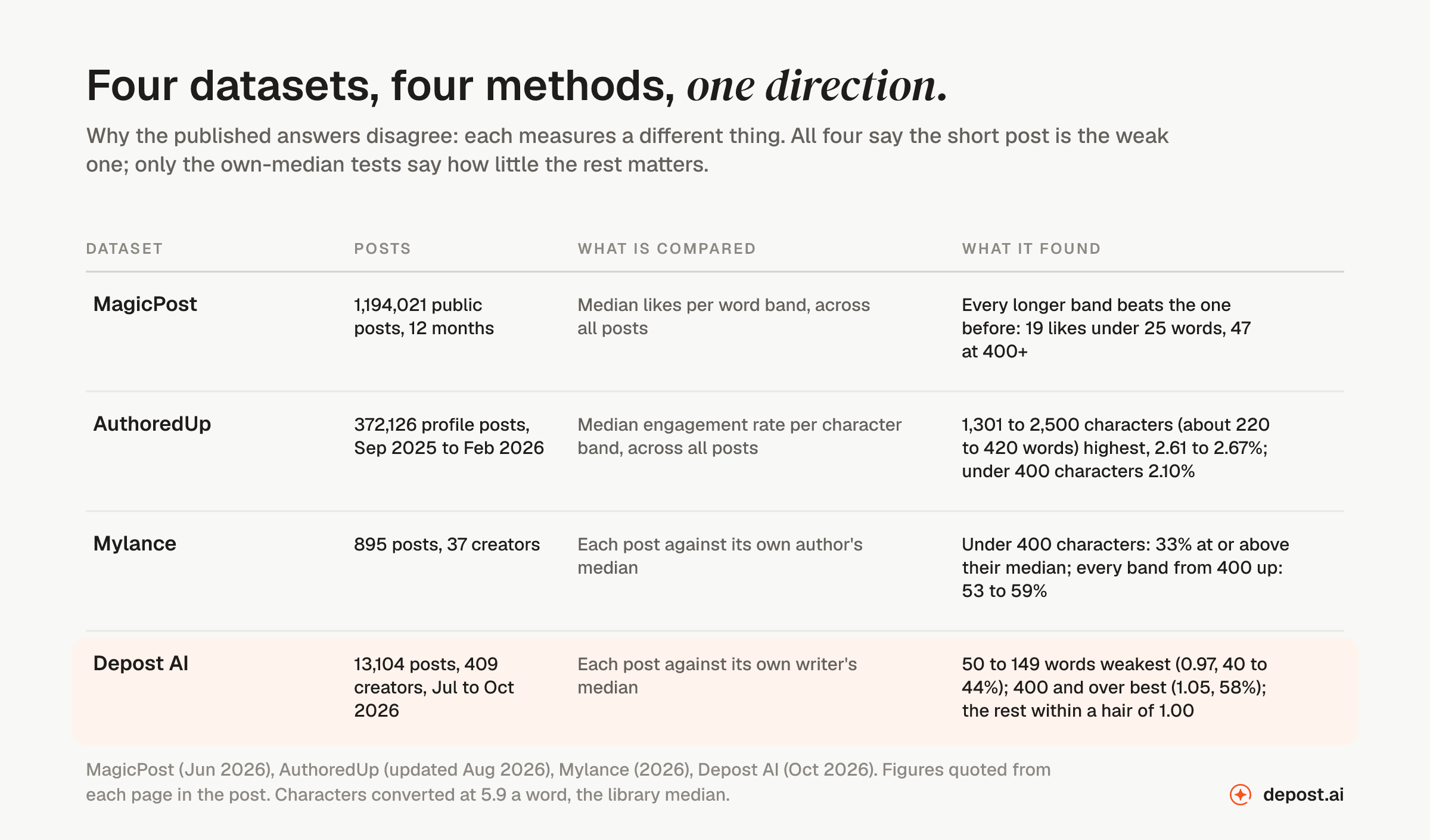
MagicPost, 1,194,021 posts, compared across all posts. Its study, updated June 2026, sorted “1,194,021 LinkedIn posts published over the last 12 months” by word count and looked at median likes per band. Under 25 words: 19 likes. At 400 words and over: 47. In its words, “every band beats the one before it” with “no peak in the middle.” It also names 200 to 400 words as the sweet spot, which is a different claim, and both are on the page.
AuthoredUp, 372,126 posts, compared across all posts. Its data, from September 2025 to February 2026, found that posts “between 1,301 and 2,500 characters generate 27% higher engagement than posts under 400 characters,” with “the highest median engagement rate (2.61–2.67%), well above the 2.10% seen for posts under 400 characters.” In words, that band is roughly 220 to 420.
Mylance, 895 posts, each against its own author. Its backtest of 895 posts across 37 creators scored every post against that author’s median. “33% of posts under 400 characters landed at or above that author’s median,” the worst length by far. Above that, “53-59% beat rate for every post 400 characters and up.” Once a post clears about 70 words, length stops mattering.
The method is the finding. When you compare all posts against each other, you are also comparing all writers against each other. Established writers with large audiences write longer posts, and their posts earn more for reasons that have nothing to do with word count. A ladder of “longer earns more” is partly a ladder of who writes long. Compare each writer with themselves and the ladder nearly disappears. Our library shows the same thing from the other side. Measured the usual way, its median engagement by band runs from 338 to 451 with no trend at all. Every writer in it is already established, so there is no ladder of writers to climb.
The fair test, by length
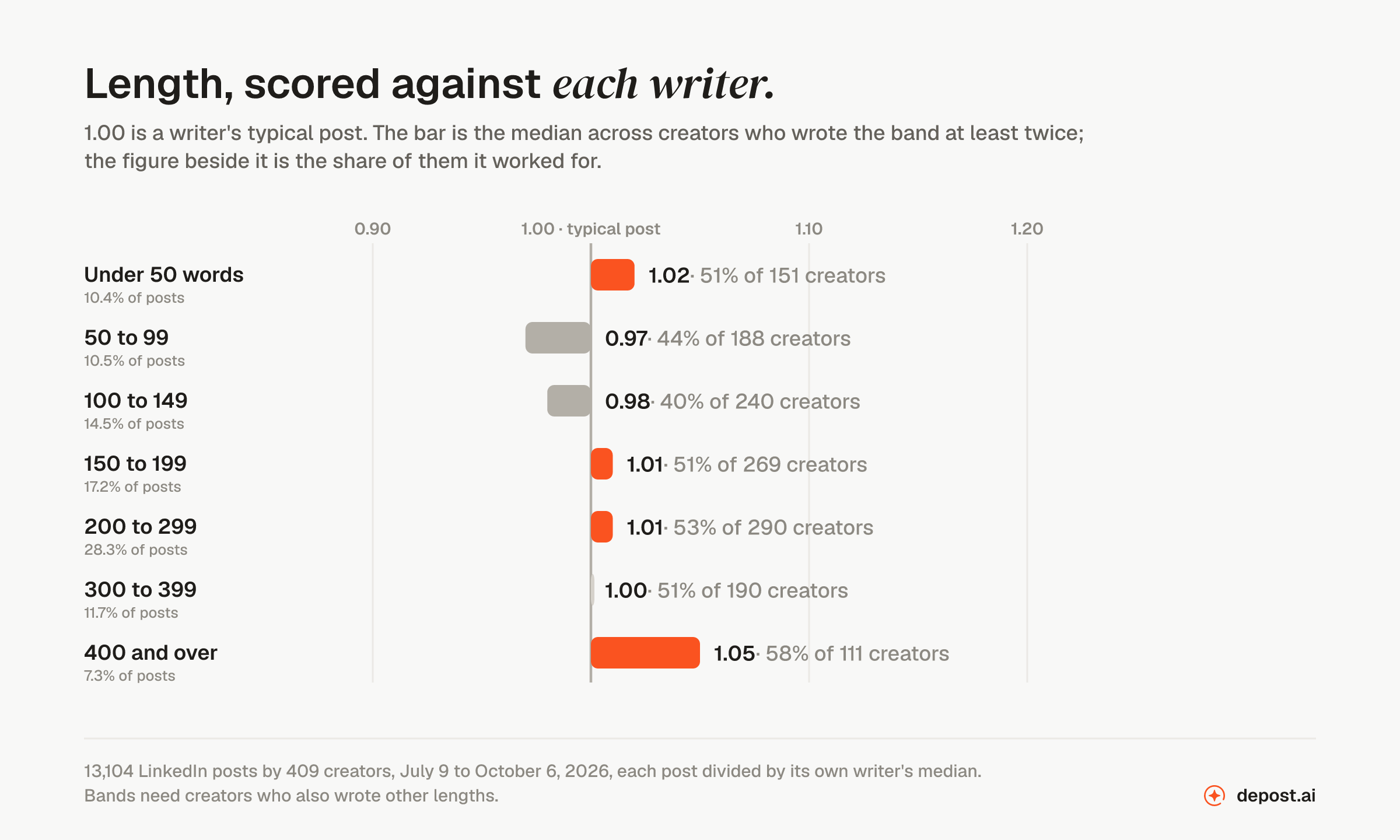
The same library and method as our test of what works on LinkedIn. 13,104 posts, published between 9 July and 6 October 2026 by 409 creators with four or more posts in the window. Each post’s engagement, meaning reactions plus comments plus reposts, is divided by the same writer’s median post. A band’s score is the median across creators who wrote that length at least twice and wrote other lengths at least twice. “Beat” is the share of those creators for whom the band beat their own median.
| Length | Share of posts | Against own median | Writers it worked for |
|---|---|---|---|
| Under 50 words | 10.4% | 1.02 | 51% of 151 |
| 50 to 99 words | 10.5% | 0.97 | 44% of 188 |
| 100 to 149 words | 14.5% | 0.98 | 40% of 240 |
| 150 to 199 words | 17.2% | 1.01 | 51% of 269 |
| 200 to 299 words | 28.3% | 1.01 | 53% of 290 |
| 300 to 399 words | 11.7% | 1.00 | 51% of 190 |
| 400 words and over | 7.3% | 1.05 | 58% of 111 |
Four things to read out of that table.
Nothing is far from 1.00. The whole range runs from 0.97 to 1.05. For comparison, in the same library a single image lifts a post to 1.39 and a webinar invite drops it to 0.60. Length is a small lever next to what the post is and what it opens with.
The weakest length is the medium-short post. Fifty to 149 words scores 0.97 to 0.98. Only 40 to 44% of the writers who use it beat their own typical post with it. That is a quarter of everything published. It is the post that is too long to be a one-liner and too short to say anything.
The one-liner is fine, and the long post is best. Under 50 words scores 1.02. Four hundred words and over scores 1.05, and 58% of the 111 writers who use it beat their own median with it. That is the highest share in the table.
Cut in two, longer edges shorter for most writers. Across the 295 creators who wrote both, posts of 200 words and over scored 1.02 and were the better band for 57% of them. Posts under 200 words scored 0.99 and were the better band for 38%. A real tilt, by a small margin.
Your best post can be any length
For creators with eight or more posts, where does their single best post sit? In the band they write most often.
| Length | Share of all posts | Share of writers’ best posts |
|---|---|---|
| Under 50 words | 10.4% | 14.2% |
| 50 to 149 words | 25.0% | 25.8% |
| 150 to 199 words | 17.2% | 14.5% |
| 200 to 299 words | 28.3% | 29.6% |
| 300 to 399 words | 11.7% | 9.7% |
| 400 words and over | 7.3% | 6.3% |
The second column tracks the first. A writer’s best post of the quarter lands where their posts land. The one-liner slightly over-delivers on best posts, which fits the one-liner’s 1.02 above. No length owns the winners.
Sellers and everyone else
The library splits into 262 creators who sell something by their headline (founders, consultants, coaches, agencies) and 147 who do not. Length treats them a little differently.
| Length | Sellers | Non-sellers |
|---|---|---|
| Under 50 words | 1.02, 51% of 92 | 1.01, 51% of 59 |
| 50 to 99 words | 0.96, 42% of 112 | 1.00, 47% of 76 |
| 100 to 149 words | 0.96, 40% of 144 | 0.99, 41% of 96 |
| 150 to 199 words | 1.01, 52% of 174 | 1.00, 49% of 95 |
| 200 to 299 words | 1.01, 53% of 190 | 1.01, 53% of 100 |
| 300 to 399 words | 1.00, 48% of 133 | 1.01, 56% of 57 |
| 400 words and over | 1.04, 54% of 80 | 1.16, 68% of 31 |
For sellers the medium-short post is the one to stop. Fifty to 149 words scores 0.96, and only 40 to 42% beat their own typical post with it. A seller’s post at that length tends to be an offer or a tip with nothing behind it, and readers treat it that way.
The long post pays non-sellers more. Four hundred words and over scores 1.16 for 68% of non-sellers, against 1.04 for sellers. Thirty-one creators is a small group, so hold that number loosely. The direction fits what we found before: a reader gives a long post from someone with nothing to sell more benefit of the doubt.
On my own account
One account is an anecdote, so here it is as one. Fifty posts from my own LinkedIn account over the three months to 12 October 2026, read through Depost AI’s analytics. One post is left out because its metrics never synced. The median post is 211 words and 689 impressions.
| Length | Posts | Median impressions | Against my median |
|---|---|---|---|
| Under 100 words | 3 | 729 | 1.06 |
| 100 to 199 words | 19 | 589 | 0.86 |
| 200 to 299 words | 24 | 704 | 1.02 |
| 300 words and over | 4 | 947 | 1.37 |
The small bands prove nothing. Three posts and four posts cannot carry a rule, and the 300-and-over median rests on four values that run from 362 to 5,451.
The middle bands match the library. My 100-to-199-word posts ran at 0.86 of my median, and four of my five weakest posts of the quarter sit in that band. My 200-to-299-word posts ran at 1.02.
My best posts share nothing about length. The top three by impressions were 214, 242 and 138 words, in three different bands. All three were image posts with a giveaway or a milestone in them. What they had in common was the shape, not the count. Which is the whole argument of this post.
Why the medium-short post loses
This part is our reading, not a measurement, because the library cannot see clicks.
A post under 50 words sits entirely above the “see more” cut. Nobody has to click, so nobody is let down. A post of 200 words and over asks for the click and pays it back with something. A post of 50 to 149 words asks for the click and then ends, which is the one experience a reader punishes. If that reading is right, the fix is not a word count. It is the question of whether what is below the cut is worth the click.
So how long should it be
The honest answer is that length is not the lever, and four rules come out of the data anyway.
- The first line decides the click. About 140 characters show on a phone. A plain claim a reader could disagree with is the only opener that beat the writer’s own average. Spend your effort there, not on the word count.
- If it needs more than a line, give it 150 words or more. The band that loses is 50 to 149. Either say it in a line or say it properly.
- Do not stop at 100 words to “keep it short”. That advice produces the one length that reliably underperforms. The long post, 400 words and over, is the best band in the table and the most under-used, at 7% of posts.
- Write to the point and stop. The most common length, 200 to 299 words, scores 1.01, and LinkedIn’s own 200-to-300-word advice lands there. It is a fine place to end up when the content fills it. It is not a target to pad toward.
The character counter shows the limit and the cut as you type. The 30 formats that keep winning show what to put inside the length, which is the part that moves the number.
What this test cannot tell you
Engagement is not reach. Impressions are visible only to the author, so the library scores reactions, comments and reposts. A length that earns more comments is not necessarily one that is shown to more people.
Correlation, not cause. A long post may do well because it is long, or because the writer who had 400 words to say also had something to say. The data cannot separate those. What it can say is that writers who write long do not pay for it, and writers who write medium-short do.
One season, one library. July to October 2026, and creators who already post well. The direction transfers better than the decimals. Your own median is the number that matters, and it is the one no benchmark can give you.
Depost AI runs this comparison on your own posts. Connect LinkedIn and the Performance Analyzer scores every post you have published against your own typical post. You can see whether length, shape or opener moved anything on your account. The analysis is free and needs no card.
FAQ
How long should a LinkedIn post be?
Long enough to say the thing, and no longer. Measured against each writer’s own median across 13,104 posts, every length band scored between 0.97 and 1.05 of a typical post. The weakest band was 50 to 149 words, which only 40 to 44% of writers beat their own average with. The strongest was 400 words and over, at 1.05 for 58% of writers. LinkedIn’s own advice is 200 to 300 words, which is the most common length and scores 1.01.
What is the LinkedIn post character limit?
3,000 characters. LinkedIn’s help page says “Posts can contain up to 3,000 characters.” At the library’s median of 5.9 characters a word, that is about 500 words.
How much of a LinkedIn post shows before “see more”?
LinkedIn publishes no figure. AuthoredUp measured about 210 characters on desktop and about 140 on mobile, which is roughly three lines. The first line is the only part most readers see, which is why it matters more than the length.
Do longer LinkedIn posts get more engagement?
Across all posts compared with each other, yes. MagicPost’s 1,194,021-post study found median likes rising from 19 under 25 words to 47 at 400 and over. Against each writer’s own median, barely. Posts of 400 words and over scored 1.05, and posts of 200 and over scored 1.02 against 0.99 for shorter ones. Most of the across-the-board ladder is who writes long, not length itself.
Are short LinkedIn posts bad?
A one-liner is not. Posts under 50 words scored 1.02 against the writer’s own median and were the better band for 51% of writers. The post that underperforms is the medium-short one, 50 to 149 words, at 0.97 to 0.98. Mylance’s own-median test found the same break at 400 characters, about 70 words. 33% of posts under it beat the author’s median, against 53 to 59% above it.
How long should a LinkedIn post be for a founder or consultant?
For the 262 sellers in the library, the medium-short post is the one to stop. Fifty to 149 words scored 0.96, and only 40 to 42% of sellers beat their own average with it. Every other length scored 1.00 to 1.04. A seller’s one-liner and a seller’s 400-word post both work; the tip with nothing behind it does not.
What does LinkedIn recommend for post length?
Its marketing blog said in June 2026 to “keep posts between 200 and 300 words.” LinkedIn gave no data beside the advice. In the fair test that band scores 1.01. That makes it a reasonable place to land when the content fills it, not a target to pad toward.
How was this measured?
13,104 LinkedIn posts from Depost AI’s post library, published between 9 July and 6 October 2026 by 409 creators with four or more posts in that window. Each post’s engagement (reactions, comments and reposts) was divided by the same writer’s median post in the window. A length band’s score is the median across creators who wrote that length at least twice and other lengths at least twice; “beat” is the share of those creators for whom the band beat their own median. Sellers were identified by their headline.